Hack Squat Machine Duty Cycle for Functional Training Studios Wholesale Supplier
Most buyers think motor horsepower is the durability benchmark — it is not. The true gatekeeper of long-term survival under studio conditions is the hack squat machine duty cycle rating, which determines whether the motor, bearings, and thermal path can endure continuous daily operation without premature failure.
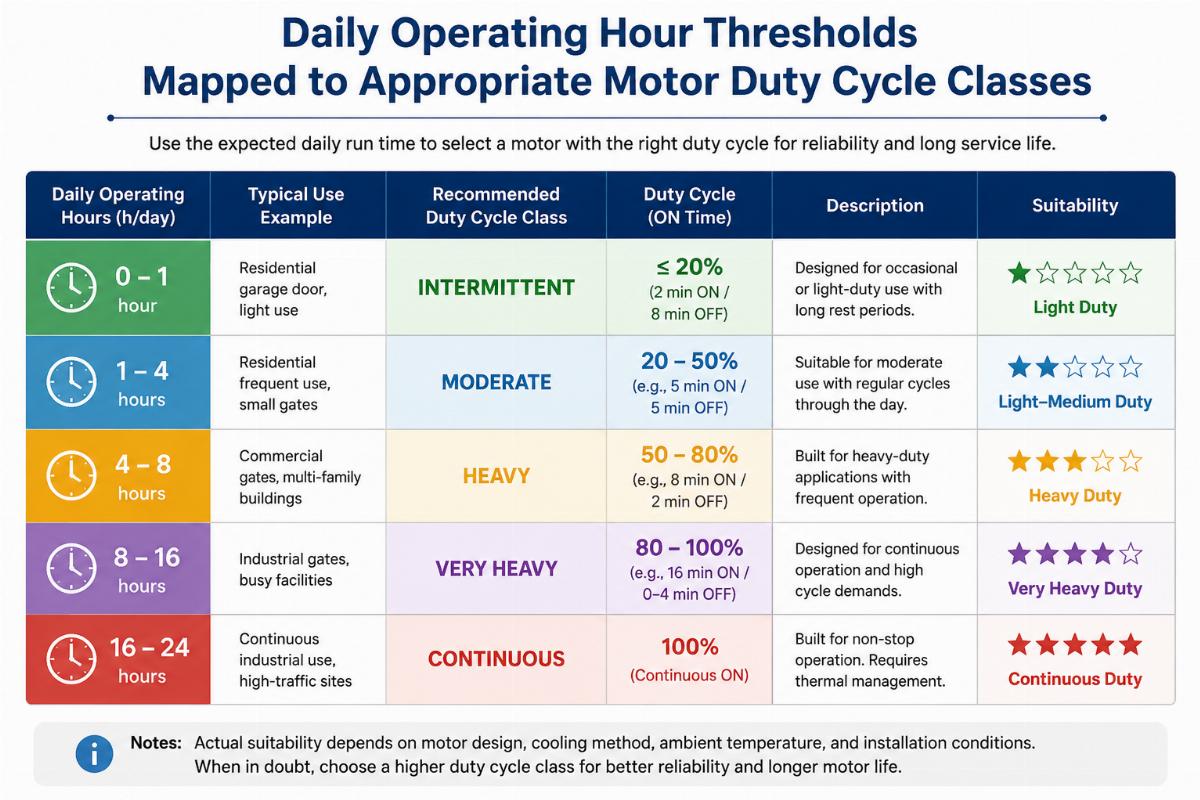
For functional training studios running eight to twelve hours per day, only an S1 continuous-duty motor class paired with heavy-duty bearings and engineered heat dissipation will hold up. Machines spec’d to S2 or S3 intermittent ratings will overheat, seize, or burn out within months under the same conditions — regardless of how heavy the frame looks or how high the peak torque is rated.
I still remember a full container of hack squats we shipped to a functional studio in the Middle East. The client ran the machines ten to twelve hours daily, with three or four units under simultaneous load during peak windows. Within a short window, multiple units started throwing thermal faults, and two motors burned out completely. The root cause was not the frame or the linkage — it was the duty cycle class of the motor. The supplier had spec’d an intermittent-duty winding to hit a lower price point, and the thermal design simply could not reject heat fast enough under continuous loading. That order nearly came back as a full-container return. [NEED_CITE: IEC motor duty cycle classification and thermal limits under continuous operation]
Since that case, I have made it a point to open every functional studio inquiry with one question: how many hours per day will these machines run, and how many units are loaded at the same time during peak periods. The answer dictates everything — motor class, bearing grade, cooling architecture, and even the weld pattern on the frame.
Getting the spec wrong at the sourcing stage is expensive. Let me walk through what duty cycle actually means on a hack squat, how the classes differ, and how to verify claims before you commit to a container order.
What Is Duty Cycle on a Hack Squat Machine and Why Does It Matter?
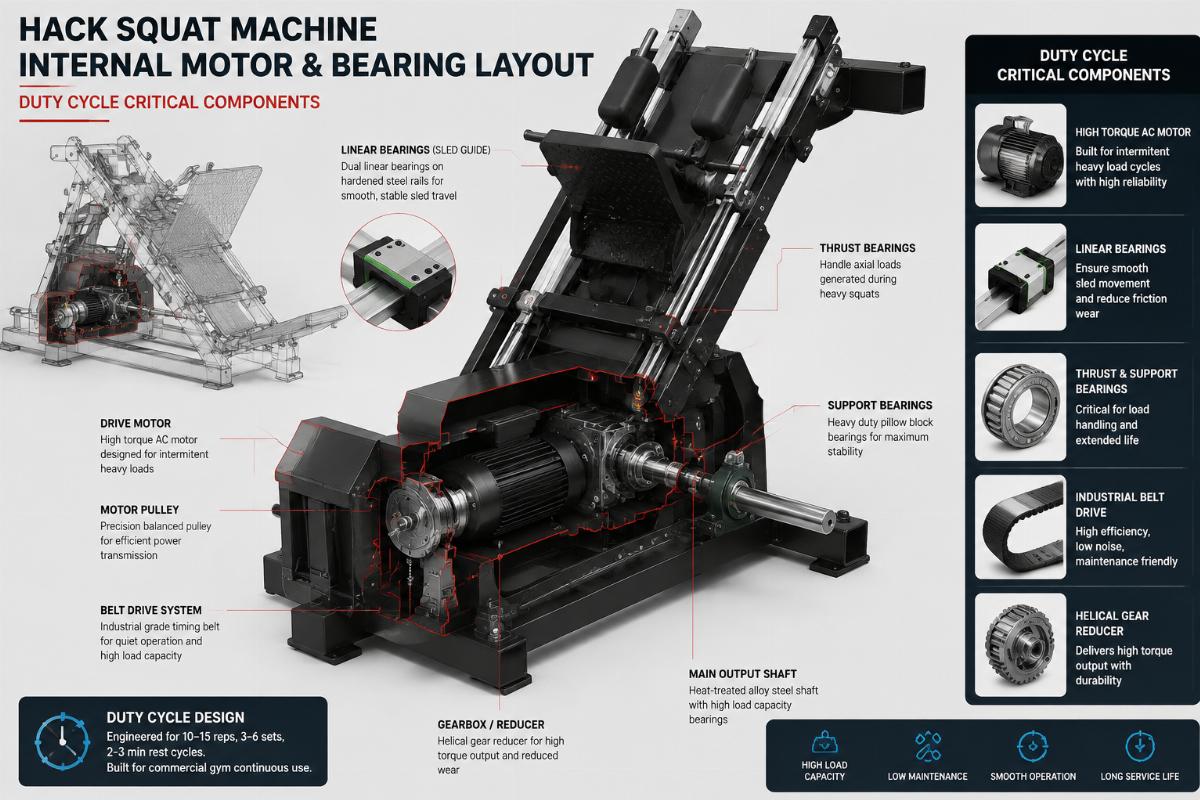
Duty cycle defines the ratio of loaded running time to rest time that a motor and its drivetrain can sustain without exceeding safe thermal limits. On a commercial hack squat — especially motorized incline or adjustable-resistance models — the motor drives the sled carriage, controls eccentric speed, and manages the return stroke. Every rep generates heat in the windings, the bearings, and the gear train. If the machine cannot shed that heat as fast as it is produced, insulation degrades, magnets weaken, and bearings lose preload.
The hack squat machine duty cycle is not a marketing label — it maps directly to internationally recognized motor工作制 classifications. An S1-rated motor is designed to run under load indefinitely at its nameplate output, with thermal equilibrium reached and held. An S2-rated motor can only sustain load for a defined short window before it must cool. An S3-rated motor operates on an intermittent cycle with defined rest intervals between loaded periods. [NEED_CITE: IEC 60034-1 motor duty type definitions and thermal equilibrium criteria]
For a boutique PT clinic seeing six to eight clients per day, an S3-rated unit may be perfectly adequate. For a high-traffic functional training studio where the hack squat is a core station and sees near-continuous use from opening to closing, S3 is a failure waiting to happen. The motor will not trip a breaker immediately — it will slowly cook its own insulation, lose torque, and eventually short. By the time the symptom appears, the damage is irreversible.
This is why the hack squat machine duty cycle must be treated as the primary selection criterion, not an afterthought buried in a spec sheet footnote.

S1 vs S2 vs S3: Which Duty Cycle Class Fits Your Studio?
The correct duty cycle class depends entirely on daily operating hours and concurrent load patterns — not on the machine’s peak power rating. Many buyers assume that a higher-horsepower motor automatically means better durability. That is a dangerous misconception. A 3HP motor rated S3 will fail faster under continuous studio use than a 1.5HP motor rated S1, because the S3 winding cannot sustain thermal equilibrium under non-stop loading.
Here is how the three classes map to real-world studio environments:
| Duty Cycle Class | Operating Pattern | Suitable Environment | Thermal Behavior |
|---|---|---|---|
| S1 Continuous | Unlimited loaded runtime | High-traffic studios, 8+ hr/day | Reaches and holds thermal equilibrium |
| S2 Short-Time | Defined load window then full rest | Low-traffic PT clinics, home use | Heat accumulates; requires extended cooldown |
| S3 Intermittent | Repeated load-rest cycles with defined duty factor | Moderate-use commercial, group classes | Cycles between heat buildup and partial dissipation |
[NEED_CITE: correlation between motor duty cycle class and expected thermal failure modes in fitness equipment]
A European functional training chain we worked with made the right call at the sourcing stage. They required the duty cycle class to be written into the purchase contract — not just "commercial grade" but the specific IEC classification. They compared an S1 continuous-duty方案 against an S3 intermittent方案 from the same product family. The S3 option was cheaper upfront, but their engineering team correctly identified that their studios run ten hours daily with overlapping user sessions. They chose S1, paired with a heavy-duty bearing package and forced-air cooling. The result has been stable operation across their locations with no motor-related service calls.
Conversely, a distributor in Southeast Asia once mixed household-grade and commercial-grade hack squats in a consolidated container. The end users could not distinguish between the two, and the household-grade units — spec’d to S2 or lower — were placed into studios running extended daily hours. The售后 rate on those units was multiples higher than the commercial-grade models, because the motors were never designed for that thermal profile. [NEED_CITE: field failure rate comparison between intermittent-duty and continuous-duty motors in commercial fitness environments]
If your studio operates beyond eight hours per day with concurrent loading, the hack squat machine duty cycle must be S1 — no exceptions.
Beyond the Motor: Bearings, Frame, and Heat Dissipation
Duty cycle is not a motor-only specification — it governs the entire mechanical system, including bearing selection, structural weld design, and thermal path engineering. A machine with an S1-rated motor but undersized bearings will still fail, because the bearings generate their own heat and lose preload long before the motor reaches its thermal limit.
Bearing life in a hack squat is governed by load, speed, and operating temperature. Under continuous studio use, the bearing raceways experience sustained radial and axial loads through every rep. The L10 life calculation — the standard method for estimating bearing fatigue life — must use a load factor appropriate for continuous commercial operation, not light intermittent use. [NEED_CITE: bearing L10 life calculation methodology and load factor selection for continuous-duty fitness equipment]
In our production approach, machines spec’d for S1 duty cycle use bearings rated for extended service life under sustained loading, with sealed construction to retain lubricant and exclude contamination from gym floor debris. The difference in bearing grade between an S1-spec unit and an S3-spec unit is not marginal — it is the gap between a bearing that lasts the machine’s service life and one that needs replacement within a year under heavy use.
Heat dissipation is the other half of the equation. An S1-rated motor in a hack squat must be paired with a thermal management system that can reject heat continuously. This means adequate fin surface area on the motor housing, unblocked airflow paths, and in higher-power configurations, forced-air cooling rather than reliance on natural convection alone. I have seen machines where the motor was technically S1-rated, but the enclosure design trapped heat around the drive electronics, causing premature capacitor failure. The motor survived; the controller did not. The hack squat machine duty cycle specification must cover the entire drive system, not just the motor winding.
Frame weld points also experience fatigue under continuous cyclic loading. Studios running extended hours accumulate rep counts that would take years in a home gym environment within months. Weld stress concentrations at the sled carriage pivot points and the guide rail mounting brackets must be designed for the cumulative load cycles that S1-level usage implies.

How to Verify Duty Cycle Claims Before Placing an Order
Never accept "commercial grade" or "heavy-duty" as a substitute for a documented duty cycle rating — insist on verifiable nameplate data, bearing specification sheets, and thermal test evidence. The gap between what a catalog claims and what a machine actually delivers under continuous studio use is where most sourcing mistakes happen.
Start with the motor nameplate. A legitimate S1-rated motor will carry the duty cycle designation directly on its nameplate, along with the rated output, voltage, and insulation class. If the supplier cannot provide a clear nameplate photo or datasheet showing the S1 designation, treat the claim as unverified. [NEED_CITE: motor nameplate marking requirements per IEC standards for duty cycle classification]
Next, request the bearing specification sheet. The sheet should identify the bearing type, bore size, dynamic load rating, and sealing configuration. Cross-reference the dynamic load rating against the expected operational loads in a hack squat application. If the bearing is a light-duty series with no sealing, it will not survive a high-traffic studio environment regardless of what the motor rating says.
Third, ask for thermal test documentation. A responsible manufacturer will have run temperature rise tests on the motor assembly under loaded continuous operation, with ambient temperature recorded. The test should demonstrate that the motor reaches thermal equilibrium without exceeding the insulation class temperature limit. Be aware that standard thermal tests are often conducted at a baseline ambient temperature — but actual studio environments in warm climates can run significantly hotter. If the supplier has only tested at a mild ambient, the real-world thermal margin may be much thinner than the report suggests. [NEED_CITE: motor temperature rise testing methodology and ambient correction factors]
Finally, ask specifically about the drive electronics, not just the motor. The motor may be S1-rated, but if the controller board, capacitors, or power stage are not rated for the same continuous thermal profile, the system will still fail. The hack squat machine duty cycle claim should cover the complete electromechanical assembly.

Real Failure Patterns We Have Seen in the Field
Motor burnout, bearing seizure, and frame fatigue — the three most common field failures on hack squats in high-traffic studios — all trace back to an underspecified duty cycle. These are not random defects. They are the predictable outcome of selecting a machine whose thermal and mechanical design was never intended for the operating profile it is being asked to deliver.
Motor burnout is the most visible failure. The symptom is sudden loss of assist or a tripped breaker. The root cause is insulation breakdown in the motor windings, caused by sustained operation above the thermal limit of the insulation class. In the Middle East studio case I mentioned earlier, the motors were not overloaded in terms of torque demand — they were simply asked to run continuously under a duty cycle class that required periodic rest. The insulation cooked, the windings shorted, and the motors were dead.
Bearing seizure is quieter but equally destructive. The bearing overheats, the lubricant degrades, and the raceways score. Once a bearing starts to seize, it loads the motor shaft unevenly, which accelerates motor winding failure as well. In machines where the duty cycle is insufficient, the bearing thermal environment is often neglected in the design — there is no thermal path to carry heat away from the bearing housing, and the sealing is inadequate to retain lubricant under sustained high-speed operation. Replacing the bearing is a temporary fix; the underlying thermal design flaw remains. [NEED_CITE: bearing failure modes and thermal degradation mechanisms in continuous-duty rotating equipment]
Frame fatigue is the slowest to appear and the most costly when it does. Guide rail mounting brackets and sled pivot welds accumulate micro-cracks over hundreds of thousands of load cycles. In a machine designed for S3 intermittent use, the total cycle count over its expected service life is far lower than what a high-traffic S1 studio environment demands. When the weld fails, the machine is out of service — and the liability exposure from a structural failure under load is serious.
These failure patterns are not unique to any one brand or region. They are the universal consequence of mismatched duty cycle specification. The hack squat machine duty cycle is the single most important parameter for predicting whether a unit will survive its intended service environment.

Conclusion
The hack squat machine duty cycle is the defining specification for studio survival — not peak power, not frame weight, and not brand reputation. Match the duty cycle class to your actual daily operating hours and concurrent usage pattern, verify the rating through nameplate data and test documentation, and ensure that bearings, thermal management, and structural design are all engineered to the same continuous-use standard. Machines spec’d correctly at the outset will run for years without motor or bearing failures; machines spec’d to a lower duty cycle to save cost will cost multiples more in warranty claims, replacements, and member dissatisfaction.