Hex Dumbbell Set Duty Cycle for Powerlifting Gyms – Bulk OEM Supplier
Most buyers assume heavier cast iron cores mean better durability. In reality, core thickness and rubber bonding工艺 determine drop resistance far more than raw weight.
Duty cycle defines how many daily impact cycles a hex dumbbell can survive before structural failure. For powerlifting gyms operating twelve-plus hours daily with constant dropping, commercial-grade hex dumbbells must handle ten times the impact frequency of home-use units. Rubber density, core wall thickness, and adhesive bonding process collectively determine whether a set lasts months or years under high-traffic conditions.
I still remember a full container of hex dumbbells I shipped to a European powerlifting facility years back. Twenty-five tons, neatly palletized. Within weeks, the gym owner sent photos—rubber coating splitting along the handle seams, cast iron cores peeking through like broken teeth. The complaint email landed like a hammer. Investigation traced the failure to a rubber compound that simply couldn’t handle the relentless pounding of a twenty-four-seven facility. The duty cycle specs were completely mismatched to the environment. That single claim wiped out most of the profit from the entire shipment. Since then, evaluating duty cycle compatibility became the first checkpoint before any bulk order moves forward [NEED_CITE: ASTM F3517 standard test methods for free weight equipment durability].
Understanding what drives duty cycle performance separates equipment that survives from equipment that becomes a recurring replacement expense.
What Is Duty Cycle and Why Does It Matter for Powerlifting Gyms?
Duty cycle measures the cumulative impact endurance of a hex dumbbell under repetitive dropping conditions, expressed as the maximum number of daily impact cycles the unit can sustain before visible structural degradation occurs.
In fitness equipment engineering, duty cycle borrows from industrial machinery terminology—it quantifies how frequently a component can undergo stress events within a given timeframe before fatigue failure initiates [NEED_CITE: ISO 20957-1 stationary training equipment safety requirements]. For hex dumbbells, this translates directly to how many times per day the unit can hit the floor before the rubber coating cracks, delaminates from the core, or exposes bare iron.
Home users might drop a dumbbell a handful of times per session, maybe a few dozen times weekly. A commercial powerlifting gym tells a completely different story. Consider a facility running twelve hours daily with multiple members performing dumbbell rows, lunges, and floor presses. Each rep that ends with the weight hitting the rubber flooring counts as an impact cycle. Multiply that across dozens of users, multiple sets, and extended operating hours—the daily impact count escalates dramatically.
I’ve seen gym operators track drop frequency in high-traffic zones. The numbers consistently show that commercial powerlifting environments generate impact counts an order of magnitude higher than boutique studios or home gym setups [NEED_CITE: commercial gym equipment failure rate analysis by usage intensity]. This isn’t a marginal difference—it fundamentally changes the engineering requirements.
The duty cycle mismatch explains why dumbbells purchased from big-box retail suppliers often fail within months when placed in serious training facilities. Those products are engineered for occasional home use, not continuous commercial abuse. The rubber compound, core dimensions, and bonding methods all reflect cost optimization for low-frequency scenarios.
Powerlifting gym owners evaluating equipment must understand that duty cycle isn’t a marketing term—it’s a measurable engineering parameter that directly predicts replacement intervals and total cost of ownership.

How Do Core Thickness and Rubber Density Affect Lifespan?
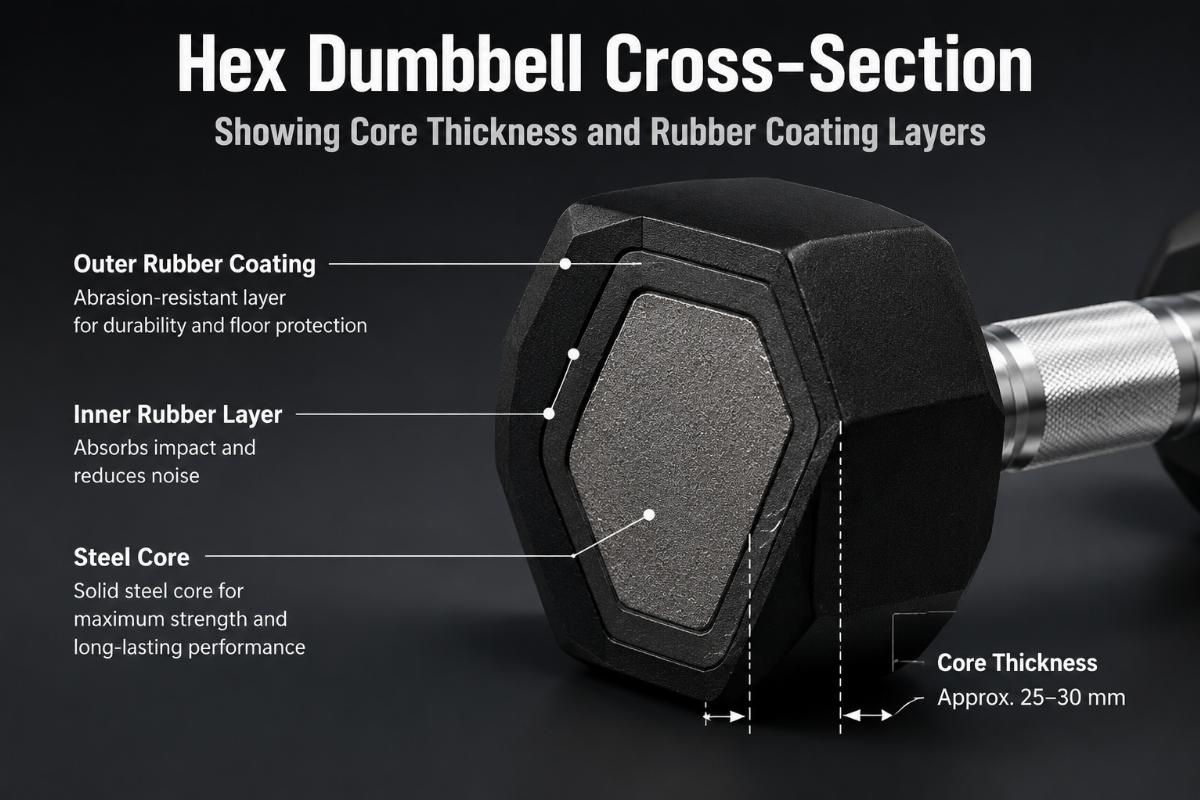
Thicker cast iron cores and higher-density rubber compounds work together to extend service life under repetitive impact, but density matters more than thickness alone.
The cast iron core serves as the structural backbone of any hex dumbbell. Its wall thickness determines how much impact energy transfers through to the rubber coating versus how much gets absorbed by deformation. Thicker cores distribute force more evenly across the bonding surface, reducing stress concentrations that initiate cracks [NEED_CITE: material fatigue principles in cast iron under cyclic loading].
However, core thickness without appropriate rubber density creates a false sense of security. I’ve examined dumbbells with substantial core walls that still failed prematurely because the rubber coating lacked sufficient density to resist compression set and surface cracking.
Rubber density directly correlates with Shore hardness ratings. Commercial-grade hex dumbbells typically use rubber compounds in the higher Shore A range, providing the necessary resistance to repeated compression without permanent deformation [NEED_CITE: rubber material properties and Shore hardness correlation for impact resistance]. Low-density rubber, even when applied thickly, compresses excessively under impact, generating internal heat and accelerating molecular breakdown.
The bonding interface between core and rubber represents the most critical vulnerability. Surface preparation of the cast iron—shot blasting, chemical etching, or primer application—determines adhesive strength. Poor bonding allows moisture ingress and mechanical separation under cyclic loading, leading to delamination that spreads rapidly once initiated.
I reviewed a batch where the rubber coating measured adequate thickness but showed consistent delamination after moderate use. Lab analysis revealed insufficient surface preparation on the cast iron cores, compromising the adhesive bond regardless of rubber quality. The duty cycle collapsed not because materials were inadequate individually, but because the integration process failed.
High-density rubber also resists environmental degradation better. UV exposure, ozone, and temperature fluctuations attack low-density compounds more aggressively, causing surface cracking that penetrates deeper over time. Commercial facilities with large windows or outdoor-adjacent training areas face accelerated degradation if rubber density falls below appropriate thresholds.
The relationship isn’t linear—doubling rubber thickness doesn’t double lifespan. Instead, density and bonding quality create a threshold effect. Below certain density and adhesion levels, failure occurs rapidly regardless of other factors. Above those thresholds, additional thickness provides diminishing returns.

What Are the Real-World Failure Modes in High-Traffic Gyms?
Cracking, delamination, and core exposure represent the primary failure modes in commercial powerlifting environments, each traceable to duty cycle specification mismatches.
Surface cracking appears first as fine lines along high-stress areas—typically the flat hex surfaces and handle junctions. These micro-fractures start in the rubber compound’s outer layer, where impact forces concentrate during floor contact. Over time, repeated compression cycles propagate cracks deeper until they reach the bonding interface [NEED_CITE: rubber fatigue failure mechanisms under cyclic compression].
Once cracks penetrate to the core-rubber interface, moisture and contaminants infiltrate the bond line. This accelerates delamination, where the rubber coating separates from the cast iron core. Delamination often starts at edges or corners where stress concentrations are highest, then spreads across flat surfaces as subsequent impacts peel the coating further.
Core exposure represents the final failure stage. Once rubber delaminates sufficiently, the bare cast iron becomes visible and vulnerable. Iron oxidizes rapidly when exposed to gym environment humidity and sweat, creating rust that stains flooring and equipment. More critically, exposed iron edges become sharp hazards that can damage flooring and pose injury risks to users.
I worked with a Middle East distributor who received customer complaints about rubber coating peeling within months of installation. Initial assumptions blamed shipping damage or manufacturing defects. Detailed investigation revealed the rubber compound formulation wasn’t optimized for the region’s extreme temperature and humidity conditions. The material’s duty cycle rating assumed temperate climate operation, but actual environmental conditions accelerated degradation dramatically [NEED_CITE: environmental factors affecting rubber material lifespan in tropical climates].
Another common failure pattern involves handle-end cracking. The transition zone between the handle and the weighted heads experiences complex stress patterns during dropping—combination of compression, shear, and torsional forces. Dumbbells with insufficient reinforcement in these transition zones develop cracks that propagate circumferentially, eventually causing complete coating failure at the handle ends.
Flooring type also influences failure rates. High-density rubber flooring absorbs more impact energy, reducing the force transmitted back into the dumbbell. Concrete or thin vinyl flooring reflects more energy, accelerating rubber degradation. Facilities that don’t account for flooring interaction in their equipment specifications often see premature failures even with otherwise adequate dumbbells.
The pattern across these failure modes reveals a consistent theme: duty cycle specifications must account for the complete operating environment, not just the equipment in isolation. Impact frequency, environmental conditions, flooring characteristics, and user behavior all combine to determine actual service life.

How Should Buyers Verify Duty Cycle Claims Before Ordering?
Request third-party drop-test reports, material certifications, and reference installations with documented usage patterns matching your facility’s operational intensity.
Manufacturers’ duty cycle claims vary widely in credibility. Some base specifications on controlled laboratory testing with standardized drop heights and frequencies. Others derive numbers from limited field trials or theoretical calculations. The verification burden falls on buyers to distinguish between substantiated specifications and marketing assertions.
Drop-test reports should document test methodology clearly: drop height, impact surface type, cycle count intervals, and failure criteria definitions. Tests conducted on concrete surfaces differ significantly from those on high-density rubber flooring. Reports that don’t specify test conditions provide limited practical value [NEED_CITE: standardized drop testing protocols for fitness equipment].
Material certifications should include rubber compound density specifications, Shore hardness ratings, and bonding strength test results. Certifications from recognized materials testing laboratories carry more weight than in-house quality reports. Look for test reports that reference international standards rather than proprietary methods.
Reference installations provide the most compelling verification. Request case studies from facilities with similar operational profiles—same daily operating hours, comparable member volume, equivalent training intensity. A manufacturer confident in their duty cycle specifications will provide multiple references willing to share operational data.
I always recommend starting with a trial order before committing to full facility outfitting. Deploy the trial units in your highest-traffic areas and track performance over several months. Document any coating degradation, measure weight loss from material wear, and compare against baseline expectations. This real-world validation under your specific conditions provides more reliable data than any laboratory report.
When evaluating suppliers, ask specifically about their commercial-grade product lines versus home-use offerings. Some manufacturers produce both but don’t clearly differentiate the specifications. Commercial-grade hex dumbbells should feature distinctly different construction—thicker cores, higher-density rubber, enhanced bonding processes—justifying the price premium through measurably longer service life.
Quality control documentation matters significantly. Request batch-level quality records showing dimensional inspections, weight tolerances, and visual inspection criteria. Consistent manufacturing quality ensures every unit in your order meets the same duty cycle specifications as the tested samples.
Warranty terms also reveal manufacturer confidence. Extended warranty periods on commercial-grade products signal confidence in duty cycle performance. However, read warranty conditions carefully—some exclude normal commercial use or require specific maintenance protocols that prove impractical in real facility operations.

Conclusion
Duty cycle compatibility determines whether hex dumbbells become long-term assets or recurring replacement expenses in powerlifting gyms. Core thickness, rubber density, and bonding quality collectively define impact endurance under high-frequency commercial use. Buyers must verify specifications through documented testing, material certifications, and real-world reference installations rather than relying on unverified claims. Matching equipment specifications to actual operational intensity prevents premature failures and optimizes total cost of ownership across the equipment’s service life.