High School Weight Room Retrofit Leg Press Machine | OEM Factory Supplier
Most schools think replacing old machines one-for-one is the cheapest path. It isn’t. Retrofitting with commercial-grade strength equipment, especially a leg press machine built for institutional abuse, cuts long-term downtime to a fraction of what home-grade replacements cost.
Retrofitting a high school weight room is about matching equipment duty cycles to student traffic, not chasing the lowest unit price. A properly specified leg press machine, paired with a disciplined space plan and a supplier who understands container logistics and destination-port compliance, turns a one-time upgrade into a decade-long asset.
I still remember a container of plate-loaded machines stuck at a West African port because the commercial invoice listed "gym equipment" while the packing list broke it down by SKU. The school district had budgeted for installation before the semester started. Instead, they paid storage fees that nearly matched the freight cost. That kind of mismatch between paperwork and physical cargo is exactly what derails a retrofit timeline, and it happens far more often than buyers admit. [NEED_CITE: common documentation errors in fitness equipment export shipments]
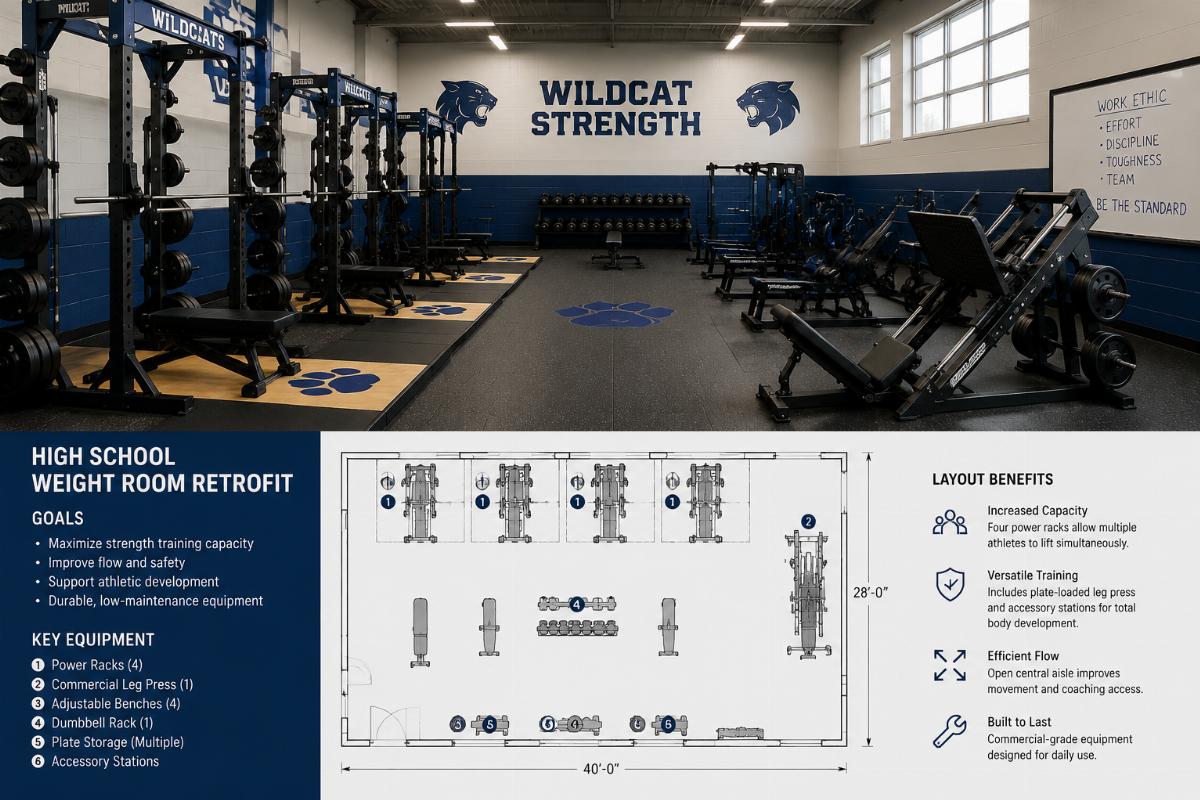
A well-planned retrofit, by contrast, moves from teardown to first student rep in a matter of weeks, not months. The difference lies in how the equipment is specified, how the container is loaded, and whether the supplier has walked the floor of a school gym rather than just a showroom.
Why Retrofit High School Weight Rooms Instead of Building New?
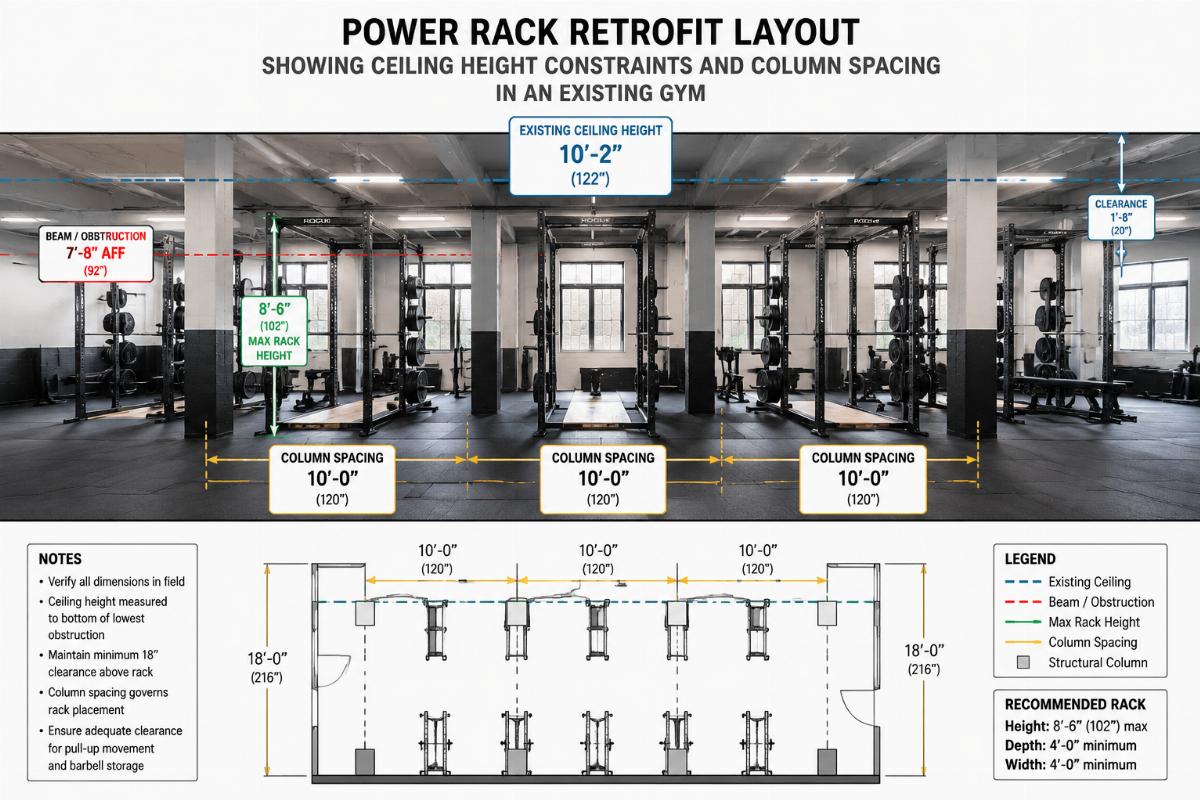
Building a new weight room from scratch typically costs multiples of what a thoughtful retrofit demands, and the timeline stretches accordingly. School districts across multiple regions have shifted toward retrofitting existing gym spaces because the structural shell, electrical rough-ins, and ventilation already exist. The real work is stripping out machines that have outlived their service windows and replacing them with equipment rated for continuous institutional use. [NEED_CITE: cost comparison between new construction and retrofit for school athletic facilities]
I once reviewed a retrofit plan for a public school where the administration wanted to expand the footprint by knocking through a partition wall. The structural assessment alone would have consumed a meaningful slice of the equipment budget. We redirected that money toward heavier-gauge frames and thicker upholstery on the leg press machine and cable stations instead. The room stayed the same size; the equipment lasted substantially longer.
The trend is clear: athletic directors and facility managers are choosing to densify existing square footage with higher-duty machines rather than pouring new foundations. [NEED_CITE: facility management trends in secondary school athletic programs]

A retrofit also sidesteps the permitting delays that new construction triggers. In many districts, any square-footage expansion requires environmental reviews, fire-code re-certifications, and board approvals that push the project past the next fiscal year. Keeping the footprint intact means the retrofit can be scheduled during summer break and be ready for fall training camps.
What Equipment Should Be Prioritized in a Weight Room Retrofit?
Core compound-movement stations, not accessory gadgets, deserve the bulk of a retrofit budget. A high school weight room sees back-to-back class periods, unsupervised peak hours, and athletes who will test every pivot point and weld. Prioritizing the machines that carry the highest load and the most complex mechanical stress is the only rational approach.
The priority list typically runs: power racks or Smith machines for squats and presses, a plate-loaded or selectorized leg press machine for lower-body work, adjustable benches, and a dedicated free-weight zone. Accessory items like preachers, lateral raise stations, and abdominal crunch machines matter, but they can be phased in during subsequent budget cycles. [NEED_CITE: equipment prioritization guidelines for secondary school strength programs]
| Equipment Category | Frame Duty Rating | Upholstery Grade | Bearing & Pivot Type | Maintenance Access |
|---|---|---|---|---|
| Power Rack / Smith | Certified heavy-duty | Commercial vinyl, stitched | Sealed bushings | Open access |
| Leg Press Machine | Certified heavy-duty | High-density foam, reinforced | Sealed bearings, linear guide | Removable shrouds |
| Adjustable Bench | Standard commercial | Medium-density foam | Pin-lock, ladder adjust | Fully exposed |
| Accessory Stations | Basic commercial | Standard vinyl | Open pivot | Partial access |
A school in the Midwestern United States retrofitted its weight room with a full set of plate-loaded machines first, then added selectorized cable stations two years later. The phased approach kept the project within a single bond measure and avoided the common trap of buying a little of everything and ending up with nothing built to survive daily student traffic. [NEED_CITE: phased procurement strategy for school athletic equipment budgets]

The leg press machine, in particular, anchors the lower-body zone. Students who are not yet cleared for free-weight squats still need progressive overload on the quadriceps, glutes, and hamstrings. A well-specified leg press machine fills that gap safely and keeps the training floor moving during class rotations.
How to Choose a Leg Press Machine for School Use?
A school-grade leg press machine must survive far more than the reps it was designed for; it must survive the misuse it was not designed for. Students will overload the sled, skip warm-up sets, adjust the seat with wet hands, and occasionally leave sweat pooled on the upholstery. The machine that survives all of this is the one built with institutional-grade materials, not the one that looks impressive in a catalog photo.
The frame must use heavy-gauge steel with welded gussets at every high-stress junction. The seat adjustment mechanism should be pin-lock or ladder-style, not a friction knob that slips under load. The upholstery needs high-density foam wrapped in commercial vinyl with double-stitched seams, because single-stitch seams split within a single semester of daily use. [NEED_CITE: durability testing standards for commercial strength equipment in institutional settings]
I walked through a school gym where the existing leg press machine had a seat rail that bent after two years. The replacement we spec’d used a thicker wall tube on the rail and a linear bearing guide instead of a simple sleeve bearing. The difference in smoothness was immediate, and the rail showed no deflection even after extended service life.
| Specification Area | School-Grade Requirement | Typical Home-Grade Shortcut |
|---|---|---|
| Frame steel gauge | Heavy-gauge, welded gussets | Thin-wall tubing, bolted joints |
| Seat adjustment | Pin-lock or ladder rail | Friction knob |
| Upholstery | High-density foam, double-stitched | Low-density foam, single-stitched |
| Sled guide | Linear bearing or sealed bushing | Open sleeve bearing |
| Safety features | Dual limit stops, anti-slip foot plate | Single stop, smooth foot plate |
A distributor in Southeast Asia once received a container of leg press machines where the foot plates were packed flat instead of nested. The plates arrived dented, and the school refused the shipment. We now nest foot plates inside the sled cavity and wrap each in molded foam. The extra packing labor is minor; the replacement cost of a dented plate shipped overseas is not. [NEED_CITE: packaging and loading best practices for strength equipment export]

The safety story does not end at the machine. The supplier should provide load-rating documentation and, where required, third-party test reports that confirm the frame and welds meet institutional safety thresholds. Schools cannot afford to rely on a supplier’s self-reported specs alone.
What Are the Hidden Costs in Gym Equipment Procurement?
The invoice price is rarely the final cost; customs paperwork, container utilization, and post-delivery support are where budgets quietly bleed. A school district that budgets strictly per machine will discover, often too late, that the leg press machine sitting on the gym floor cost substantially more than the purchase order suggested.
Customs compliance is the first hidden cost. Harmonized System codes for strength equipment vary by destination country, and a misclassified shipment can trigger duty reassessments that add a meaningful percentage to the landed cost. I have seen shipments held at port because the HS code on the bill of lading described "general gym equipment" while the commercial invoice listed specific machine types. The demurrage alone erased the margin the school thought it had saved by choosing the lowest quoted price. [NEED_CITE: HS code classification issues for commercial fitness equipment imports]
Container utilization is the second. A leg press machine is bulky. If a supplier loads a container without optimizing the nesting of frames, seats, and weight horns, the school pays freight for air. Consolidating a full order of strength equipment into a single container, with plate-loaded machines, benches, and free weights nested together, drops the per-unit freight cost noticeably. [NEED_CITE: container loading optimization strategies for fitness equipment shipments]
| Cost Category | Typical Risk | Mitigation Approach |
|---|---|---|
| Customs classification | Duty reassessment, port delays | Pre-shipment HS code confirmation with local broker |
| Container utilization | Paying freight for unused volume | Nested loading plan, mixed-SKU container |
| Spare parts availability | Extended downtime after warranty | Supplier commitment to multi-year parts supply |
| Technical support | Incorrect installation, voided warranty | Remote installation guidance, video support |
A school procurement officer in the Middle East learned this the hard way when a single-selectorized machine order arrived in a half-empty container. The freight per unit was roughly double what it would have been in a consolidated load. The next order, a full weight room package including a leg press machine, power rack, cable crossover, and free-weight set, filled a single container and brought the landed cost per machine down substantially. [NEED_CITE: freight cost impact of container utilization in fitness equipment procurement]

Post-delivery support is the third hidden cost. A machine without a reliable spare parts pipeline becomes a paperweight the moment a bearing fails or a cable frays. Schools need a supplier who commits to multi-year parts availability and can ship replacement components without requiring a full container order.
How to Ensure Long-Term Value from Retrofit Investments?
The machines that deliver the longest service life are the ones backed by a supplier who treats the sale as the beginning of the relationship, not the end. A retrofit is a multi-year commitment. The leg press machine installed today should still be in daily use a decade from now, and that outcome depends as much on the supplier’s after-sale infrastructure as on the steel in the frame.
Warranty terms matter, but they are only the surface layer. What truly separates a durable investment from a depreciating asset is the supplier’s willingness to supply replacement bearings, cables, upholstery kits, and adjustment pins on demand, years after the original order. A school that cannot source a replacement seat rail from the original supplier is forced to fabricate one locally or retire the machine entirely. [NEED_CITE: after-sales parts availability as a factor in commercial fitness equipment total cost of ownership]
I worked with a school district that consolidated its strength equipment order across multiple campuses into a single procurement cycle. The supplier provided a unified spare parts catalog, standardized upholstery colors across all sites, and offered remote installation guidance via video calls. When one campus reported a worn sled bearing two years in, the replacement part shipped within days, not weeks. The downtime was measured in hours, not a full semester.

Standardization across campuses also reduces the training burden on maintenance staff. When every school in a district uses the same leg press machine model, the same adjustment mechanism, and the same upholstery specification, the custodial and coaching staff learn the equipment once and apply that knowledge everywhere. [NEED_CITE: standardization benefits in multi-site school athletic equipment procurement]
The long-term value equation also includes the supplier’s willingness to support OEM branding for districts that want their athletic logo on the shroud or the seat pad. This is not vanity; it reinforces institutional pride and discourages unauthorized resale of surplus equipment.
Conclusion
A high school weight room retrofit succeeds when the equipment matches the abuse, the logistics match the budget, and the supplier matches the timeline. Choosing a commercial-grade leg press machine, consolidating container loads, and locking in spare parts availability before the first machine arrives are the decisions that separate a decade-long asset from a five-year liability. The invoice price is only the opening line of the cost story; the rest is written in uptime, maintenance hours, and the number of semesters the equipment actually serves the students who depend on it.