How High School Weight Rooms Buyers Deploy Functional Trainer
A functional trainer is not a machine you drop into a corner and call a day. It is a traffic-flow node that must be sized to peak class concurrency, coach sightlines, and the full strength gradient from seventh graders to varsity athletes.
Deploying a functional trainer in a high school weight room requires reverse-engineering equipment count from peak-period student throughput, selecting pulley configuration based on class rotation rhythm rather than spec-sheet appeal, and sizing the weight stack to span the entire grade-level strength range — not just the varsity ceiling. Get the layout wrong, and the unit sits idle during peak hours while students queue; get the stack wrong, and younger students cannot access the machine at all.
I spent several years on the procurement side for private school fitness facilities across the Gulf — Dubai, Riyadh, Doha — before switching to the manufacturing side. One project still sticks with me. A private school in Riyadh bought two dual-pulley functional trainers for a weight room that served roughly two hundred students across rotating PE blocks. The room was compact. The machines were placed back-to-back against a wall. During peak periods, students waited in line for extended stretches while the coach tried to supervise from a single vantage point. The equipment utilization rate dropped noticeably below projections. That project collapsed, and it pushed me to ask a different question: why do some schools run their functional trainers at full capacity all day, while others turn them into expensive coat racks?
The answer is almost never the machine itself. It is the deployment logic around it.
Let me walk through what actually determines whether a functional trainer deployment succeeds or fails in a school environment.
Why Most High School Weight Rooms Waste Significant Functional Trainer Capacity?
The root cause is almost always a mismatch between equipment count and peak-hour student concurrency — not a lack of budget or floor space.
School weight rooms do not operate like commercial gyms. In a commercial gym, members drift in and out across a wide window. In a school, an entire class of students hits the weight room at the same time, rotates through stations on a fixed schedule, and leaves. That creates sharp demand spikes. If the functional trainer cannot serve enough students per rotation cycle, it becomes a bottleneck. [NEED_CITE: peak-period equipment utilization methodology in school physical education facilities]
The calculation is straightforward in principle: divide the number of students in the peak concurrent class by the number of students one machine station can serve per rotation cycle. If a class has thirty students and a single-pulley station serves one student at a time with a rotation cycle of roughly five minutes, a single functional trainer handles a limited number of students per block. Schools that buy one unit for a thirty-student class are, in effect, guaranteeing that a large portion of the class will spend rotation time standing around.
I reviewed a project at a private school in the Gulf where the procurement team specified two dual-pulley functional trainers for a room serving upper-grade athletes. The room footprint was tight. Each dual-pulley unit occupied substantial floor area, and because dual-pulley configurations require users on both sides to operate simultaneously for full efficiency, the effective station count during single-user exercises was lower than expected. Students queued. Coaches adjusted by skipping the functional trainer entirely during peak blocks. The utilization rate fell well below what the purchase order assumed.
The fix is not to buy more machines blindly. It is to model the peak concurrent headcount first, then determine station count per machine type, and only then select how many units the room can physically accommodate with proper clearance.

Single vs Dual Pulley: Which Configuration Actually Fits a School Schedule?
Dual-pulley functional trainers are not inherently superior for school environments. In many cases, single-pulley configurations deliver higher throughput per square meter during peak class rotations.
The conventional assumption is that dual-pulley machines offer more exercise variety and therefore represent better value. That logic holds in a commercial gym where a single user may spend twenty minutes on one machine cycling through multiple movements. It does not hold in a school weight room where the constraint is how many students can complete a station within a fixed rotation window. [NEED_CITE: functional trainer throughput comparison in high-traffic institutional settings]
A single-pulley functional trainer allows one student to work at a time but enables rapid exercise transitions — the user loads the pin, performs a set, steps off, and the next student steps in. A dual-pulley unit technically offers two cable columns, but in practice both sides are rarely occupied simultaneously during a school rotation because the coach needs to manage the flow and students are often working in synchronized groups. The dual-pulley footprint is larger, the cable routing is more complex, and the maintenance surface area increases.
At a Latin American public high school project I consulted on, the procurement team initially specified dual-pulley units based on a commercial gym recommendation. When we modeled the actual class schedule — six rotations per day, roughly twenty-five students per rotation — the dual-pulley configuration created a throughput bottleneck. Switching to single-pulley units with a broader weight stack range allowed more students to cycle through per block without expanding the room footprint.
That said, dual-pulley configurations do have a place in school environments — specifically for varsity athletic programs where smaller groups train simultaneously on coordinated movements like cable crossovers or rotational exercises. The key is matching the configuration to the actual user profile, not to a generic "more features equals better" assumption.
Our manufacturing line offers both single-pulley and dual-pulley functional trainer configurations with customizable weight stack ranges, so schools can select based on their actual rotation model rather than being locked into a standard catalog SKU.

How to Size the Weight Stack for Grades Seven Through Twelve?
The weight stack must span the full strength gradient of the school population — from the weakest seventh grader to the strongest varsity athlete — or a significant portion of the student body will never use the machine.
This is where many school procurement projects go wrong in a subtle way. The instinct is to spec a heavy weight stack because the coach or athletic director is thinking about the football team’s training needs. But a weight stack that starts at a high minimum increment is unusable for younger or less developed students. Conversely, a stack that tops out too low forces varsity athletes to perform high-repetition sets that do not match their strength development goals. [NEED_CITE: adolescent strength development ranges across secondary school grade levels]
The sizing logic should follow a range-mapping approach. Identify the approximate lower bound of the weakest student population — typically early-grade students or those with limited training background — and the upper bound of the strongest athletes. The weight stack must cover that full range in usable increments. If the stack starts too high, younger students cannot perform movements with proper form at any resistance level. If the increments between plates are too large, students at intermediate levels cannot progress smoothly.
At a Southeast Asian international school project, the original specification called for a functional trainer with a weight stack that started at a relatively high baseline. During the first semester, PE teachers reported that middle-school students could not perform cable row or chest press movements at the lowest available resistance without compromising form. The machine was effectively off-limits to that entire grade cohort. The school eventually had to add a separate lighter-resistance unit — at additional cost and floor space — to serve the lower grade levels.
The better approach is to spec the weight stack range during the procurement phase based on the school’s actual grade composition and athletic program profile. Our production facility supports custom weight stack configurations, allowing schools to define the lower bound, upper bound, and increment spacing based on their student population rather than accepting a one-size-fits-all stack.

Traffic Flow and Safety: Keeping the Coach’s Eyes on Every Rep
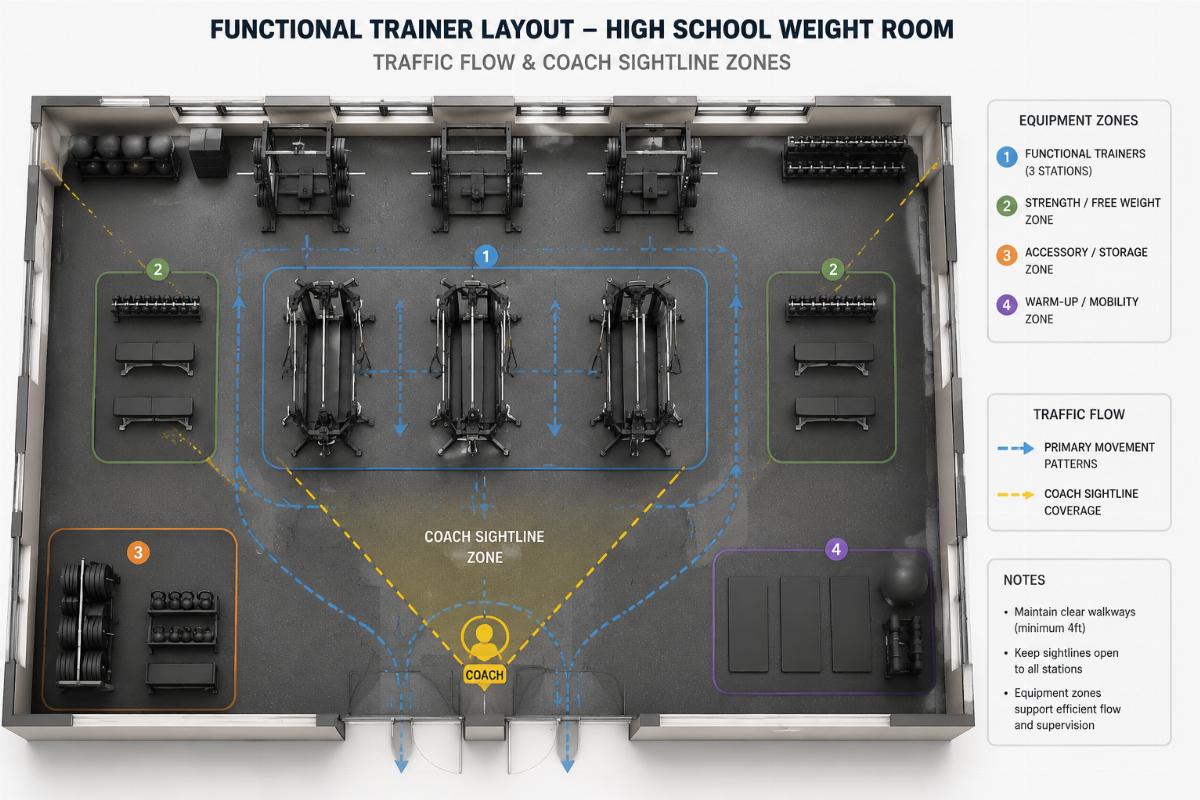
Placing a functional trainer in a corner to save floor space is one of the most common deployment mistakes in school weight rooms — because corners fall outside the coach’s primary sightline, and unsupervised student lifting is where injuries occur.
School weight rooms carry a fundamentally different liability profile than commercial gyms. The users are minors. The supervision ratio is one coach to many students. And the activities involve loaded cables, moving weight stacks, and dynamic movements that require spatial awareness. [NEED_CITE: supervision sightline requirements in youth strength training facility design standards]
The functional trainer must be positioned within the coach’s unobstructed visual field from the primary supervision station — typically the center of the room or the entrance point. Placing the machine in a corner, behind a rack, or around a structural column creates a blind zone where a student performing a cable movement could lose control without the coach seeing it in time to intervene.
Beyond sightlines, traffic flow between the functional trainer zone and adjacent areas — particularly free-weight zones — must be designed to prevent collision risk. Students carrying dumbbells or barbells need clear travel paths that do not cross through the functional trainer’s cable arc or user standing area. I reviewed an incident at a Southeast Asian international school where a student performing a cable rotation exercise collided with another student carrying a barbell through an intersecting traffic path. The injury was minor, but the school had to reconfigure the entire weight room layout afterward at significant cost.
The minimum clearance principle: maintain a defined buffer zone around the functional trainer where no other equipment or traffic path intrudes. This buffer must account for the full range of cable movement, the user’s standing position, and the step-off area where the next student waits.

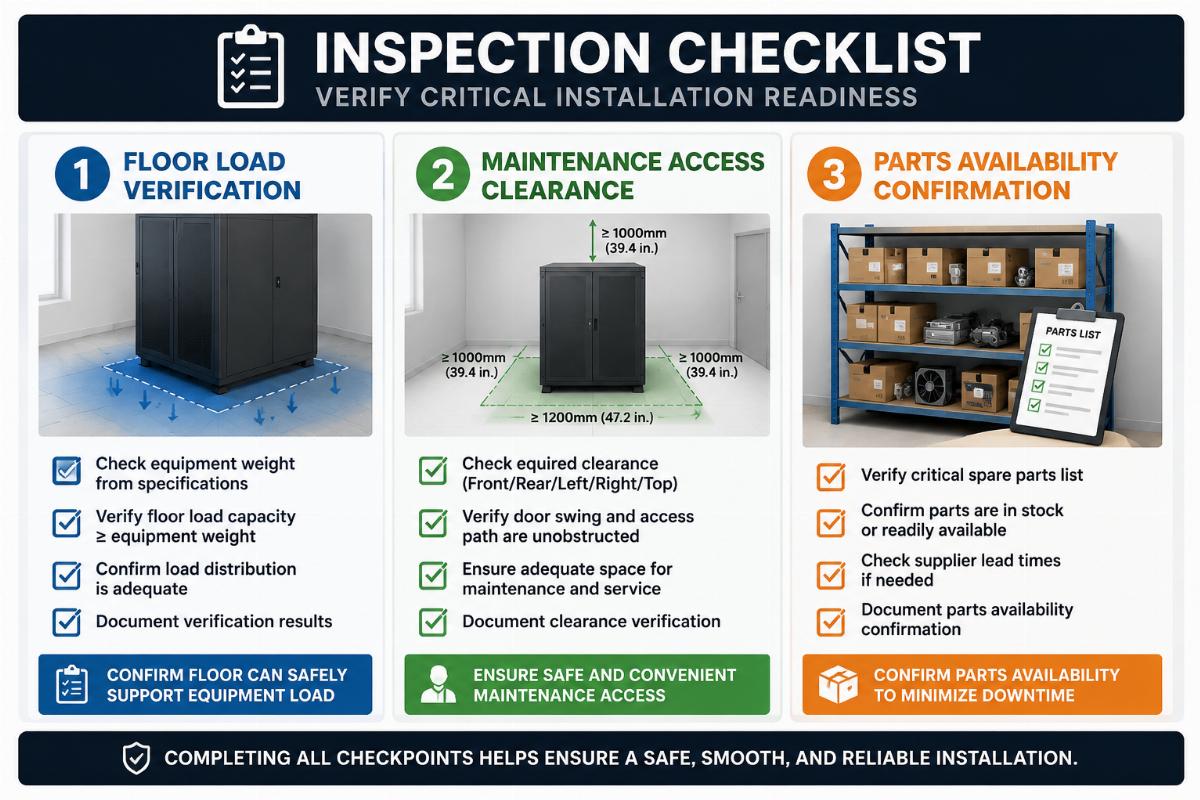
What to Verify Before Signing the Purchase Order?
Floor load capacity, maintenance access clearance, and long-term parts availability are the three隐性 cost drivers that school buyers routinely overlook until after installation.
School weight rooms are often located on upper floors of existing buildings — not ground-level structures designed for heavy equipment loads. A functional trainer’s static weight plus the dynamic load of a student performing cable exercises creates a combined floor load that must be verified against the building’s structural capacity. [NEED_CITE: floor load requirements for institutional fitness equipment installation]
I have seen projects where the functional trainer was delivered and installed, only for the school’s facilities team to discover that the floor deflection under dynamic load exceeded acceptable thresholds. The solution required structural reinforcement — at a cost that dwarfed the machine itself.
Maintenance access is the second overlooked factor. Functional trainers require periodic cable inspection, pulley lubrication, and weight stack guide rod maintenance. If the machine is placed flush against a wall with no rear or side access panel clearance, routine maintenance becomes disruptive or impossible without moving the entire unit.
Parts availability is the third. A functional trainer’s cables, pulleys, and weight stack pins are wear components. If the manufacturer cannot supply replacement parts within a reasonable timeframe, a minor component failure can take the entire machine out of service for weeks. Schools operating on tight academic schedules cannot afford that downtime.
Before finalizing a purchase order, the procurement team should verify: floor load certification from a structural engineer, minimum rear and side clearance for maintenance access, and a written commitment from the manufacturer on parts availability duration and delivery lead times.
Conclusion
Deploying a functional trainer in a high school weight room is an exercise in matching equipment configuration to institutional traffic patterns, not simply selecting a machine from a catalog. Peak-hour concurrency determines station count. Class rotation rhythm determines pulley configuration. The full grade-level strength span determines weight stack range. Coach sightlines determine placement. And floor load, maintenance access, and parts supply determine whether the installation remains functional over the long term. Schools that reverse-engineer the deployment from these constraints — rather than starting with the machine spec — consistently achieve higher utilization, fewer safety incidents, and lower total cost of ownership.