How Strongman Training Facilities Buyers Deploy Chest Press Machine
Most buyers assume a chest press machine is a "plug-and-play" unit—until the guide rails bind, the weight stack misaligns, or the anchor bolts tear through the rubber flooring. Deploying a chest press machine in a strongman or heavy-duty training facility requires precise floor anchoring, clearance planning for oversized plates, and load-path alignment that accounts for high-rep, high-force usage patterns typical in these environments.
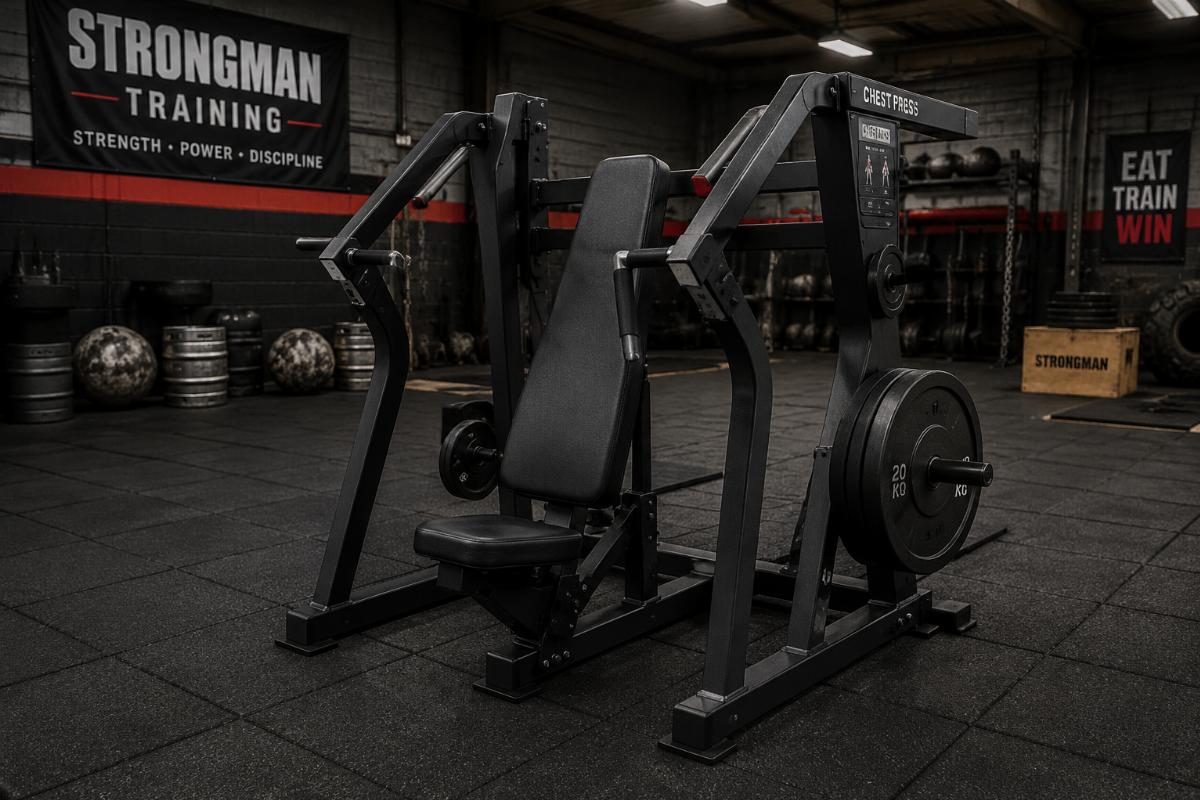
I still remember the first time I stood in a private strength gym in Riyadh watching a newly arrived chest press being unboxed. The floor was custom-poured rubber, nearly twice the thickness of standard commercial gym flooring, and the mounting holes on the machine base did not line up with the pre-drilled anchor points the client had prepared. The track was off by a fraction of an inch, and when the selectorized weight stack was loaded, the carriage slammed into the end stop with a metallic crack that made everyone in the room wince. That was the order where I transitioned from quality inspection into trade, and I had personally reviewed the drawings. The lesson was brutal but unforgettable: deployment is not assembly—it is integration.
If you are sourcing equipment for a strongman-focused facility, the chest press is often the first machine buyers test for build quality, because it takes the heaviest abuse. Understanding how to deploy it correctly saves you from structural damage, user injury, and warranty disputes that can cost several times the original freight savings. [NEED_CITE: common deployment failure modes in commercial strength equipment per industry field reports]
Why Does Floor Anchoring Matter More in Strongman Facilities Than in Standard Gyms?
In strongman training environments, chest press machines experience lateral and torsional loads that far exceed those in general-purpose fitness centers, making floor anchoring the single most critical deployment variable.
Standard commercial gyms typically see controlled, moderate-force usage on selectorized machines. Strongman facilities, by contrast, attract users who push near-maximal loads on every set, often with explosive concentric movements and incomplete eccentrics. The cumulative effect is a significantly higher rate of micro-vibrations and lateral shift forces transmitted through the machine frame into the floor. [NEED_CITE: biomechanical load differences between strongman training and conventional resistance training]
When I worked with a strength facility in Dubai that catered to competitive strongman athletes, the owner insisted on placing the chest press directly on a raised platform without through-bolting to the concrete subfloor. Within weeks, the machine developed a perceptible rock at the base. The guide rods began to wear unevenly, and the selectorized pin mechanism started to jam under load. The fix required pulling the entire unit, re-cutting the flooring, and drilling new anchor points into the structural slab—a process that delayed the facility’s opening and cost a mid-five-figure sum in labor and downtime.
The key deployment considerations for floor anchoring in strongman facilities include:
- Subfloor type verification: Confirm whether the floor is poured concrete, raised platform, or rubber-over-concrete. Anchor bolt length and diameter must match the subfloor specification.
- Rubber flooring thickness: Thick rubber absorbs vibration but reduces anchor grip if bolts are not long enough to reach the structural layer.
- Anchor bolt grade: Standard expansion bolts are often insufficient; wedge anchors or chemical anchors are recommended for high-load environments. [NEED_CITE: anchor bolt selection guidelines for heavy fitness equipment on rubber flooring]
- Load distribution plates: Steel plates beneath the machine base can spread point loads across a wider area of the flooring, reducing the risk of localized cracking.

A practical rule I now follow on every deployment: photograph the floor condition before the machine arrives, confirm the anchor specification with the installation team, and verify that the machine base plate has pre-drilled holes matching the chosen anchor pattern. Skipping any of these steps is how a straightforward installation turns into a multi-day remediation.
How Should Clearance and Surrounding Equipment Layout Be Planned for a Chest Press in a Strongman Gym?
A chest press machine in a strongman facility needs significantly more surrounding clearance than in a standard gym, because users frequently load oversized competition plates and perform high-intensity sets with spotters nearby.
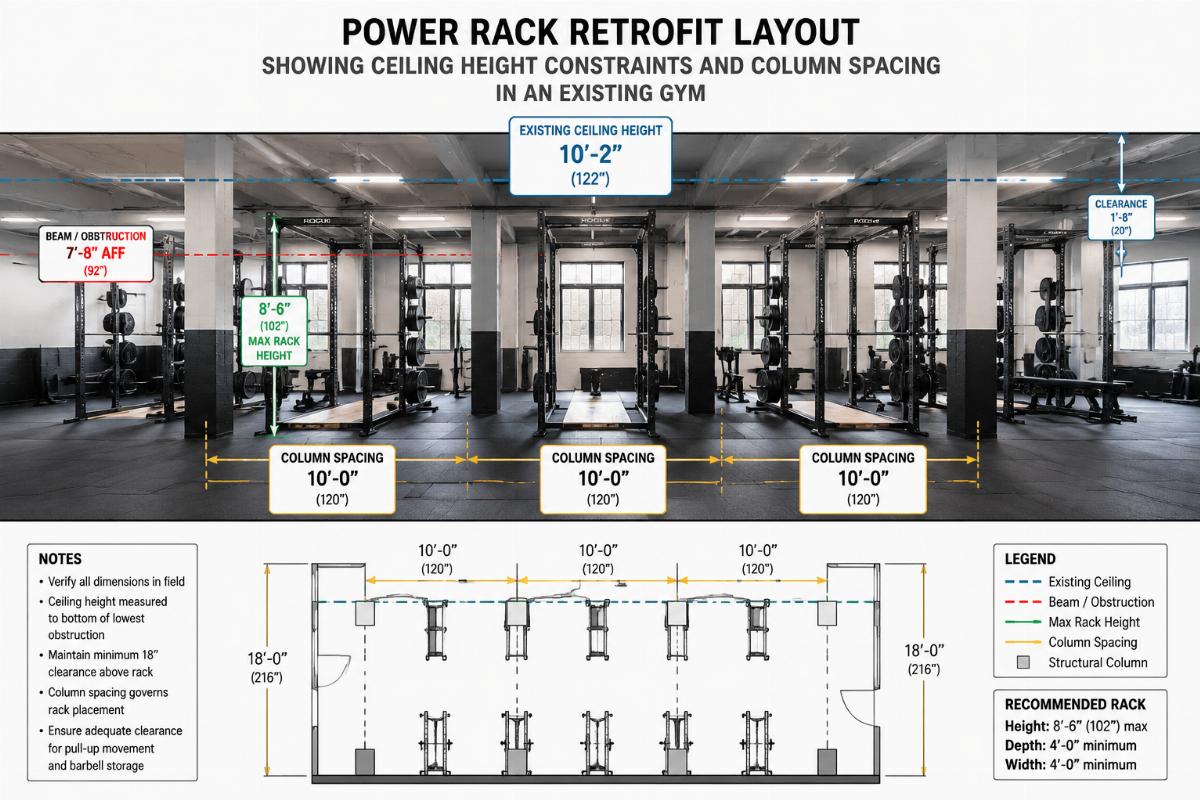
The typical mistake buyers make is treating the chest press footprint as the only space requirement. In reality, you must account for plate loading clearance on both sides, rear access for maintenance, and user circulation space for spotters and loading assistance. In a strongman gym, where 500mm diameter competition plates are common, the lateral clearance requirement increases noticeably compared to facilities using standard 450mm plates. [NEED_CITE: spatial clearance recommendations for plate-loaded and selectorized strength machines in high-usage gyms]
I once reviewed a layout plan for a strength facility in Doha where the chest press was positioned with its back against a wall, leaving no rear access. When the guide rods needed lubrication six months into operation, the technicians had to disconnect the weight stack and pull the entire carriage forward just to reach the rear bushings. The downtime was avoidable, and the awkward working position led to an incomplete service job that caused premature wear on the linear bearings.
The clearance planning checklist I now use for chest press deployment in strongman facilities covers:
- Lateral plate loading space: Minimum clearance on both sides to accommodate the largest plate diameter the facility plans to use, plus hand room for the user.
- Rear maintenance access: At least enough space for a technician to stand and service guide rods, cables, and pulleys without disassembling the carriage.
- Spotter circulation: Space behind and to the sides for a spotter to stand safely during heavy sets.
- Adjacent equipment interference: Ensure that nearby machines or free-weight zones do not create traffic conflicts when the chest press is in use at full capacity.

One additional point that often gets overlooked: the chest press should not be placed directly under an overhead rig or monkey bar system. In strongman facilities, athletes frequently perform pull-ups or rope climbs on overhead rigs, and chalk dust, sweat, and debris fall directly onto the equipment below. Over time, this contaminants the guide rods and accelerates bushing wear. Positioning the chest press away from overhead contamination sources extends service intervals noticeably.
What Load-Path Alignment Checks Should Be Performed Before a Chest Press Enters Service?
Before any chest press machine is cleared for member use, the load path—from the weight stack through the cables, pulleys, and guide rods to the press carriage—must be verified for smooth, friction-free travel across the full range of motion.
Load-path alignment is the technical heart of chest press deployment. If the guide rods are not perfectly parallel, the carriage will bind at certain points in the stroke. If the cable routing does not match the pulley groove profile, the cable will wear prematurely and may jump the pulley under heavy load. In a strongman facility, where the machine will see near-maximal loads on every session, even a minor alignment issue will compound rapidly into a major failure. [NEED_CITE: linear guide alignment tolerances for selectorized strength equipment]
During a deployment at a private training facility in Jeddah, I noticed that the chest press carriage moved smoothly through the middle of the stroke but caught slightly at the very end of the extension. The installation team assumed it was normal resistance from the weight stack. A closer inspection revealed that one of the guide rods had been installed with a slight twist—less than a degree of angular deviation, but enough to create binding at full extension. The fix was straightforward once identified: loosen the rod mounts, realign, and re-torque. But if the issue had gone unnoticed, the bushing on that side would have worn out within months, leading to a service call and potential user complaint.
The load-path alignment verification process should include:
- Guide rod parallelism check: Use a straight edge or precision level to confirm that both guide rods are parallel across their full length.
- Carriage travel test: Move the carriage through the complete stroke without any weight loaded, feeling for any binding, catching, or uneven resistance.
- Cable routing inspection: Verify that each cable sits correctly in its pulley groove and does not rub against any adjacent surface.
- Pulley spin test: Each pulley should spin freely without lateral wobble or grinding noise.
- Weight stack drop test: With the selector pin set to a moderate load, release the carriage and observe whether the weight stack descends smoothly and evenly on both sides.

These checks take only a few minutes but prevent the vast majority of early-life service issues. In my experience, the majority of chest press warranty claims in high-usage facilities trace back to alignment problems that were present at installation but went undetected.
How Do Strongman Facility Buyers Evaluate Chest Press Machines for Deployment Readiness?
Strongman facility buyers evaluate chest press machines not just on specifications, but on deployment readiness—the degree to which the machine can be installed, aligned, and commissioned without modification or remediation on site.
Deployment readiness is a concept that separates equipment that looks good on a spec sheet from equipment that performs reliably in a real-world strongman gym. A machine may have an impressive maximum load rating, but if the base plate does not accommodate standard anchor patterns, or if the guide rods are shipped without protective caps and arrive scratched, the deployment will be compromised from day one. [NEED_CITE: deployment readiness criteria for commercial strength equipment per facility operator surveys]
I have seen buyers reject an entire shipment of chest press machines because the packaging did not include foam protection for the chrome guide rods, and several rods arrived with surface scratches that would accelerate bushing wear. The machines were technically within specification, but the deployment readiness was unacceptable. The manufacturer had to replace the rods and re-ship, delaying the facility opening by weeks.
Key deployment readiness factors that strongman facility buyers should evaluate include:
- Base plate anchor compatibility: Does the base plate have pre-drilled holes that match common anchor bolt patterns used in the target region?
- Component protection during shipping: Are guide rods, cables, and finished surfaces adequately protected to prevent transit damage?
- Assembly documentation clarity: Are the installation instructions clear, complete, and available in the local language?
- Adjustment range: Does the machine offer sufficient seat and press arm adjustment to accommodate the full range of user body sizes typical in a strongman facility?
- Spare parts availability: Are critical wear components—bushings, cables, pulleys—available as spare parts with reasonable lead times?

A supplier who understands deployment readiness will ship machines with protective caps on all guide rods, include a complete anchor bolt template, and provide assembly documentation that accounts for regional flooring variations. These details are not glamorous, but they determine whether a deployment goes smoothly or becomes a costly lesson.
What Role Does the Supplier Play in Ensuring Successful Chest Press Deployment?
The supplier’s role in chest press deployment extends far beyond manufacturing and shipping—it includes pre-deployment consultation, on-site technical support, and post-installation follow-up to ensure the machine performs as intended in the specific facility environment.
In my experience working with strongman facility buyers across the Middle East, the difference between a successful deployment and a problematic one often comes down to the level of supplier involvement. A supplier who simply ships the machine and walks away is leaving too much to chance. A supplier who engages with the buyer on floor specifications, layout planning, and installation verification adds value that goes well beyond the product itself. [NEED_CITE: supplier involvement impact on commercial gym equipment deployment success rates]
I recall a project where a buyer in Qatar was setting up a new strongman-focused training center and had ordered a full package of strength equipment, including multiple chest press machines. The supplier assigned a technical representative to review the facility layout plans before shipment, identified a clearance issue with one of the chest press locations, and recommended a revised layout that improved traffic flow and maintenance access. The buyer implemented the changes, and the deployment proceeded without a single installation issue. That level of pre-deployment engagement built trust that led to repeat orders and a long-term supply relationship.
The supplier contributions that matter most for successful chest press deployment include:
- Pre-shipment layout review: Offering to review the facility layout and flag potential clearance or anchoring issues before the machines ship.
- Installation guidance: Providing detailed installation documentation, including anchor bolt specifications, clearance requirements, and load-path alignment procedures.
- On-site technical support: Making a technician available—remotely or in person—to assist with installation and commissioning if needed.
- Post-installation follow-up: Checking in with the buyer after deployment to confirm that the machines are performing as expected and to address any early concerns.

For buyers sourcing chest press machines for strongman facilities, evaluating a supplier’s deployment support capabilities is just as important as evaluating the machine specifications. A well-deployed machine will outperform a poorly deployed machine of equal or even higher specification, every time.
Conclusion
Deploying a chest press machine in a strongman training facility is a technical integration process, not a simple installation task. Floor anchoring, clearance planning, load-path alignment, deployment readiness evaluation, and supplier engagement all play critical roles in determining whether the machine will perform reliably under the extreme demands of strongman training. Buyers who invest time in these deployment details upfront will avoid costly remediation, reduce downtime, and build a training environment that earns the trust of serious athletes.