How CrossFit Boxes Buyers Deploy Plate Storage Tree
Most buyers treat plate storage trees as passive racks. In a real CrossFit box, they are active traffic-control nodes — and placing them wrong turns a WOD transition into a collision zone.
The core answer to how CrossFit box buyers deploy plate storage trees is simple: start from the movement geometry of your most common WODs, not from leftover wall space. Plate storage tree deployment must account for athlete clearance arcs during transitions, anchoring demands from repeated plate-drop vibration, and peg configuration matched to the bumper plate weight range the box uses daily. Get these three layers right, and the plate storage tree becomes a performance multiplier; get them wrong, and it becomes a bottleneck, a tip-over hazard, and a floor-plan liability.
I used to sit on the other side of the table — sourcing gear for a CrossFit box down in Melbourne. We ordered a batch of plate storage trees from a Qingdao factory, and when the container landed, we just parked them wherever there was open floor. Big mistake. During a Friday night WOD, two athletes collided near a tree because nobody thought about traffic flow around the rig. One tree actually tipped when someone yanked a 20-kilo plate mid-metcon — no wall anchor, no rubber base. I spent the whole next weekend drilling brackets and redrawing the floor plan. That mess is exactly why I switched sides. Now I’m with a manufacturer here in Shandong, helping overseas box owners nail down placement before the shipment leaves the port. A plate storage tree isn’t just a rack — it’s part of your workout geometry. [NEED_CITE: CrossFit affiliate layout guidelines on equipment spacing and transition zones]

Let me walk through what actually matters when you deploy a plate storage tree in a high-intensity functional training environment.
Why Plate Tree Placement Matters More Than You Think in a CrossFit Box
In a commercial gym, a plate tree sits against a wall and people walk past it. In a CrossFit box, athletes sprint to it, yank plates mid-brep, and drop bumpers within a meter of it — repeatedly, under fatigue.
The conventional assumption is that plate storage trees go wherever wall space is free after the rig, rower bay, and cardio line are locked in. That logic works for a traditional globo gym where members grab plates, walk to a station, and settle in. It fails completely in a CrossFit environment where WOD transitions involve multi-directional movement, partner work, and timed equipment swaps. [NEED_CITE: biomechanical analysis of athlete movement patterns during CrossFit WOD transitions]
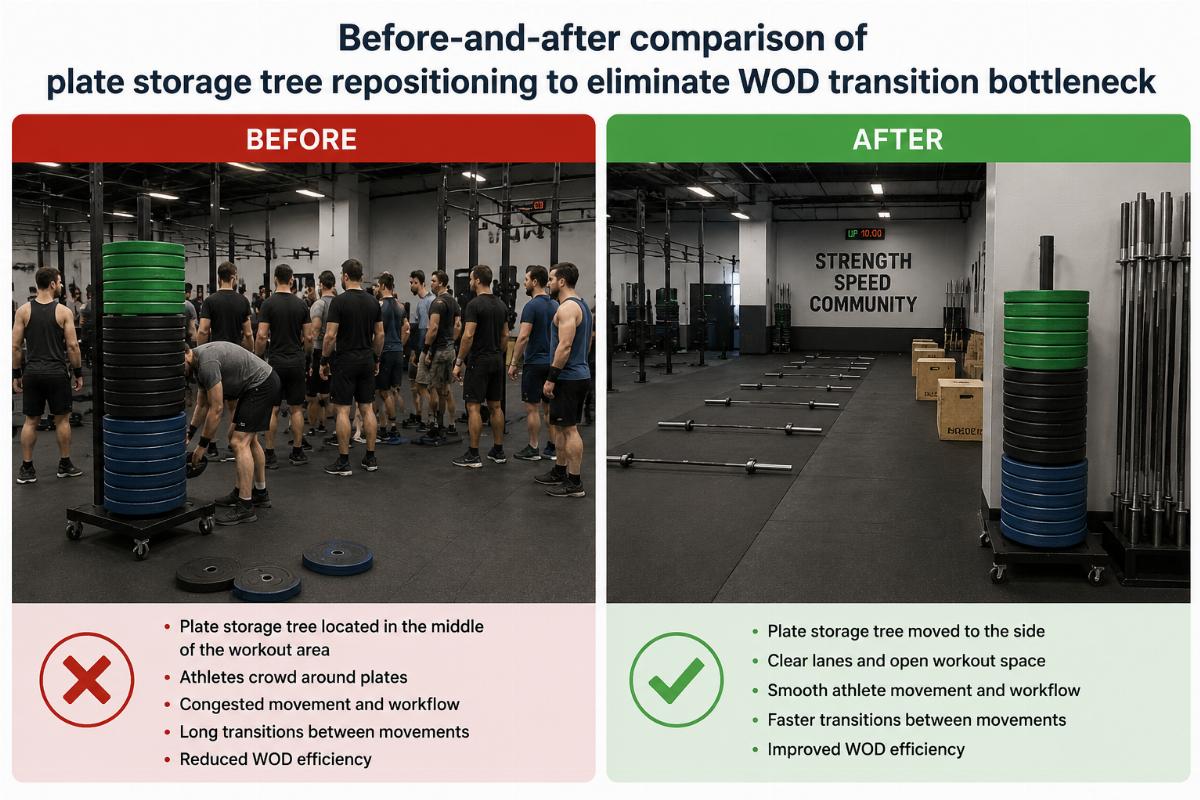
When I review floor plans from box owners who are deploying plate storage trees for the first time, the most common error is clustering all storage along a single wall. That creates a "loading dock" effect — every athlete in a chipper-style WOD funnels through the same zone during the plate-grab phase. I watched a partner WOD where four teams rotated through a wall-mounted plate storage tree setup; the congestion added noticeable time to every round and created near-misses between athletes carrying loaded barbells back to the rig.
The insight that changed how I advise buyers: map your WOD movement patterns first, then place the plate storage tree where it serves the most common transition routes without sitting inside any athlete’s acceleration or deceleration arc. [NEED_CITE: ergonomic guidelines for equipment placement in high-intensity functional training facilities]
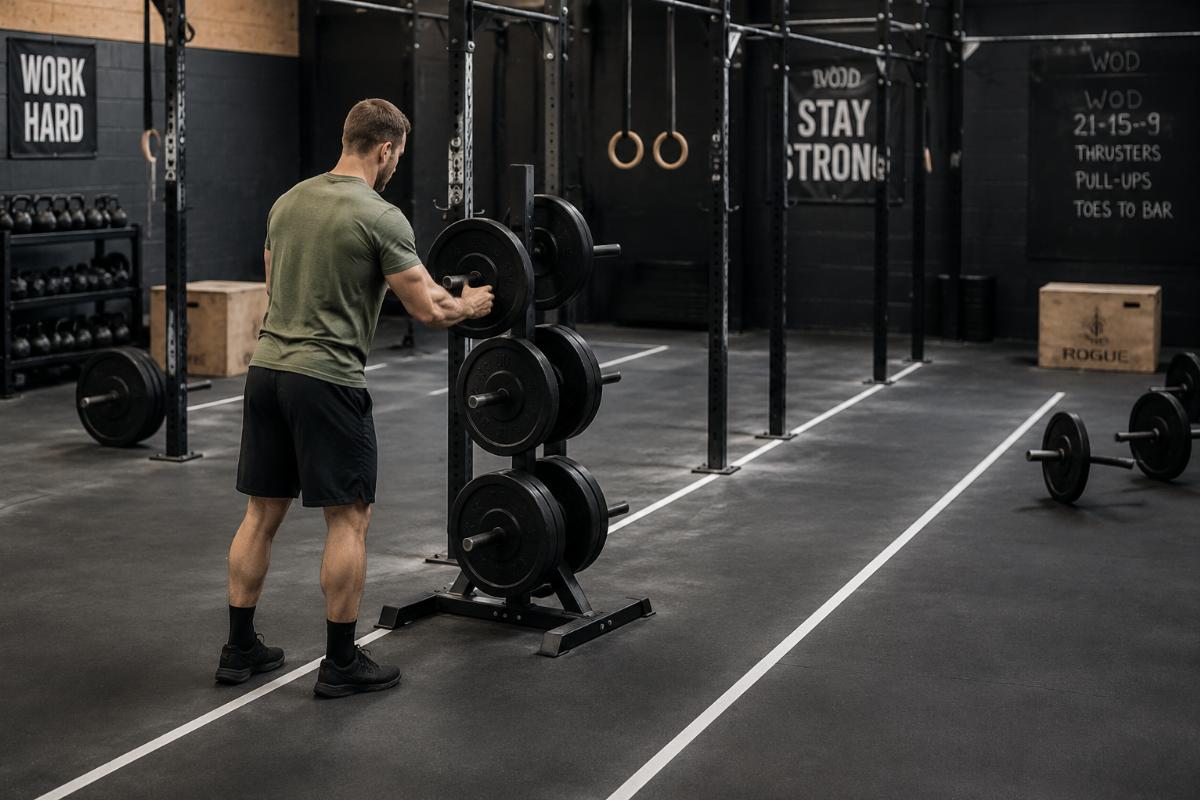
A well-deployed plate storage tree should sit at the intersection of two or more movement corridors — close enough to the rig for barbell loading, accessible from the open floor for wall-ball or dumbbell stations, and positioned so that an athlete approaching it has a clear entry and exit path without crossing another athlete’s line.
How to Map Your Floor Plan Around Plate Storage Zones
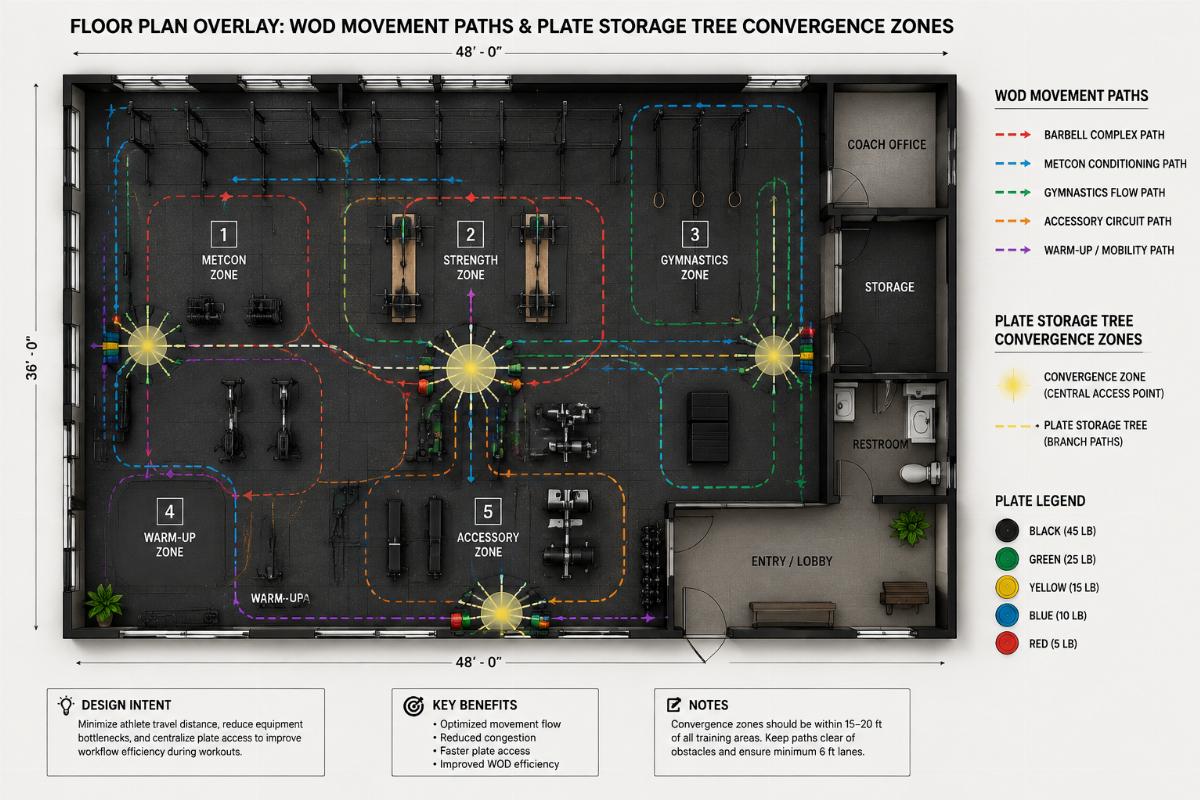
Start with your top five most-programmed WOD formats, trace the equipment pickup sequence for each, and overlay those paths on your floor plan before you bolt anything down.
The plate storage tree deployment process should follow a structured layout method rather than intuitive placement. Here is the approach I use when consulting with box owners on floor planning:
Step 1 — Audit your WOD library. Pull the last several months of programming. Identify the WOD structures that appear most frequently: chipper, AMRAP, partner relay, EMOM with equipment rotation. Each structure generates a different traffic pattern.
Step 2 — Diagram equipment pickup sequences. For each high-frequency WOD, draw the path an athlete takes from the whiteboard to the first piece of equipment and through each station. Mark where plates are grabbed and where they are returned. [NEED_CITE: facility layout methodology for functional training gyms based on workflow analysis]
Step 3 — Identify convergence points. Look for zones where multiple WOD paths cross. These are your high-traffic transition areas. The plate storage tree should be positioned adjacent to — not inside — these convergence zones.
Step 4 — Define clearance radii. Each plate storage tree needs a minimum clearance perimeter on all accessible sides. Athletes need room to bend, load, and unload without encroaching on neighboring stations. In a CrossFit box, this clearance must account for dynamic movement, not just static walking.
Step 5 — Validate with a dry run. Before final anchoring, place the plate storage tree using temporary markers on the floor. Run through your most demanding WOD with a full class and observe. Adjust.
A buyer in the Pacific Northwest deployed plate storage trees using this method for a new build. Instead of lining all six trees along the back wall as originally planned, they split the deployment: three near the rig for barbell work, two flanking the open floor for dumbbell and kettlebell stations, and one near the rower bay. The result was a noticeable reduction in transition congestion during peak-hour classes. [NEED_CITE: case study on CrossFit box layout optimization and member throughput]
Anchoring and Base Stability — What CrossFit Intensity Demands
Standard gym installation assumes static loads. CrossFit generates repetitive impact vibration from plate drops, bumper impacts, and dynamic loading — and that vibration works loose any plate storage tree that is not anchored to the correct standard.
This is where a lot of deployments fail quietly. The tree looks fine on day one. After several weeks of classes, the base starts to shift. By the time someone notices, the tree has drifted from level, the pegs are at awkward angles, and the whole unit feels unstable when loaded.
The root cause is almost always under-spec anchoring for the environment. In a commercial gym, a plate storage tree might see plates loaded and removed a few dozen times per day in controlled fashion. In a CrossFit box, that same tree endures plates being yanked, dropped nearby, and slammed back onto pegs — sometimes from shoulder height — multiple times per class, multiple classes per day. [NEED_CITE: vibration impact analysis on freestanding gym equipment in high-intensity training environments]
There are two anchoring approaches I recommend depending on floor type:
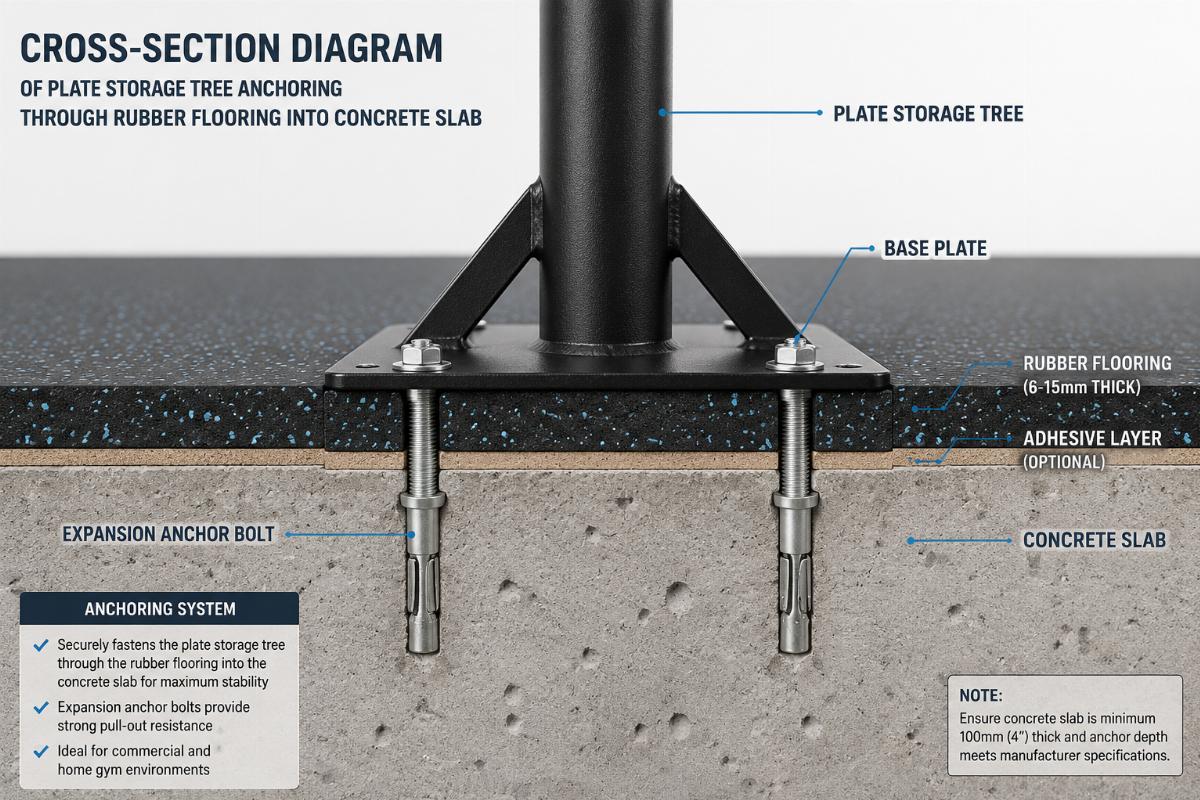
Rubber flooring over concrete — This is the most common CrossFit box floor. The rubber mat absorbs some impact but also isolates the tree base from the concrete slab, meaning friction alone cannot hold the tree. Through-bolting into the concrete beneath the rubber is the only reliable method. The tree base must have pre-drilled anchor points, and the bolts must penetrate past the rubber layer into solid concrete with adequate embedment depth.
Direct concrete floor — If the box uses exposed concrete (less common but seen in industrial conversions), wedge anchors or epoxy-set anchors into the tree base plate provide rigid fixation. The key is that the base plate must be steel of sufficient thickness to distribute load without flexing.
For walls, L-bracket anchoring to studs or masonry adds lateral stability, particularly for taller multi-tier plate storage tree units. A tree loaded with plates across four or five peg levels becomes top-heavy; without wall restraint, a strong lateral pull on a lower peg can generate enough torque to tip the unit.
I once reviewed a deployment where a box owner had simply placed four plate storage trees on rubber flooring without any anchoring, assuming the weight of the plates would keep them stable. During a competition-style WOD with rapid plate changes, one tree shifted forward as an athlete pulled a loaded barbell away. Nobody was hurt, but the tree slid nearly a full meter. The fix was straightforward — through-bolting — but it required emptying the trees, repositioning, and cutting access holes in the rubber mat. [NEED_CITE: equipment anchoring standards for dynamic load environments per EN 20957 or equivalent]
Peg Configuration: Matching Tree Specs to Your Plate Inventory
A plate storage tree is only as useful as its peg layout matches the plates your box actually programs with. Mismatched peg spacing, diameter, or count creates friction that slows down every WOD.
This is a detail that gets surprisingly little attention during procurement. Buyers often focus on the overall frame — height, number of tiers, finish — and treat pegs as a generic feature. But in a CrossFit box, the peg configuration directly affects how fast athletes can load and unload, how cleanly plates sit, and whether bumper plates of different weights interfere with each other on the same peg.
The key variables in plate storage tree peg design are:
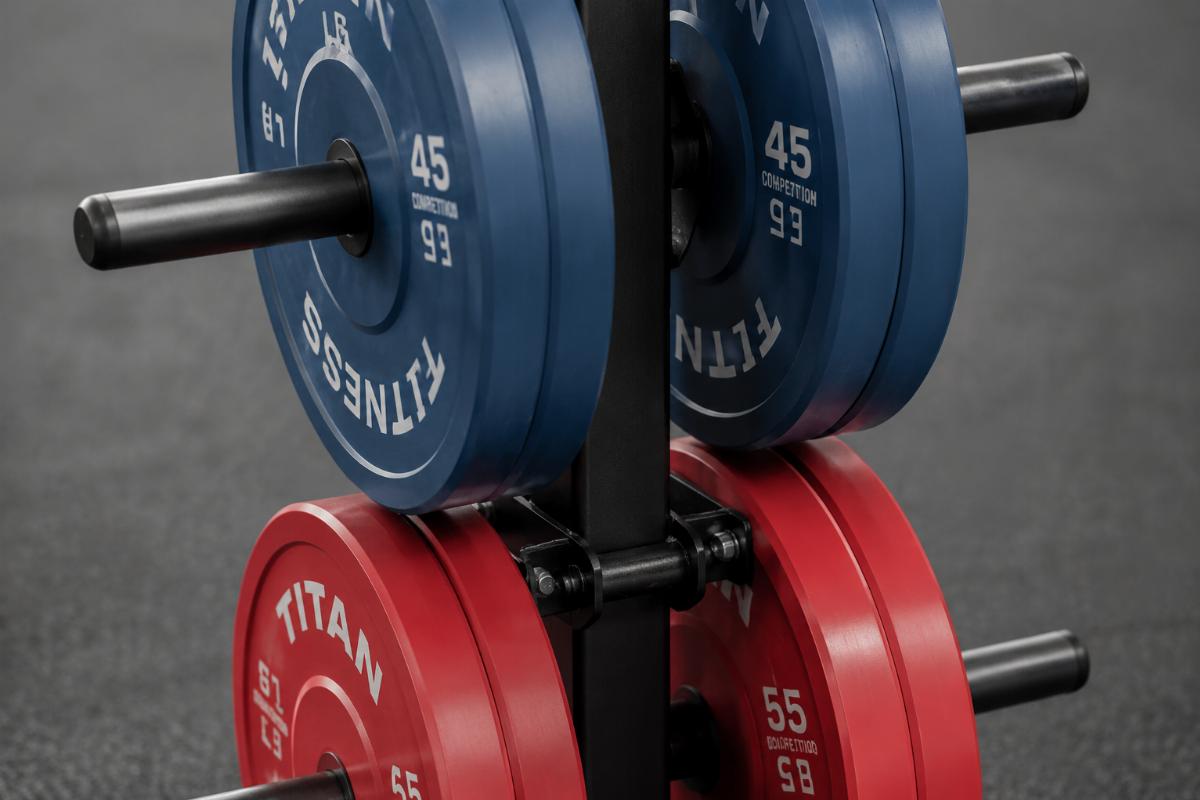
Peg diameter — Must match the sleeve inner diameter of the plates you use. Standard Olympic bumper plates have a sleeve opening that requires a peg diameter in a specific range. Too tight, and athletes struggle to slide plates on and off under time pressure. Too loose, and plates wobble, tilt, and can slide off if the tree is bumped. [NEED_CITE: Olympic plate sleeve diameter standards and compatibility with storage peg specifications]
Peg length — Determines how many plates of a given weight can stack on a single peg. For a high-volume CrossFit box that runs multiple classes per day with full plate sets, peg length must accommodate the full complement of each weight without overhang.
Peg spacing (vertical) — The vertical distance between pegs on a multi-tier tree must account for the largest plate diameter in your inventory. If you stock large-diameter technique plates or fractional plates alongside standard bumpers, the spacing must prevent interference between tiers.
Peg count per tier — Some plate storage tree designs offer single pegs per tier; others offer dual or even triple pegs. For a box with high member volume, dual pegs per tier allow separation by weight category (e.g., competition bumpers on one peg, training bumpers on the other), which speeds up plate selection during WODs.
A box owner in the UK contacted me after receiving a shipment of plate storage trees where the peg diameter was slightly undersized for their competition bumper plates. The plates fit, but with noticeable friction. During a timed chipper, athletes were losing seconds per plate change — across a full class, that added up to a meaningful drag on workout flow. The solution was to swap the peg sleeves to a slightly larger diameter specification. [NEED_CITE: plate storage peg dimension compatibility guidelines for competition bumper plates]
When I help buyers spec a plate storage tree order, I always ask for their full plate inventory list — every weight, every type, every diameter. The peg configuration is then matched to that inventory, not to a generic assumption.
Common Deployment Mistakes and How to Fix Them Post-Install
Most plate storage tree deployment errors are correctable after installation — but the longer you wait, the more they cost you in workflow friction and safety risk.
Having reviewed dozens of box layouts and walked through post-install fixes, I can list the mistakes that show up again and again:
Mistake 1 — All trees on one wall. As discussed, this creates a single-point congestion zone. Fix: relocate one or two trees to a secondary position near the open floor or adjacent training zone. This may require re-anchoring and patching the original anchor points, but the workflow improvement is immediate.
Mistake 2 — No anchoring on rubber flooring. The tree relies on friction and plate weight for stability. Under CrossFit-level dynamic loading, this is insufficient. Fix: through-bolt into the concrete slab beneath the rubber. Cut access holes in the mat, drill, anchor, then seal around the bolt heads.
Mistake 3 — Trees placed inside rig clearance zones. The rig is the heart of a CrossFit box, and athletes move in and out of it constantly. A plate storage tree positioned too close to the rig creates a collision risk during barbell transitions. Fix: maintain a clear buffer zone between the rig perimeter and any plate storage tree. The exact distance depends on your rig configuration and the types of lifts performed, but the principle is that no athlete should have to navigate around a tree while carrying a loaded barbell.
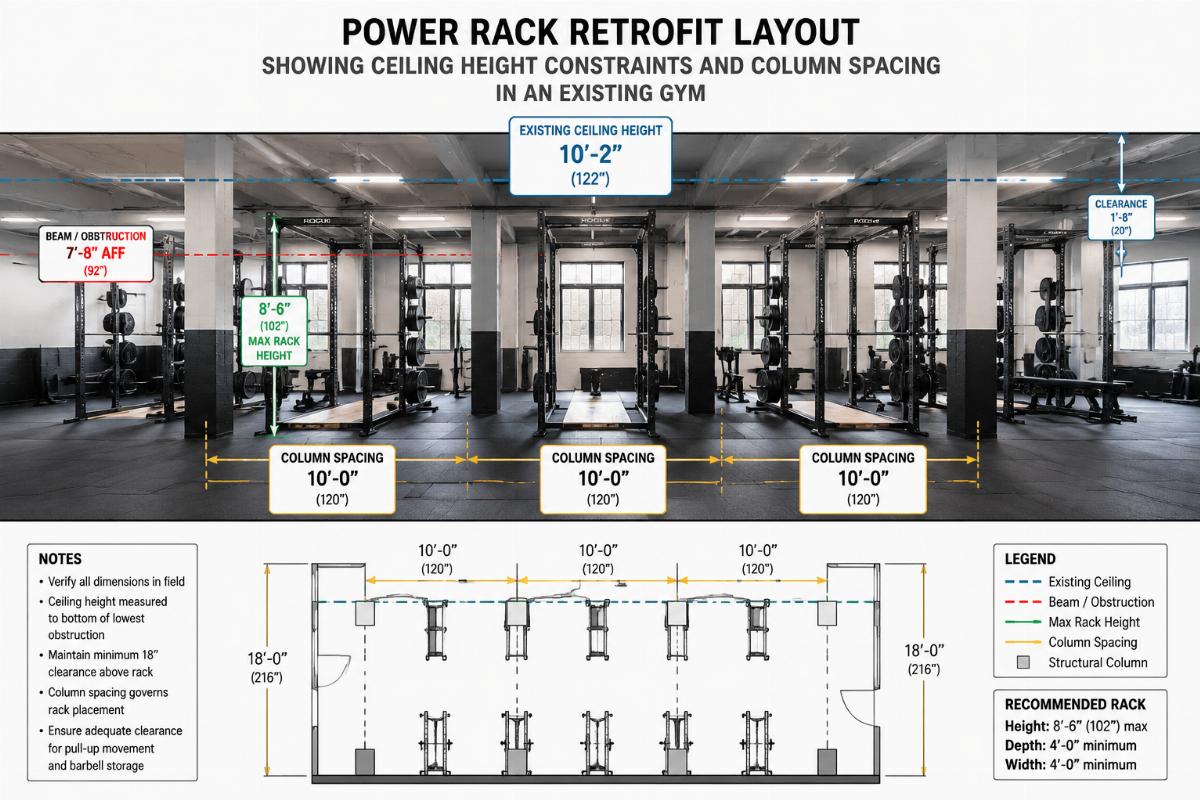
Mistake 4 — Ignoring ceiling height for tall trees. Some plate storage tree models extend to full standing height with five or six tiers. In a box with lower ceiling clearance — particularly in converted warehouse spaces — a tall tree can interfere with overhead movements or rope climb stations nearby. Fix: verify ceiling height against tree height during planning, and opt for a lower-profile multi-tier design if clearance is tight.
Mistake 5 — Uniform peg spacing regardless of plate sizes. If the box uses a mix of standard bumpers, technique plates, and fractional plates, uniform peg spacing can cause smaller plates to rattle or larger plates to contact adjacent tiers. Fix: specify variable peg spacing matched to your plate diameter range, or use adjustable peg sleeves if the plate storage tree design supports them. [NEED_CITE: equipment deployment error correction guide for functional training facilities]
A buyer in the Middle East had deployed a full set of plate storage trees in a new box and noticed within weeks that two trees near the warm-up area were developing a lean. Investigation revealed the floor was not perfectly level — a common situation in converted spaces — and the trees had not been shimmed during installation. The fix involved lifting each tree, inserting precision shims under the base plate to achieve level, and then re-anchoring. A simple step that should have been part of the initial install.
Conclusion
Plate storage tree deployment in a CrossFit box is a layout engineering problem, not an afterthought. Treat the plate storage tree as a node in your WOD traffic system. Map your movement patterns first, anchor for dynamic intensity, match peg configuration to your actual plate inventory, and audit your layout after the first few weeks of real programming. The plate storage tree that is deployed with this discipline disappears into the flow of the box — exactly as it should.