Preventive Maintenance Schedule for Kettlebell Set – Wholesale Supplier
Most gym owners assume kettlebells are "maintenance-free" until the first handle causes a blister or the base starts flaking rust.
A proper Kettlebell Set Preventive Maintenance schedule must include: pH-neutral cleaning after every use, immediate drying protocols, weekly coating integrity checks in humid climates, off-ground storage with ventilation spacing, and quarterly handle texture assessments — because environmental factors (humidity, chlorine-based disinfectants, reactive flooring) degrade kettlebells far faster than workout intensity alone.
I still remember walking into a commercial gym in São Paulo, less than half a year after opening, where the owner was furious about a full rack of kettlebells showing handle peeling and base corrosion. He filmed the damage and blamed the casting quality. What I found on the floor told a different story: a bucket of chlorine-based disinfectant sitting next to the rack, a mop used to wipe down equipment without a single dry towel in sight, and a storage room with no dehumidifier despite the coastal humidity. The iron never stood a chance. That shipment cost us in replacement parts and return freight, and it taught me something I now build into every order: selling equipment without a maintenance protocol is just pre-paying for warranty claims [NEED_CITE: root cause distribution of fitness equipment corrosion claims in tropical climates].
Let me walk you through what actually works — broken down by the real failure modes we see across different climates and facility types.
Why Do Kettlebells Rust or Wear Out Faster Than Expected?
The short answer: it is almost never the workout. It is the cleaning agent, the humidity, and the floor.
Most facility managers treat kettlebells the same way they treat treadmills — wipe them down with whatever disinfectant is on hand and push them into a corner. But kettlebells are fundamentally different. They sit directly on the floor, they get gripped with sweaty hands constantly, and their coating (or bare cast iron) is in continuous contact with moisture, salts, and chemical residues [NEED_CITE: corrosion mechanisms in cast iron fitness equipment exposed to sweat and cleaning agents].
Here is what we observe across different environments:
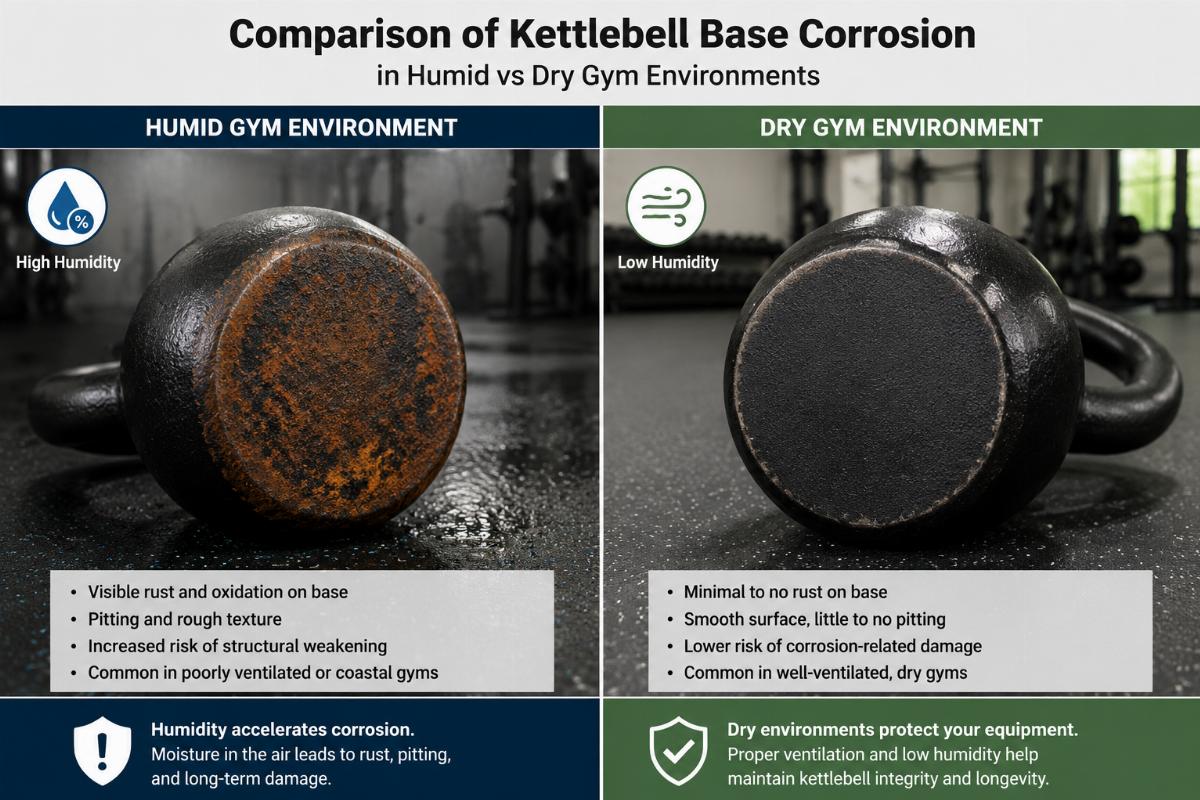
Coastal and tropical facilities face the most aggressive conditions. High ambient humidity combined with chlorine-based or acidic cleaning solutions accelerates oxidation dramatically. We have seen bare cast iron kettlebells develop visible base corrosion in a matter of months in these settings — not years. The chlorine reacts with the iron surface, and without immediate drying, the moisture sits in the microscopic pores of the casting.
Dry, dusty environments present a different problem. In facilities with rough concrete flooring and no rubber mats, the abrasive contact wears through powder coatings on the kettlebell base. Once the coating is breached, the exposed iron corrodes faster than if it had been bare all along — because the coating edge traps moisture against the metal [NEED_CITE: coating breach acceleration effect on underlying substrate corrosion].
High-traffic shared facilities — hotel gyms, apartment fitness centers, boutique studios — deal with cumulative sweat residue. If members do not wipe the handles after use, or if staff clean with a damp cloth but do not dry, the salt and urea in sweat create localized corrosion spots. These show up as dark patches on the handle, eventually accompanied by odor as bacteria colonize the pitted surface.
The common thread is not the quality of the iron. It is the absence of a structured Kettlebell Set Preventive Maintenance routine adapted to the specific environment.
What Should a Weekly and Monthly Maintenance Schedule Include?
A tiered checklist — adjusted for climate — is the only reliable way to catch degradation before it becomes a liability.
The frequency and focus of your Kettlebell Set Preventive Maintenance should scale with environmental stress. A facility in a dry, air-conditioned interior does not need the same attention as one in a humid coastal city. But every facility needs a baseline protocol [NEED_CITE: preventive maintenance frequency guidelines for commercial free weight equipment per environmental conditions].
Here is the framework we recommend to our commercial gym clients:
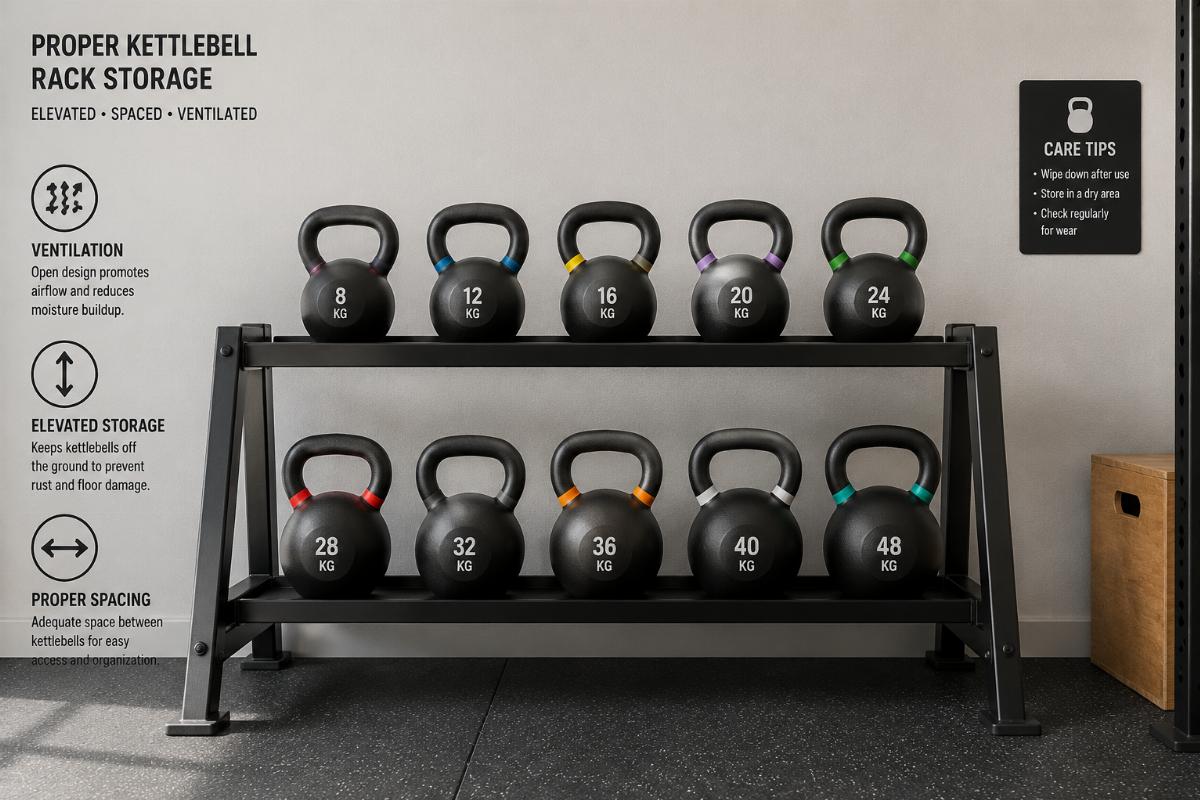
Daily (After Every Operating Session)
- Clean with pH-neutral solution only. The safe range sits between pH 6.5 and pH 7.5. Anything outside this band — especially chlorine-based, ammonia-based, or acidic disinfectants — will attack the iron or coating over time. Spray the solution onto a microfiber cloth, not directly onto the kettlebell, to prevent pooling in the handle junction.
- Dry immediately. Use a separate dry towel. Air-drying is not sufficient in any climate above moderate humidity. The handle-to-body junction and the flat base are the areas where moisture lingers longest.
- Return to rack, base down, with spacing. Do not stack kettlebells directly on top of each other without a separator. Metal-on-metal contact under humidity creates galvanic corrosion spots.
Weekly (High-Humidity Environments) or Monthly (Dry/Climate-Controlled)
- Handle texture inspection. Run your palm along the handle. Any roughness, pitting, or flaking indicates early-stage corrosion or coating failure. A smooth handle should feel consistent — any "gritty" zones need attention.
- Coating integrity check. For powder-coated or polyurethane-encased kettlebells, visually inspect the base and the lower body for chips, scratches, or lifting edges. A simple coin-edge test along the coating surface can reveal subsurface lifting that is not yet visible [NEED_CITE: non-destructive coating adhesion field test methods for fitness equipment].
- Base flatness check. Place the kettlebell on a known-flat surface. If it rocks or wobbles, the base has worn unevenly — a sign of abrasive floor contact or coating loss.
Quarterly
- Deep inspection and rotation. For kettlebells stored in sets, rotate positions so that units at the bottom of stacks or in high-traffic zones get evaluated. Check for any odor emanating from the handle area — this indicates bacterial colonization in micro-pits.
- Protective treatment application. In humid climates, a light food-grade mineral oil wipe on bare cast iron handles can provide a temporary moisture barrier. This is not necessary for powder-coated or polyurethane finishes.
A gym operator in Southeast Asia once told me that within a few months of opening, members were complaining about kettlebell handles smelling and leaving black marks on their hands. The root cause was not the material — it was the absence of a drying step in their cleaning routine. Sweat residue accumulated, bacteria thrived in the micro-texture of the handle, and the problem compounded with every passing week. Once they added a mandatory dry-towel step and switched to a neutral cleaner, the complaints stopped.
How to Store Kettlebells to Prevent Bottom-Side Corrosion?
The floor is the enemy. If your kettlebells sit directly on concrete, rubber mats, or any moisture-trapping surface, the base will corrode — regardless of coating.
This is the most overlooked element of any Kettlebell Set Preventive Maintenance program. Facility managers focus on the handles — because that is what members touch — but the base is where silent damage accumulates. The mechanism is simple: ground-level humidity rises, especially at night when temperatures drop, and condensation forms between the kettlebell base and the floor. If the floor is reactive (certain rubber compounds, untreated concrete, or moisture-permeable surfaces), chemical interaction accelerates the process [NEED_CITE: floor material reactivity with cast iron and coated fitness equipment bases].
Storage Principles That Actually Work
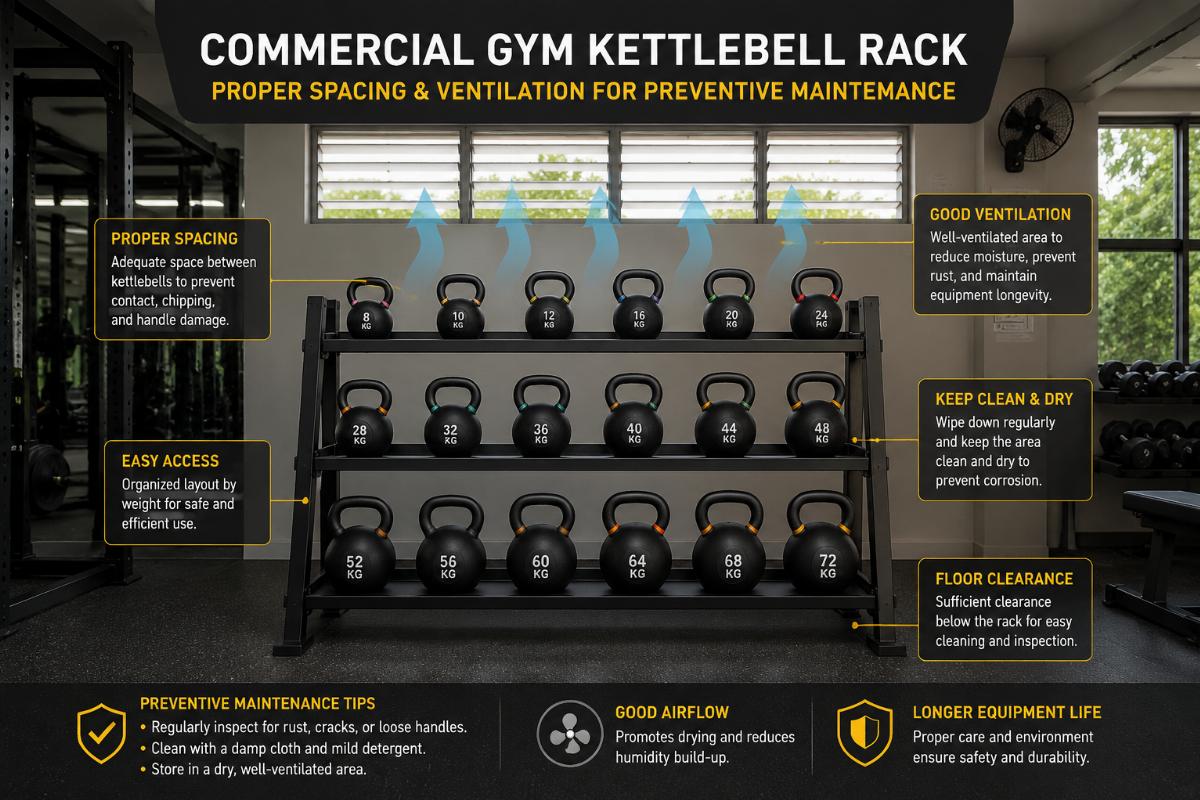
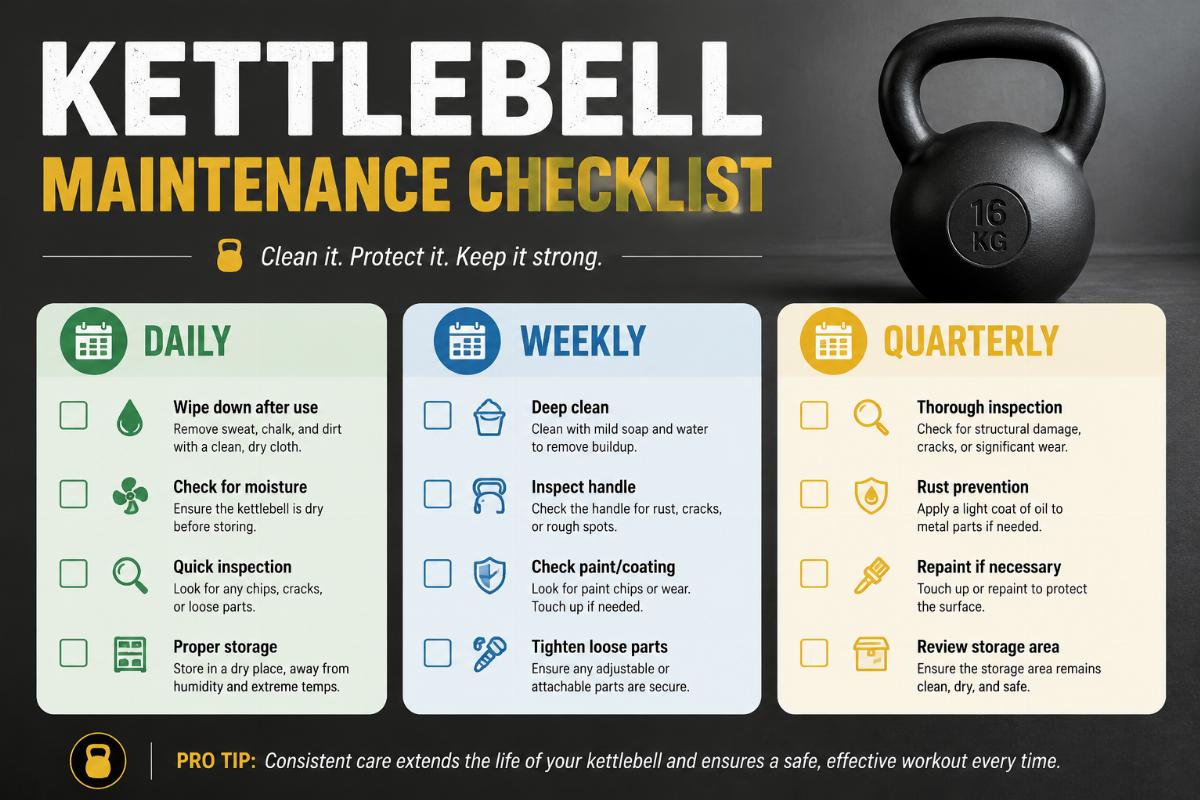
Elevated storage. Kettlebells should be stored on a rack with a minimum clearance from the floor. This allows air circulation beneath the base and prevents moisture pooling. A dedicated kettlebell rack with individual slots is ideal — it also prevents metal-on-metal contact between units.
Ventilation spacing. Do not push kettlebells tightly together on a shelf. Leave at least a finger-width gap between units to allow air movement. In humid environments, stagnant air between touching surfaces creates a micro-climate where condensation persists long after the room appears dry.
Avoid reactive flooring contact. Certain rubber floor mats contain sulfur compounds or plasticizers that can chemically interact with iron and some coating types over extended contact. If kettlebells must be placed on the floor during use, ensure the mat material is verified as non-reactive with metals. We have seen cases where the rubber mat itself left permanent discoloration and pitting on the kettlebell base after only a few months of contact.
Periodic rotation and inspection. In storage, flip or rotate kettlebells periodically so that any single contact point is not under sustained pressure and moisture exposure. This is especially important for coated kettlebells, where prolonged pressure on one spot can compromise the coating adhesion over time.
Climate-specific adjustments. In high-humidity regions, consider using silica gel packs or a small dehumidifier in the storage area. In dry, dusty regions, the priority shifts to preventing abrasive dust accumulation on the base — a periodic wipe with a dry cloth prevents dust from acting as an abrasive during placement and removal.
A CrossFit facility in the Middle East learned this the hard way. Their kettlebells were stored on a bare concrete floor in a warehouse-style space with significant dust infiltration. The combination of dust abrasion and occasional ground-level moisture caused the powder coating on the bases to wear through, exposing bare iron. Within a short period, the bases were corroding, and the rough surface was scratching their flooring. The fix was straightforward: elevated rack storage with individual slots, a floor mat swap to a verified non-reactive material, and a weekly dry-wipe routine for the bases.
When to Retire vs. Refurbish a Damaged Kettlebell?
There is a clear threshold where maintenance stops being cost-effective and liability begins. Knowing that line is part of the Kettlebell Set Preventive Maintenance discipline.
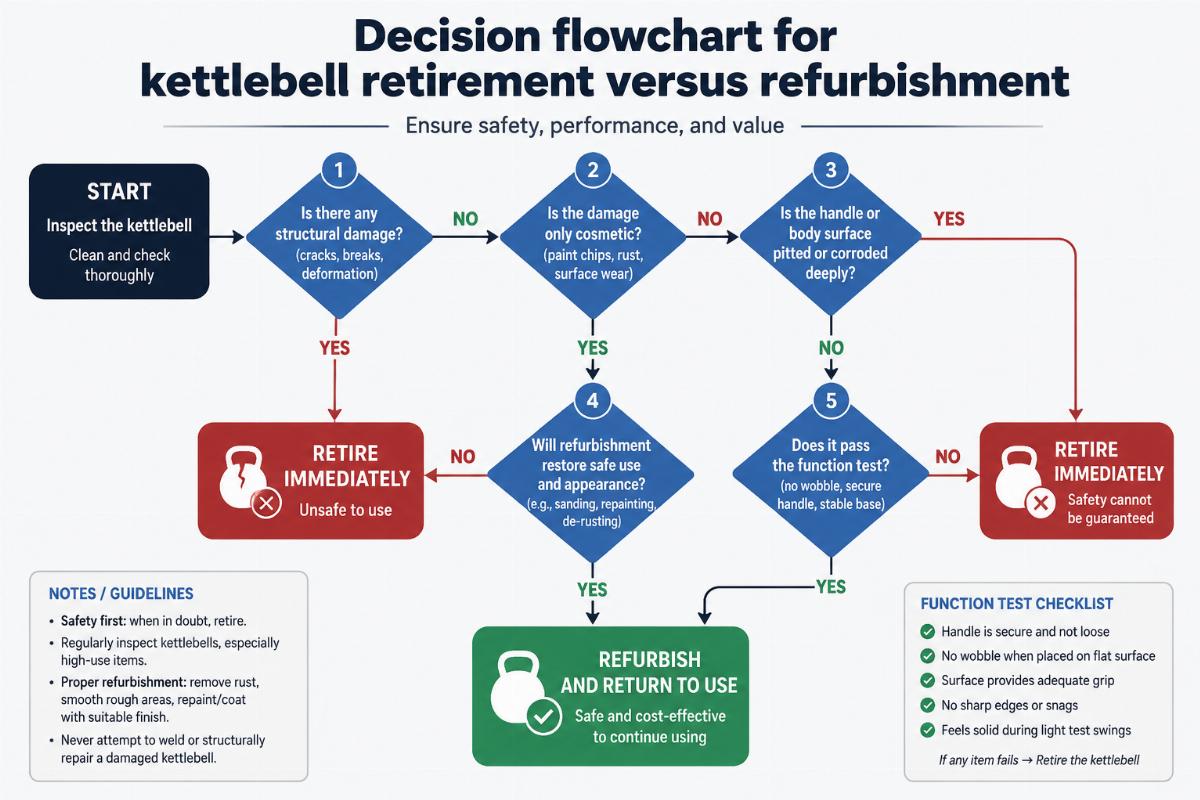
Not every damaged kettlebell needs to be replaced. But not every damaged kettlebell should be kept in service either. The decision depends on three factors: handle safety, coating breach depth, and structural integrity.
Handle Slippage Risk
If the handle has developed noticeable pitting, roughness, or uneven wear that affects grip security, the kettlebell must be retired immediately. A compromised handle during a swing, snatch, or clean is a direct injury risk — the kettlebell can slip from the athlete’s hand mid-motion. No amount of cleaning or oiling will restore a pitted handle to safe condition. This is a non-negotiable retirement trigger.
Coating Breach Assessment
For coated kettlebells (powder-coated or polyurethane-encased), the critical question is whether the breach is superficial or deep. Surface scratches that do not reach the iron substrate can be monitored — they are cosmetic. But any chip, crack, or lift that exposes the underlying cast iron requires removal from service. Once iron is exposed, corrosion will spread beneath the surrounding coating through capillary action, and the damage will accelerate far beyond the original breach point [NEED_CITE: subsurface corrosion propagation under compromised protective coatings on iron substrates].
Small, isolated breaches on a kettlebell body (not the handle) can sometimes be addressed with a touch-up coating application, but this is only viable if the breach is caught early and the surrounding coating is still fully adhered. If the coating is lifting in multiple areas or the breach is near the handle junction, retirement is the safer call.
Structural Integrity
Cracks, deformations, or significant weight loss from corrosion are immediate retirement conditions. These are rare in quality kettlebells but can occur if units have been subjected to extreme abuse, dropped repeatedly on hard surfaces from height, or left to corrode unchecked for extended periods. A kettlebell that has lost structural mass from corrosion is unpredictable under load.
The Cost Calculation
Facility operators often hesitate to retire kettlebells because of replacement cost. But consider the alternative: a member injury from a handle slip during a dynamic movement, or a coating failure that spreads to adjacent units in storage. The liability exposure and reputational cost far exceed the replacement price of a single unit. A disciplined Kettlebell Set Preventive Maintenance program includes clear retirement criteria — and the documentation to support those decisions.
This is also where the choice of coating type at the point of purchase matters significantly. Bare cast iron offers the best grip feel but requires the most frequent maintenance in any humid environment. Powder coating provides a strong moisture barrier but is vulnerable to impact chipping on the base. Polyurethane encasement offers the highest corrosion resistance and floor protection but adds diameter and changes the grip profile. Matching the coating type to the facility’s environment and maintenance capacity is the most effective form of preventive maintenance — because it happens before the kettlebell ever arrives.
Conclusion
Kettlebell longevity is determined more by environment and care routine than by usage intensity. A disciplined Kettlebell Set Preventive Maintenance program — covering pH-neutral cleaning, immediate drying, climate-adjusted inspection frequency, elevated storage, and clear retirement thresholds — prevents the corrosion, handle degradation, and coating failures that drive premature replacement costs and liability exposure. Match your coating selection to your climate at the point of purchase, and the maintenance burden drops accordingly.