Rubber Coated Dumbbell Set for Military Base Strength Facilities | OEM Manufacturer
Thicker rubber does not mean better dumbbells for military use—excess coating shifts the center of gravity and ruins grip feel under high-repetition conditions.
Military base strength facilities require rubber coated dumbbell sets engineered for continuous multi-user access, climate-specific rubber compound durability, knurling standards aligned with functional training demands, and space-efficient rack configurations that differ fundamentally from commercial gym layouts. Procurement must prioritize material verification, weight-range distribution logic, and aisle-width planning over unit price alone.
I still remember the shipment that came back in photos. A Southeast Asian defense client opened crates of rubber coated dumbbell sets at a tropical base facility, and within months the coating turned sticky, cracked along the seam, and gave off a sharp chemical odor. The rubber compound we used was standard commercial-grade—perfectly fine for an air-conditioned fitness chain in Europe, but completely unsuitable for a non-climate-controlled training hall where ambient temperature and humidity stayed elevated year-round. That batch taught me something no material datasheet could: military environments demand formulation-level customization, not just spec-sheet compliance. [NEED_CITE: rubber compound degradation mechanisms under tropical heat and humidity exposure]

Let me walk through what actually matters when specifying a rubber coated dumbbell set for military base strength facilities, from rubber chemistry to rack footprint.
Why Military Base Gyms Need Different Dumbbell Specs Than Commercial Facilities?
Military strength facilities operate under conditions that commercial gyms simply do not face: near-continuous usage cycles, minimal climate control in many regions, and a user base that trains with higher intensity and less equipment care.
In a typical commercial gym, dumbbells see sequential use—one member grabs a pair, trains for twenty to thirty minutes, racks them. In a military base facility, especially during unit physical training windows, the same dumbbells may cycle through dozens of hands within a single hour, with users dropping them on rubber flooring, dragging them across concrete, or leaving them exposed to outdoor air when training areas are semi-open. [NEED_CITE: usage frequency and equipment wear patterns in military versus commercial fitness environments]
The rubber coated dumbbell set must therefore survive impact frequencies that would be considered abnormal in a commercial setting. Hex-shaped rubber coated designs help prevent rolling on uneven surfaces common in field-adjacent training zones, while the rubber compound itself must resist compression set—the permanent deformation that occurs when a material is repeatedly compressed and fails to rebound.
Knurling depth presents another divergence. Commercial gym users often prefer moderate knurling for comfort during longer sets. Military functional training programs, however, emphasize high-repetition conditioning circuits where grip security under sweat is non-negotiable. The knurl pattern on a rubber coated dumbbell set destined for military use needs deeper, more aggressive spacing—enough to bite through chalk and sweat, but not so sharp that it tears callused skin during extended pull-up or farmer-walk protocols. [NEED_CITE: knurling depth standards and grip performance under high-sweat conditions]
I supplied a rubber coated dumbbell set to a Southeast Asian military training compound where the facility had no air conditioning and daytime temperatures regularly exceeded typical indoor comfort thresholds. The initial order used a standard SBR-based rubber compound. Within a short cycle, the coating showed surface tackiness and micro-cracking near the handle junction. We reformulated with a compound adjusted for higher thermal stability and UV resistance, and the replacement batch held up through extended service. The lesson: military procurement cannot copy-paste commercial specifications.

What Rubber Compound Works Best for Tropical and Desert Military Bases?
The rubber formulation must match the deployment climate—heat, humidity, UV exposure, and ozone levels—because a compound optimized for temperate indoor use will fail prematurely in extreme environments.
Rubber coated dumbbell sets rely on the compound’s ability to absorb impact, resist deformation, and maintain surface integrity over thousands of cycles. The Shore A hardness of the rubber directly affects both drop protection and feel. Softer compounds absorb impact well but deform faster under repeated loading; harder compounds resist deformation but transmit more shock to the floor and generate more noise. [NEED_CITE: Shore A hardness selection logic for impact-absorbing rubber in fitness equipment]
For tropical military bases—think Southeast Asia, parts of Africa, coastal Latin America—the primary enemies are heat, humidity, and microbial growth. Standard rubber compounds in these conditions can develop surface tackiness, emit volatile organic compounds, and become breeding grounds for mold in crevices where moisture accumulates. The formulation needs enhanced thermal stability, hydrolysis resistance, and ideally an antimicrobial additive integrated into the compound rather than applied as a surface coating that wears off.
For desert military installations—Middle East, North Africa, Central Asia—the threats shift. Intense UV radiation breaks down rubber polymer chains, causing surface chalking, cracking, and eventual flaking. Ozone levels in arid, high-altitude desert environments accelerate oxidative degradation. The rubber compound for a rubber coated dumbbell set in these regions must include UV stabilizers and ozone-resistant polymers, with carbon black or equivalent pigmentation providing additional photoprotection. [NEED_CITE: rubber degradation mechanisms under UV and ozone exposure in arid climates]
A Middle East military client once received a rubber coated dumbbell set with a light-colored rubber compound marketed as "premium." The aesthetic looked excellent in the showroom. But after a few months in a semi-open training area with direct sunlight exposure, the lighter pigment offered less UV protection, and the surface began to chalk and crack noticeably faster than darker-compound equivalents. We switched subsequent orders to a dark-pigmented, ozone-resistant formulation, and the durability improved substantially.
Verification matters. Before committing to a full order, procurement should request accelerated aging test data—thermal aging cycles, UV exposure hours, and ozone resistance ratings—rather than relying on generic material certificates. [NEED_CITE: accelerated aging test protocols for rubber fitness equipment components]

How to Configure Weight Ranges for Military Strength Training Programs?
Weight distribution in a military rubber coated dumbbell set should follow functional training demand patterns, not the balanced gradient typical of commercial gyms.
Commercial gym dumbbell racks usually progress in uniform increments across a broad range, assuming diverse user goals—bodybuilding, general fitness, rehabilitation. Military strength training programs, by contrast, cluster around specific physical readiness objectives: muscular endurance through high-repetition lighter loads, functional strength through moderate-to-heavy compound movements, and occasional maximal effort work.
A typical military rubber coated dumbbell set configuration concentrates volume in the light-to-moderate range for conditioning circuits, with strategic heavy increments for strength development. The lighter pairs see far more total repetitions across a training cycle, so having multiple pairs of the same weight reduces bottlenecks during unit PT sessions. The heavier pairs, used less frequently per individual but essential for progressive overload, need fewer duplicates but must be present. [NEED_CITE: weight distribution patterns in military physical training programming]
The increment spacing also differs. Commercial setups often use uniform jumps. Military configurations benefit from tighter increments in the moderate range—where most functional training occurs—allowing finer load progression without requiring a massive rack footprint.
Handle diameter is another consideration unique to military populations. Military personnel tend to have larger hand dimensions on average, and glove use is uncommon during dumbbell training. The handle on a rubber coated dumbbell set for military use should accommodate a full-power grip without the fingers overlapping excessively, which means a slightly larger diameter than typical commercial offerings. The knurling, as noted earlier, must be aggressive enough to maintain grip security during high-rep, high-sweat circuits.
I worked with a defense facility planner on a rubber coated dumbbell set configuration for a new garrison gym. The initial spec called for a standard commercial weight spread. After reviewing the unit’s PT curriculum—which emphasized metabolic conditioning circuits with moderate loads and maximal-strength sessions with heavier pairs—we restructured the order to double the quantity of light-to-moderate pairs and add tighter increments in the middle range, while keeping the top-end pairs at single-pair quantities. The result was a rack that served the actual training demand without wasted inventory or mid-session equipment shortages.

How Much Space Does a Complete Dumbbell Rack System Require in a Military Facility?
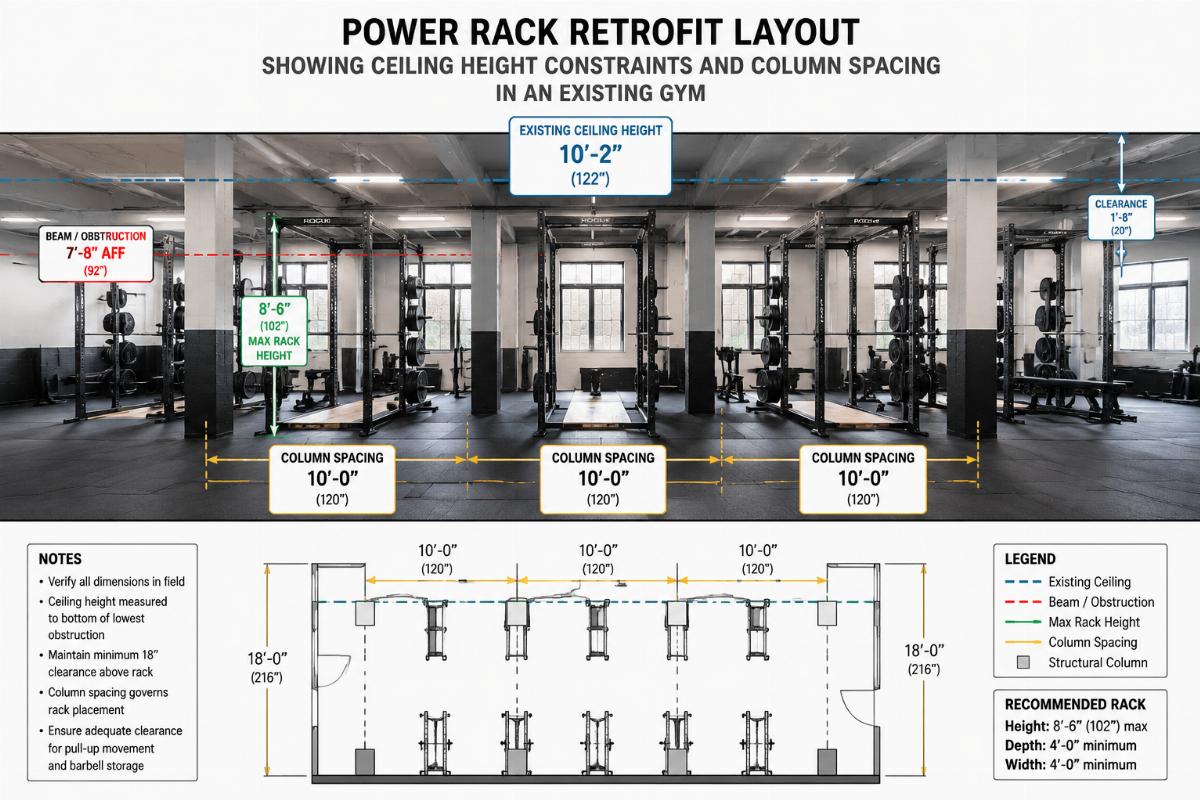
Space planning for a military rubber coated dumbbell set rack system must account for simultaneous multi-user access, safe operating clearance, and traffic flow—not just the footprint of the rack itself.
Commercial gym designers often maximize rack density to fit more equipment into limited square footage. Military facilities cannot follow this approach. During unit physical training, multiple service members may access the dumbbell rack simultaneously, and the movements performed—farmer’s walks, lunges, overhead presses—require clearance space around the user that exceeds typical commercial gym spacing.
A single three-tier dumbbell rack unit holding a full rubber coated dumbbell set typically occupies a base footprint of a few square meters. However, the functional space requirement includes approach aisles on at least one side—wide enough for a user to step back with a loaded pair without colliding with someone behind them—and lateral clearance between adjacent rack stations so that two users can load and unload simultaneously without interference. [NEED_CITE: spatial planning standards for free-weight zones in high-occupancy fitness facilities]
The aisle width between rack rows becomes critical. In a commercial setting, narrow aisles are acceptable because users typically access equipment sequentially. In a military setting, where a squad of trainees may hit the rack at the same time, insufficient aisle width creates congestion, increases drop-risk, and slows down circuit transitions—directly impacting training efficiency.
Flooring interaction also matters. Military facilities often use rolled rubber flooring or poured rubber surfaces. The rubber coated dumbbell set must be compatible with these surfaces—the coating compound should not mark, stain, or chemically interact with the flooring material under repeated impact. Rack base design should include floor-protective feet or a continuous base plate to distribute load and prevent point-loading damage.
When planning a rubber coated dumbbell set layout for a military facility, I recommend mapping the rack position relative to the functional training zone it serves. The rack should be positioned so that users can grab a pair and immediately step into open space for their first movement, rather than having to navigate through other equipment or traffic. This simple layout principle reduces congestion and accident risk significantly.

What OEM Verification Steps Ensure Long-Term Durability?
Before placing a bulk order for a rubber coated dumbbell set, military procurement must demand material-level verification—not just finished-product inspection—because coating failures originate at the compound formulation stage.
The most common failure modes in rubber coated dumbbells—cracking, tackiness, odor, delamination from the core—are all traceable to rubber compound quality and the bonding process between rubber and the steel or cast-iron core. Visual inspection of finished dumbbells cannot detect these issues. Verification must happen at the material and process level.
Request compound-level test reports. These should cover hardness (Shore A), tensile strength, elongation at break, compression set resistance, and—critically for military deployments—accelerated aging data simulating the target climate. A supplier unwilling or unable to provide compound-level documentation is a significant risk flag. [NEED_CITE: material testing standards for rubber-coated fitness equipment durability verification]
Bonding integrity between the rubber and the core is another verification point. Poor bonding leads to delamination under repeated impact, where the rubber shell separates from the core, creating an uneven surface and compromising the dumbbell’s structural integrity. Pull-off adhesion tests or cross-section analysis of sample units can reveal bonding quality before bulk production begins.
Sample validation under simulated use conditions is essential. Request pre-production samples and subject them to drop tests, repeated compression cycles, and—if possible—environmental chamber exposure matching the deployment climate. This step catches formulation mismatches before they become a full-container problem.
At Bick, our OEM verification process for institutional and defense clients includes compound-level material certification, accelerated aging simulation matched to the deployment environment, bonding integrity checks on sample units, and pre-shipment dimensional and weight accuracy audits. We have reformulated rubber compounds specifically for tropical and desert military deployments, and our facility planning support extends to rack layout optimization for high-occupancy training environments. A rubber coated dumbbell set built for military use is not a catalog item—it is a specification-driven project, and the OEM partner must treat it as one.

Conclusion
Military base strength facilities demand rubber coated dumbbell sets built to a fundamentally different standard than commercial gym equipment—climate-matched rubber compounds, aggressive knurling for high-sweat grip security, weight distributions aligned with functional training demand, and rack layouts designed for simultaneous multi-user access. Procurement officers who treat these as catalog items rather than specification-driven projects will face premature coating failures, training bottlenecks, and costly replacements. The right OEM partner validates at the compound level, not just the finished-product level, and supports space planning alongside manufacturing.