Seated Leg Curl Duty Cycle College Weight Rooms Wholesale Supplier
Most buyers think duty cycle is a motor rating. On a plate-loaded or selectorized seated leg curl, it is the combined fatigue life of pivot bearings, cable routing, weld joints, and pad density under continuous daily rotation.
In college weight rooms running 60 to 100-plus user cycles per day, seated leg curl duty cycle is not defined by a single spec sheet number—it is the real-world intersection of structural endurance, bearing L10 life, cable safety factor, and foam compression resistance across semesters of non-stop use.
I still remember standing in the weight room of a Midwestern community college, watching the seated leg curl get hit by back-to-back users during peak afternoon hours. The strength coach asked me point-blank whether the hinge and cable system could handle that kind of rotation without going down mid-semester. At the time, I was still transitioning from assembly and field service into sales, and I realized I could talk about steel thickness all day but could not give him a verifiable answer on bearing fatigue under that specific load rhythm. That conversation pushed me to pull apart return units, cross-reference bearing catalogs, and map out exactly which components define seated leg curl duty cycle in high-traffic environments.
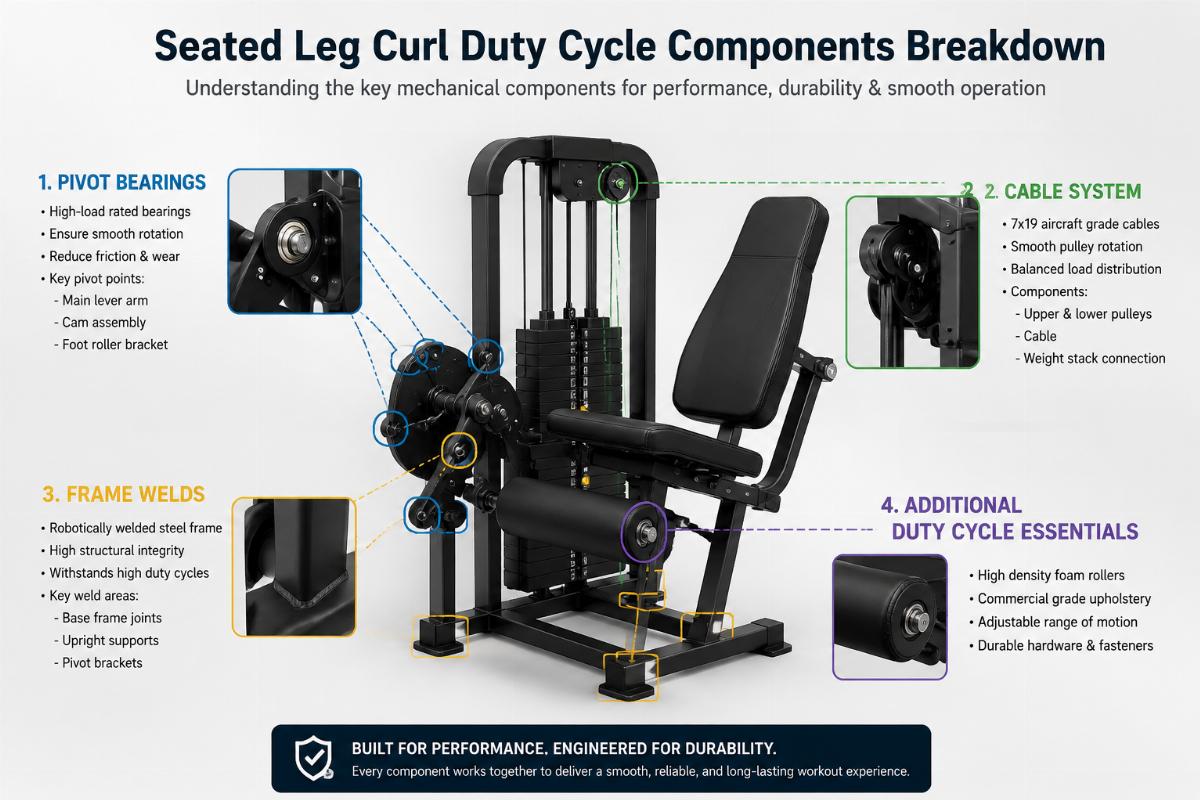
When facility directors evaluate a seated leg curl duty cycle college weight rooms wholesale supplier, they are really asking one question: which parts will fail first under 60 to 100-plus daily users, and how is the machine engineered to delay that failure?
What Exactly Is "Duty Cycle" in a Seated Leg Curl?
Duty cycle on a seated leg curl is not a single motor or hydraulic parameter—it is the aggregate endurance rating of the frame, pivot assembly, cable-pulley system, and contact surfaces under repeated daily loading.
In commercial fitness equipment standards, duty cycle is often loosely borrowed from industrial motor ratings, but on a strength machine driven by user-loaded weight stacks or plate horns, the concept shifts entirely to mechanical fatigue. The frame may remain visually intact for years, while the pivot bearing develops play, the cable frays at the pulley exit, or the thigh pad compresses to a point where users feel the support plate underneath. Each of these is a duty cycle failure, just not the kind that shows up in a glossy brochure.
According to ASTM F2216 and EN 957 testing frameworks, strength equipment is evaluated through repeated load cycles on structural welds, pivot points, and cable systems, with pass-fail thresholds tied to deformation and functional integrity rather than a single "hours of operation" number [NEED_CITE: ASTM F2216 cyclic fatigue test methodology for strength equipment]. For a seated leg curl in a college setting, the pivot bearing endures radial and axial loads every rep, the cable flexes over pulleys with each contraction, and the pad foam undergoes repeated compression—all of which accumulate fatigue independently of the frame itself.
What most buyers miss is that duty cycle is load-dependent. A machine rated for moderate commercial use may perform well in a boutique studio with 30 users a day but show early bearing wear in a university weight room running 80-plus rotations daily across multiple shifts. This is why a seated leg curl duty cycle college weight rooms wholesale supplier must be able to articulate bearing selection, cable routing geometry, and weld joint design rather than just quoting steel gauge.

Which Components Fail First in High-Traffic College Gyms?
In university weight rooms, pivot bearings and cable systems consistently degrade long before the frame shows any visible stress—often by a wide margin.
During field service visits to several community college and Division II athletic facilities, the pattern was remarkably consistent. The frame welds remained clean, the powder coat looked nearly new, yet the leg curl arm had developed noticeable lateral play at the pivot, and the cable showed localized fraying near the upper pulley. The thigh pad, meanwhile, had compressed to the point where users could feel the underlying support structure, compromising isolation and comfort.
Pivot bearings on a seated leg curl carry the full moment load of the lever arm plus the user’s resistance. Under continuous daily use, standard deep-groove bearings without adequate sealing begin to show lubrication breakdown and race wear. Bearing L10 life calculations are highly sensitive to radial load and operating speed, and in a leg curl application the load is cyclical and often exceeds the nominal rating if the lever ratio is not properly engineered [NEED_CITE: bearing L10 life calculation methodology per ISO 281 for oscillating applications]. When a seated leg curl duty cycle college weight rooms wholesale supplier selects undersized bearings to cut cost, the first symptom is usually a clicking or grinding sound at the pivot, followed by measurable arm wobble.
Cable systems fail in a different but equally predictable pattern. The cable experiences repeated bending fatigue as it routes over multiple pulleys, and the highest stress concentration occurs at the point where the cable exits the weight stack guide or enters the pivot housing. If the pulley groove diameter is too small relative to the cable diameter, bending fatigue accelerates dramatically. Industry guidance typically recommends a pulley-to-cable diameter ratio that minimizes internal wire fatigue, and cables on strength equipment are generally specified with a safety factor well above the maximum load [NEED_CITE: wire rope safety factor recommendations for fitness equipment per EN 957].
Pad foam is the third common failure point, though it is often dismissed as cosmetic. High-density foam with adequate ILD retention will maintain support over extended use, while lower-density foam compresses permanently and loses its ability to stabilize the user’s thigh—directly affecting exercise form and perceived machine quality.

How to Evaluate a Seated Leg Curl for 60–100+ Daily Users?
Evaluating a seated leg curl for heavy daily use requires looking past steel thickness to bearing specification, cable routing geometry, weld joint design, and pad foam density.
When a university recreation director or a commercial gym owner is comparing options from a seated leg curl duty cycle college weight rooms wholesale supplier, the conversation should focus on four engineering areas that directly determine long-term reliability under continuous use.
First, pivot bearing specification matters more than frame steel gauge. Ask for the bearing type, size, sealing method, and whether the manufacturer has performed fatigue testing aligned with recognized standards. Sealed bearings with adequate radial load rating for the lever moment will outlast open or lightly sealed units substantially in a high-rep environment [NEED_CITE: sealed bearing selection criteria for oscillating fitness equipment pivots].
Second, cable routing and pulley design deserve close scrutiny. The cable should route smoothly without sharp bends, and pulley grooves should match the cable diameter to avoid accelerated bending fatigue. A cable safety factor appropriately above the maximum stack load is a baseline expectation, not a premium feature.
Third, weld joint design at high-stress points—particularly where the pivot housing attaches to the main frame and where the seat adjustment mechanism mounts—determines whether the machine develops structural play over time. Fillet welds with proper penetration and stress-relieved joints resist fatigue cracking far better than intermittent or poorly accessible welds. Testing standards such as EN 957 and ASTM F2216 include cyclic loading protocols that reveal weak weld joints long before they would fail in the field [NEED_CITE: cyclic weld fatigue testing protocols per EN 957 for strength equipment].
Fourth, pad foam density and cover material affect both user experience and long-term maintenance cost. Foam specified with appropriate ILD ratings and tested for compression set will retain shape across semesters of use, while cheaper foam requires replacement within the first year in a busy facility.
| Evaluation Area | Basic Commercial Spec | Heavy-Use College Spec |
|---|---|---|
| Pivot Bearing | Standard open or lightly sealed | Sealed, load-rated for lever moment |
| Cable Safety Factor | Minimum acceptable | Substantially above max stack load |
| Weld Joint Design | Standard fillet | Stress-relieved, cyclic-tested |
| Pad Foam Density | Standard | High ILD retention, low compression set |
| Pulley-to-Cable Ratio | Functional | Optimized to reduce bending fatigue |
A Midwestern community college that transitioned from a light-duty commercial leg curl to a heavy-use spec unit reported noticeably fewer service calls within the first semester, with bearing play and cable issues essentially eliminated during the evaluation period. The initial unit cost difference was modest compared to the downtime and parts replacement savings.

What Maintenance Intervals Extend Duty Cycle in University Weight Rooms?
Quarterly bearing inspection and semi-annual cable assessment prevent the majority of unplanned downtime on seated leg curls in university weight rooms.
Even a well-engineered machine requires structured maintenance to reach its full duty cycle potential. In high-traffic college facilities, the maintenance rhythm should align with the academic calendar—pre-semester inspections, mid-semester checks, and post-semester overhauls.
Pivot bearings should be inspected quarterly for axial and radial play, lubrication condition, and seal integrity. Any detectable roughness or noise under load indicates early-stage fatigue that, if addressed promptly, can be resolved with bearing replacement before damage spreads to the pivot housing. Bearings on a seated leg curl duty cycle college weight rooms wholesale supplier’s heavy-use models should be readily available as spare parts, and replacement should be a straightforward field task.
Cable systems benefit from semi-annual visual inspection focusing on fraying, kinking, and pulley groove wear. Cables showing localized wire breaks should be replaced proactively rather than waiting for a complete failure, which in a peak-hour setting can take the machine out of service for days if parts are not stocked. Pulley wheels should also be checked for groove wear, as a worn pulley accelerates cable degradation.
Pad foam and upholstery should be evaluated each semester. Foam that has lost resilience or developed permanent compression marks should be replaced to maintain user comfort and proper exercise mechanics. Upholstery tears, if left unrepaired, allow moisture and contaminants to reach the foam core, accelerating deterioration.
A university recreation department in the southeastern United States adopted a structured quarterly maintenance protocol across its strength equipment fleet and saw a substantial reduction in mid-semester equipment outages. The seated leg curl, previously one of the most frequently serviced machines, moved to a predictable maintenance schedule with minimal unplanned intervention.

Conclusion
Seated leg curl duty cycle in college weight rooms is a systems-level endurance metric, not a single component rating.
For facility directors and distributors evaluating a seated leg curl duty cycle college weight rooms wholesale supplier, the focus must shift from surface-level specs to bearing selection, cable engineering, weld integrity, and foam durability. Machines designed around these four pillars, supported by a clear spare parts and maintenance framework, deliver substantially longer service life under the relentless daily use that defines university and high-traffic commercial environments.