Lat Pulldown Machine Duty Cycle for 24-Hour Gym Chains Wholesale
"Commercial-grade" does not mean "24-hour-grade." Most buyers discover this only after the first warranty claims arrive.
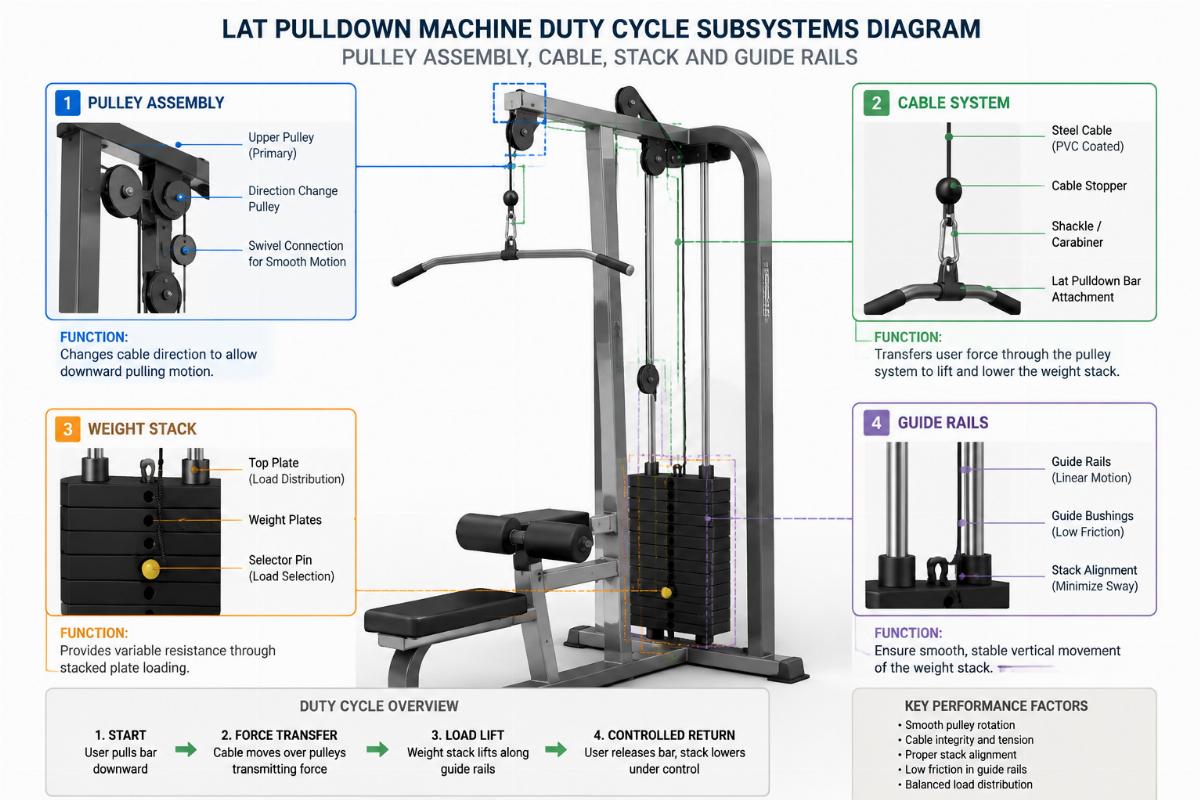
Lat pulldown machine duty cycle is the single most overlooked specification when outfitting a 24-hour gym chain. It defines how long the cable stack, pulley assembly, and guide rails survive under continuous daily operation before requiring replacement. For chains running 16+ hours per day, standard commercial configurations fail within months, not years. The duty cycle is not a single number printed on a spec sheet—it is the combined lifespan of three subsystems: the pulley bearing set, the steel wire rope, and the weight stack guide rails. Procurement teams that verify each subsystem independently avoid catastrophic mid-contract failures.
I learned this the hard way. A full container of lat pulldown machines shipped to a 24-hour fitness chain in the Middle East came back with complaints before the first year ended. The guide rails had warped, the wire ropes were fraying, and the pulley assemblies were grinding loudly. We had spec’d standard commercial-grade bearings and light-duty cables—the kind that perform perfectly in an 8-hour-per-day boutique studio. But under non-stop operation, those same components degraded rapidly. The client refused to release the final payment. That dispute forced me to rebuild our entire approach around the lat pulldown machine duty cycle, starting with component-level verification instead of relying on vague "commercial-grade" labels. [NEED_CITE: failure pattern analysis of strength equipment under extended daily operation]
Let me walk you through what actually determines the duty cycle, why standard configurations collapse under 24-hour use, and exactly which documents you need before signing off on shipment.
What Exactly Is "Duty Cycle" on a Lat Pulldown Machine?
The duty cycle on a lat pulldown machine is not a single整机 parameter—it is the shortest lifespan among three interacting subsystems: the pulley bearing set, the wire rope, and the weight stack guide rails.
Most procurement teams treat duty cycle as if it were like a motor’s rated runtime. It is not. A lat pulldown has no motor. Its "duty cycle" is entirely mechanical, determined by how many load-unload cycles each component endures before showing measurable wear. The pulley bearings rotate every single rep. The wire rope bends over those pulleys under full load. The guide rails slide under the weight stack’s lateral forces. Each subsystem degrades at its own rate, and the machine’s effective duty cycle is whichever subsystem fails first. [NEED_CITE: mechanical wear mechanisms in selectorized strength equipment]
In a standard 8-hour-per-day gym, this distinction rarely matters. Components are over-engineered for that workload. But in a 24-hour chain where peak usage can stretch across 16 or more hours with minimal idle time, the wear rate accelerates dramatically. Bearings that last years in low-traffic environments begin showing play and noise within months. Wire ropes that retain full integrity at moderate cycle counts develop core fatigue and surface fraying much sooner. Guide rails that glide smoothly in controlled testing begin to develop grooves and binding points.
The key insight is that you cannot assess duty cycle from a brochure. You must request subsystem-level data for each of the three components and cross-reference it against your actual daily operating hours and peak concurrent user count. [NEED_CITE: relationship between daily operating hours and component replacement intervals in commercial strength equipment]

Why 24-Hour Gym Chains Fail with Standard "Commercial-Grade" Equipment?
Standard commercial-grade lat pulldown machines are engineered for an 8-hour daily operating window. When deployed in 24-hour chains, their failure cycle compresses severely, often producing visible degradation within the first several months.
The term "commercial-grade" creates a false sense of security. Inside that label, there are at least two distinct tiers: one designed for typical daytime gym schedules and another built for round-the-clock operation. The difference is not in the frame tubing thickness or the upholstery quality—those are visible and easy to spec. The difference lives inside the pulley assemblies, the wire rope construction, and the bearing seal ratings. These are hidden components that buyers rarely inspect unless they know what to ask for.
A 24-hour gym chain in Southeast Asia learned this after deploying a batch of lat pulldowns across multiple locations. Within a short period, maintenance teams across several sites reported identical issues: pulley noise, cable roughness, and weight stack binding. The root cause was consistent—standard sealed bearings that were never rated for continuous thermal cycling, paired with wire ropes sized for moderate rather than relentless use. [NEED_CITE: bearing seal classification and thermal cycling endurance in fitness equipment applications]
The cost structure tells the story. The price gap between an 8-hour configuration and a 24-hour configuration is not driven by the steel frame or the paint finish. It is driven by the bearing seal grade, the wire rope tensile rating, and the guide rail surface treatment. These are precisely the areas where cost-cutting hides in plain sight. A frame that looks identical can house bearings that differ substantially in sealed contamination resistance and lubrication retention.
For chains operating around the clock, the procurement question shifts from "Is this commercial-grade?" to "Which duty cycle tier does this configuration actually support?" That question can only be answered with component-level documentation, not marketing language. [NEED_CITE: cost structure analysis of duty cycle upgrades in selectorized strength machines]

Which Components Determine Duty Cycle—and How to Verify Them?
Three components govern the lat pulldown machine duty cycle: bearing seal rating, wire rope breaking strength, and pulley assembly cycle life. Each requires independent verification through specific documentation.
The first component is the pulley bearing set. Bearings in lat pulldown machines operate under constant radial load and repetitive rotation. Their lifespan depends heavily on seal type. Open or shielded bearings allow dust and moisture ingress, accelerating grease degradation. Double-sealed bearings with rubber contact seals provide substantially better contamination protection and retain lubrication far longer. When reviewing a supplier’s specification, ask for the exact bearing seal designation. The difference between a basic shield and a full-contact double seal is not marginal—it is the difference between months and years of reliable service under heavy use. [NEED_CITE: bearing seal type classification and contamination ingress protection ratings]
The second component is the wire rope. The critical specification here is the minimum breaking force relative to the maximum stack load. Industry safety standards require a defined safety multiplier between the rated load and the rope’s breaking threshold. For 24-hour environments, the rope must also demonstrate resistance to core fatigue from repetitive bending over pulleys. A rope that meets the minimum safety threshold for a standard gym may still develop internal strand fractures prematurely under continuous cycling. Request the wire rope test certificate showing actual breaking force values, not just a generic "meets standard" statement. [NEED_CITE: wire rope safety factor requirements per ISO 20957 for selectorized strength equipment]
The third component is the weight stack guide rail system. The rails must maintain smooth linear travel under the lateral forces generated during use. Surface treatment and material hardness determine how long the rails resist groove formation and friction buildup. Chrome-plated or hardened steel rails with low-friction bushings substantially outperform basic painted or untreated steel in extended-use environments.
When I work with 24-hour chain buyers, I structure the verification around these three items as a mandatory checklist. No single component can be assumed to match the others. A machine with premium bearings but an undersized wire rope will still fail early. The duty cycle is only as strong as its weakest subsystem link.

How to Match Configuration to Your Actual Usage Pattern?
Before selecting a duty cycle tier, map your actual daily operating hours and peak concurrent user count, then work backward to determine the required bearing grade, wire rope specification, and guide rail treatment.
Many buyers make the mistake of selecting the highest available configuration across their entire fleet, regardless of location-specific usage patterns. This over-specifies machines in low-traffic sites and inflates costs unnecessarily. Others do the opposite—they standardize on the base commercial configuration across all sites and accept premature failures in their highest-traffic locations.
The rational approach is to segment your locations by usage intensity. A flagship urban location operating from early morning through late night with peak-hour queues demands a fundamentally different configuration than a suburban site with moderate midday traffic. The bearing seal grade, the wire rope breaking margin, and the guide rail surface treatment should all scale with the intensity profile.
Start by documenting the daily operating window for each site. Then estimate the peak concurrent users per machine during the busiest hours. These two figures determine the approximate daily cycle count per machine. From there, you can cross-reference the bearing manufacturer’s rated cycle life, the wire rope’s fatigue endurance profile, and the guide rail’s wear characteristics to identify the appropriate configuration tier. [NEED_CITE: methodology for estimating daily cycle counts per station in high-traffic fitness facilities]
A chain operator in the Gulf region used this approach to differentiate configurations across their portfolio. Their high-traffic downtown clubs received the highest duty cycle tier with double-sealed bearings, high-margin wire ropes, and hardened guide rails. Their lower-traffic suburban locations received a mid-tier configuration that still exceeded basic commercial grade but avoided the cost premium of the top tier. The result was a fleet that matched actual wear conditions without over-capitalizing across every unit.
This segmentation also simplifies spare parts planning. When you know which sites run the highest-duty-cycle components, you can pre-position replacement bearing kits and wire ropes at those locations, reducing downtime when service intervals arrive. [NEED_CITE: spare parts inventory optimization based on equipment duty cycle tier classification]

What Documentation Should You Require Before Shipment?
Before accepting delivery, require three mandatory documents: a pulley assembly cycle life test report, a wire rope breaking force certificate, and a complete bearing specification sheet. These form the verifiable foundation of your duty cycle claim.
Documentation is where vague "commercial-grade" promises either get substantiated or exposed. A supplier confident in their duty cycle rating will provide these documents without hesitation. A supplier who hesitates or offers only generic compliance certificates is signaling that their configuration may not withstand scrutiny.
The pulley assembly cycle life test report should document the number of continuous load-unload cycles the pulley system endured during controlled testing, along with the load magnitude used and any observable wear at the test conclusion. This report directly correlates to expected field lifespan when adjusted for your actual daily cycle count. [NEED_CITE: cycle life testing methodology for pulley assemblies in selectorized strength equipment]
The wire rope breaking force certificate must show the actual tested breaking force of the specific rope batch shipped, not a catalog specification. This allows you to verify that the safety margin above the maximum stack load meets or exceeds the required threshold. Batch-level certificates are the standard for reputable manufacturers; generic "type-tested" statements are insufficient for duty cycle verification.
The bearing specification sheet should list the exact bearing model, seal type designation, and the manufacturer’s rated service life under defined load and speed conditions. This allows your maintenance team to plan proactive replacement intervals before field failures occur.
Our factory has standardized this documentation package for all 24-hour chain orders. Every container shipping out includes these three documents as a mandatory part of the pre-shipment checklist. For OEM and ODM projects, we also provide the flexibility to configure different duty cycle tiers across the same order—allowing buyers to match specifications to their site-level usage analysis without placing separate orders. This approach has become the baseline expectation for serious chain operators who have learned that post-delivery verification is far more expensive than pre-shipment documentation. [NEED_CITE: pre-shipment documentation standards for commercial strength equipment procurement]

Conclusion
The lat pulldown machine duty cycle is not a marketing label—it is a verifiable, component-level engineering reality that determines whether your equipment survives or fails in 24-hour operation. Procurement teams that treat "commercial-grade" as sufficient will inevitably face premature failures, member complaints, and costly reactive maintenance. Those who demand subsystem-level documentation—pulley cycle life, wire rope breaking force, and bearing specifications—before shipment build fleets that perform reliably across their intended service life. Match configuration to actual usage intensity, verify every component independently, and never accept vague assurances in place of testable data.