V-Squat Trainer for High-Traffic College Gyms | Wholesale Supplier
Most facility managers think V-Squat machines are "set-and-forget" — until a pivot bushing fails mid-semester and the machine sits idle for weeks.
The real answer to extending V-Squat Trainer service life in 24/7 college weight rooms is shifting from time-based maintenance to usage-volume-based preventive replacement of pivot bushings, cables, and guide rod coatings — combined with pre-audited spare parts sourcing to avoid customs delays that turn a simple repair into a multi-week shutdown.
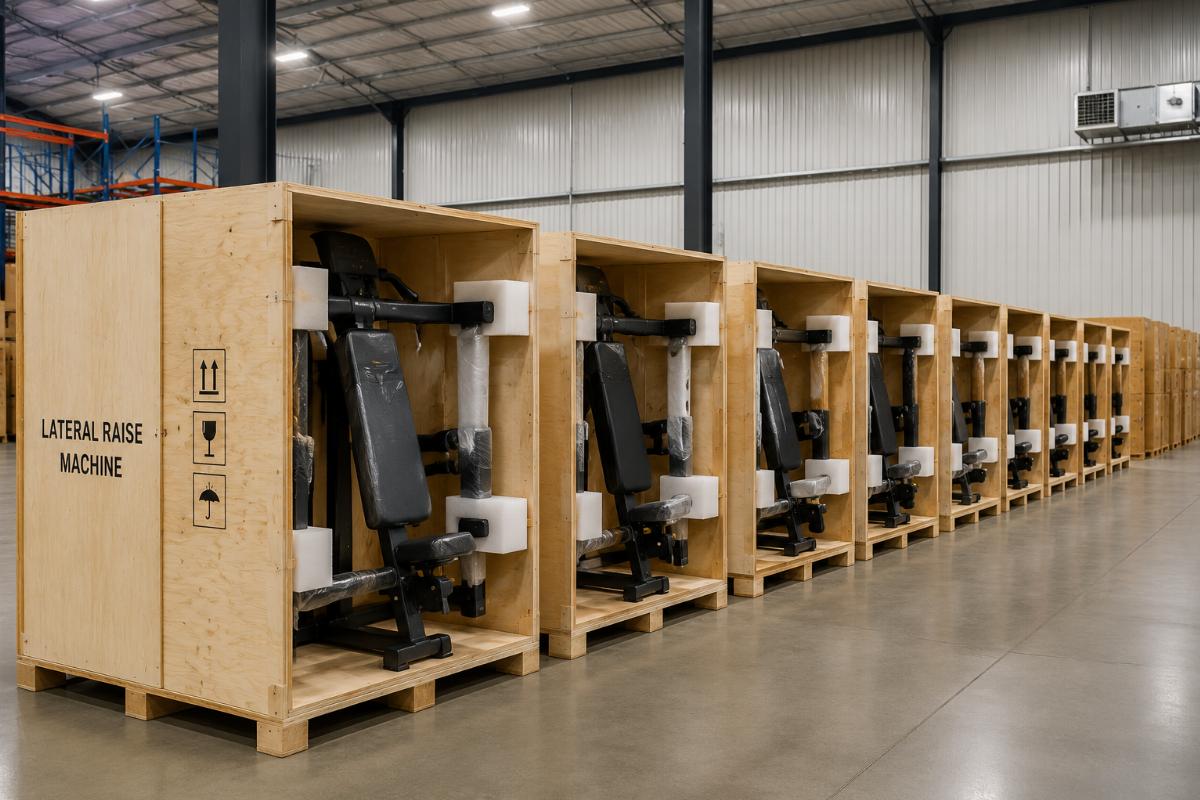
I still remember a container of plate-loaded machines we shipped to a West African university gym. The replacement pivot bushings we included as spare parts got held up at port for nearly a month — not because the parts were wrong, but because the packing list description didn’t match the bill of lading down to the HS code granularity. The demurrage fees ended up costing more than the parts themselves. That kind of paperwork mismatch is exactly what turns a routine V-Squat Trainer repair into a budget disaster.
Here’s what years of outfitting and supporting high-traffic institutional gyms has shown me: the machines that survive aren’t the ones with the thickest steel — they’re the ones backed by a maintenance rhythm matched to actual rep counts, not calendar dates.
Why College Weight Rooms Destroy V-Squat Trainers Faster?
College gyms operate under a usage profile that commercial fitness centers simply don’t match — and most maintenance schedules ignore this reality entirely.
A typical university recreation center running extended hours during semester peaks sees user traffic that dwarfs even busy commercial boxes. Students arrive in waves between classes, during late-night study breaks, and on weekends — creating concentrated load cycles on machines like the V-Squat Trainer that commercial gyms rarely experience. Add to this the wide variance in user body weight, lifting technique, and general equipment handling awareness, and you get an acceleration of wear that standard OEM maintenance intervals were never designed to handle. [NEED_CITE: usage intensity comparison between institutional and commercial gym environments per IHRSA facility benchmarks]
The pivot point of a V-Squat Trainer takes the brunt of this abuse. Every repetition loads the bushing with eccentric force, and in a college setting where proper form isn’t always guaranteed, lateral stress compounds the problem. Guide rods on the weight horn accumulate micro-scratches from careless plate loading. Cable anchor points experience fatigue from rapid, uncontrolled releases rather than smooth eccentrics.
A mid-size university client of ours once tracked usage across their strength floor. Their V-Squat machines logged rep volumes that would take a typical commercial gym several times longer to accumulate. When they followed the manufacturer’s standard time-based service schedule, failures started appearing well before the recommended intervals. The lesson was clear: maintenance calendars need to be calibrated to actual usage density, not just months on a wall calendar.

What Are the Real Wear Points Most People Miss?
The catastrophic failures on V-Squat machines almost never start where you’d expect — they originate in hidden interfaces that look fine during a casual walkthrough.
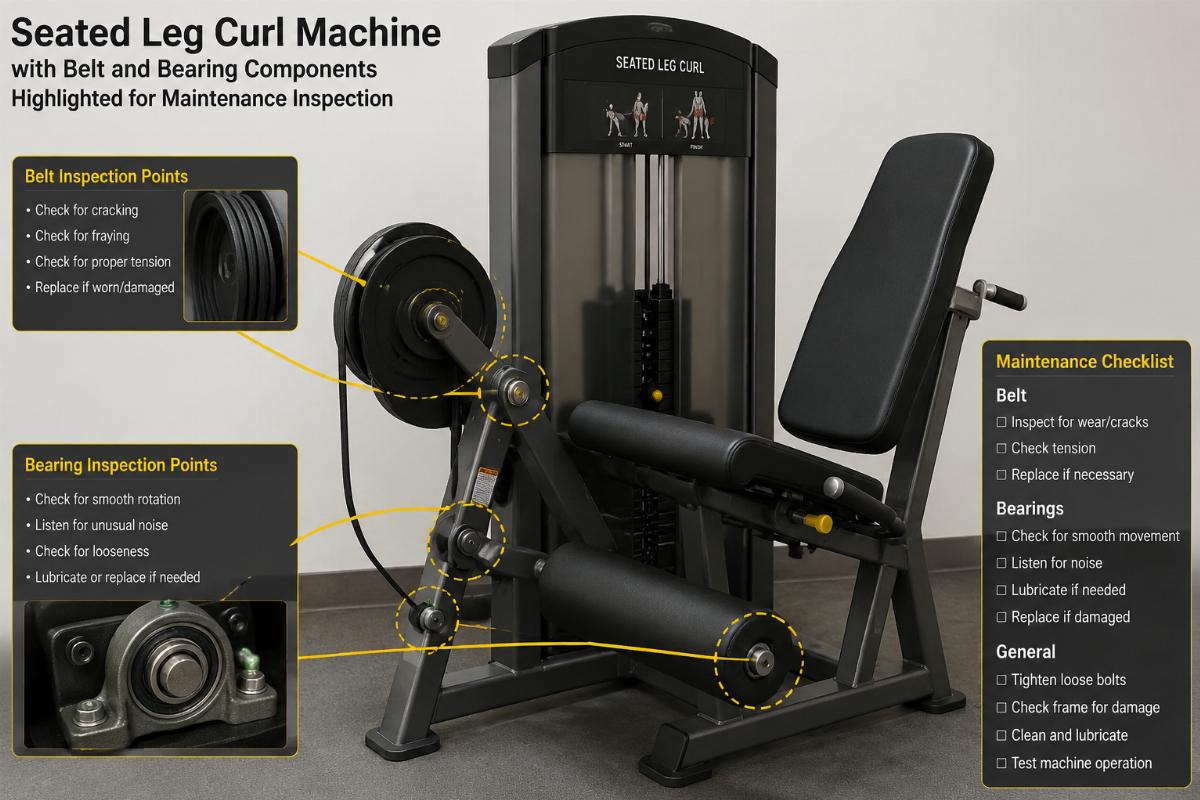
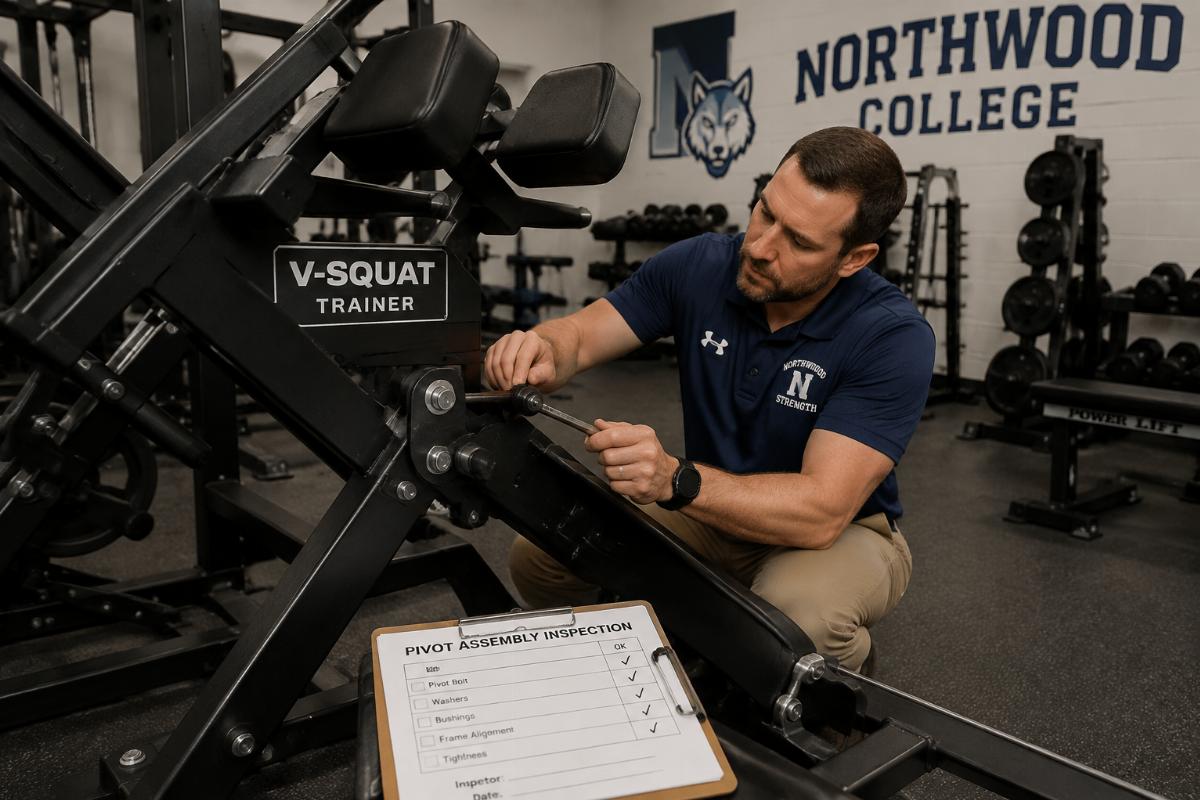
Pivot bushings are the number one culprit. These components sit inside the main frame joint and absorb the oscillating load during every squat repetition. Over time, the internal clearance — what engineers call "play" or "slop" — increases gradually. To the naked eye, the machine looks solid. But place a hand on the carriage and give it a firm lateral push. If there’s any perceptible movement before resistance kicks in, the bushing has exceeded its service threshold. [NEED_CITE: pivot bushing failure modes in selectorized and plate-loaded strength equipment per ASTM F3513]
The second overlooked point is the cable termination. On cable-assisted or counterbalanced V-Squat designs, the swage fitting where the cable meets the carriage is a fatigue hotspot. Frayed strands or visible wire breaks near the ferrule mean the cable is living on borrowed time. A cable snap under load isn’t just a repair bill — it’s a safety incident waiting to happen.
Third, the guide rod surface coating on the weight horn sleeve. College users load plates aggressively, often dropping them rather than sliding them down. This chips the chrome or ceramic coating, exposing bare steel to oxidation. Once rust starts, friction increases, plate loading becomes rough, and the entire guide rod assembly needs replacement — a far costlier fix than catching surface damage early.
| Wear Point | Inspection Method | Failure Indicator | Risk Level |
|---|---|---|---|
| Pivot Bushing | Manual lateral push + feeler gauge measurement | Perceptible play beyond tolerance | High |
| Cable Termination | Visual inspection of swage area | Frayed strands, wire breaks near ferrule | Critical |
| Guide Rod Coating | Visual and tactile surface check | Coating chips, rust spots, rough sliding | Moderate |
| Seat Upholstery | Visual tear and compression check | Foam breakdown, vinyl cracking | Low |

How to Build a Preventive Maintenance Calendar by Usage Volume?
Throw away the "every six months" mindset — in high-traffic college gyms, your V-Squat Trainer maintenance schedule should be tied to estimated rep throughput, not calendar weeks.
The principle is straightforward: estimate daily user volume per machine, multiply by average reps per session, and set inspection and replacement triggers at cumulative rep thresholds. This mirrors how aviation and industrial equipment maintenance has worked for decades — operating hours or cycles drive service intervals, not arbitrary dates. [NEED_CITE: usage-based maintenance methodology for fitness equipment per IHRSA operational guidelines]
Here is a framework we’ve developed through supporting institutional gym clients across multiple regions:
Daily (Operator Level):
- Visual walk-around: check for loose bolts on seat adjusters, foot plate mounting, and weight horn retainer pins
- Wipe down guide rods with a dry cloth to remove chalk and sweat residue — never use wet lubricants that attract abrasive dust
- Listen for unusual grinding or clicking during a test rep through full range of motion
Weekly (Technician Level):
- Inspect cable condition at termination points and along the full routing path
- Check pivot joint for audible clicking or visible movement under manual load
- Verify that all adjustment pin detents engage cleanly without excessive force
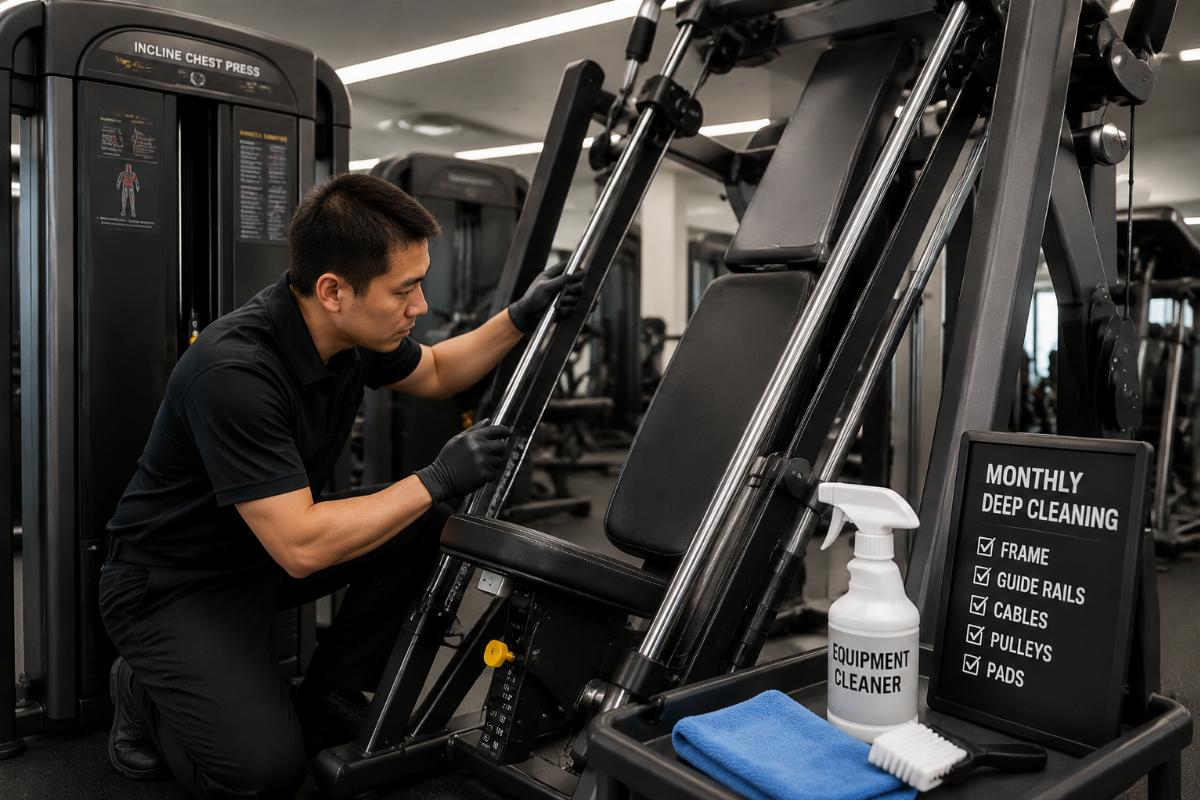
Monthly (Preventive Level):
- Measure pivot bushing play using a dial indicator or feeler gauge at the carriage joint
- Inspect guide rod surface under angled light to detect early coating degradation
- Torque-check all structural fasteners against manufacturer specifications
Quarterly (Component Replacement Window):
- Replace pivot bushings if play exceeds the acceptable threshold — do not wait for visible frame damage
- Swap cables showing any strand irregularity, regardless of apparent remaining life
- Re-coat or replace guide rods where surface pitting has begun
Annual (Overhaul Level):
- Full disassembly of pivot assembly, inspection of inner race and shaft surfaces
- Replace all cables regardless of visible condition
- Re-grease all linear bearings and pivot points using manufacturer-specified lubricant type only
The critical detail here is lubricant selection. Many well-intentioned maintenance crews default to heavy grease on pivot points. But in a dusty college gym environment, grease acts as a magnet for chalk particles and floor debris, creating an abrasive paste that accelerates bushing wear far faster than dry operation would. A dry PTFE-based lubricant or manufacturer-approved dry film is almost always the better choice for high-traffic installations. [NEED_CITE: lubricant selection guidelines for gym equipment pivot points considering particulate contamination]

How to Source Replacement Parts Without Customs Nightmares?
The fastest V-Squat Trainer repair means nothing if the replacement part sits in a container at port because the shipping documents don’t align with customs classification requirements.
This is where gym equipment maintenance collides with international trade logistics — and where most facility managers have zero visibility until something goes wrong. Let me walk you through a scenario that plays out more often than you’d think.
A university gym in Southeast Asia needed a set of replacement pivot bushings and cables for their V-Squat machines. The order was placed, the parts were manufactured, and a shipment was arranged. But when the parcel arrived at the destination port, customs flagged it. The commercial invoice described the items as "gym machine parts," the packing list said "metal components," and the bill of lading referenced "fitness accessories." Three different descriptions for the same shipment — none matching the precise HS code classification that the importing country required for duty assessment.
The result? The shipment sat in a bonded warehouse for weeks. Storage fees accumulated. The gym’s V-Squat machines remained out of service. By the time the documentation was corrected and the parts cleared, the total landed cost of those small metal components had multiplied several times over.
The fix is preventive and entirely administrative:
Pre-audit HS codes for every spare part SKU. Fitness equipment parts often fall under different tariff headings depending on whether they’re classified as "parts of strength training machines" versus "general hardware" versus "cable assemblies." Get this right before the shipment leaves the factory. [NEED_CITE: HS code classification challenges for fitness equipment spare parts in international trade]
Ensure document consistency across all shipping paperwork. The product description on the commercial invoice, packing list, and bill of lading must use identical terminology. Even minor wording variations can trigger customs holds in strict jurisdictions.
Consolidate spare parts with equipment orders when possible. When outfitting a new college gym, bundling a one-to-two-year supply of high-wear V-Squat Trainer components — pivot bushings, cables, guide rod sleeves, seat pads — into the initial container shipment avoids the cost and risk of standalone spare part shipments entirely. This is a standard practice in our turnkey gym packages, and it eliminates the customs exposure that comes with smaller, ad-hoc orders.
Leverage consolidated port clearance systems where available. In regions like Shandong Province, China, integrated port clearance models allow pre-clearance of documentation before cargo reaches the loading berth, reducing the window where paperwork errors can cause physical shipment delays. For overseas buyers, working with suppliers familiar with these systems adds a layer of logistical insurance.

When Should You Replace vs. Repair?
Knowing when a worn V-Squat Trainer component has crossed the line from "serviceable" to "scrap" is the difference between proactive maintenance and reactive emergency repairs.
Pivot bushings are a clear example. Once measurable play develops, the bushing cannot be "adjusted" back to tolerance. It must be replaced. Attempting to shim or tighten a worn bushing only transfers stress to the pivot shaft and frame ears — turning a straightforward bushing swap into a frame welding project.
Cables follow a similar logic. Any visible wire break at the termination point means the entire cable should be replaced, not just the end fitting. The fatigue damage propagates along the cable length, and a repaired cable that fails under load creates liability exposure that no gym operator wants to carry. [NEED_CITE: cable replacement criteria for fitness equipment per ASTM F3513 safety standards]
Guide rods present a cost calculation. Minor surface scratches can sometimes be polished out. But once pitting or rust has penetrated the coating, the rod must be replaced — and this is where sourcing matters. A replacement guide rod from the original equipment manufacturer will match the diameter, surface finish, and tolerance of the original. An off-spec aftermarket rod may fit physically but introduce friction inconsistencies that accelerate wear on the weight horn sleeve.
The economic tipping point for full machine replacement versus component-level repair typically arrives when multiple major wear points fail simultaneously on a machine that has already seen several rounds of component swaps. At that stage, the cumulative labor cost of disassembly, part replacement, and reassembly approaches the value of a new unit — and a new V-Squat Trainer comes with full structural integrity and updated warranty coverage.
For facility managers overseeing large inventory of strength equipment, maintaining a critical spares inventory — pivot bushings, cables, and seat pads sized to cover the V-Squat Trainer fleet for at least one full replacement cycle — converts unpredictable downtime into scheduled, brief maintenance windows.

Conclusion
V-Squat Trainer longevity in college gyms depends on usage-based maintenance, not calendar-based hope. Pivot bushings, cables, and guide rod coatings are the hidden failure points that demand inspection by rep volume, not months elapsed. Spare parts sourcing requires the same discipline as the maintenance itself — correct HS codes, consistent documentation, and strategic pre-stocking eliminate the customs delays that turn minor repairs into extended shutdowns. The machines that last are the ones where the maintenance rhythm matches the reality of the floor.