Commercial Chain Gyms Retrofit Low Row Machine – OEM Wholesale Supplier
Most retrofit failures happen not because the new machine is bad, but because it physically cannot fit the hole left by the old one.
Successful commercial chain gyms retrofit low row machine projects depend on three non-negotiable checks before a single unit is ordered: dimensional envelope matching against existing floor anchors, cable travel stroke aligned to the local user demographic, and weight stack compatibility with the adjacent selectorized line. Skip any one of these, and the container sits in a warehouse for months while the gym floor stays half-empty.
I still remember a job in Riyadh where a chain pulled out their old low row units, the replacements arrived on schedule, and then everything stopped. The floor bolt pattern on the new frames was off by a noticeable margin from the预埋 anchors already drilled into the slab. Nobody had measured the old machine’s base plate before ordering. The containers sat in a bonded warehouse, the gym stayed half-finished, and the client was paying storage fees every single day. That kind of pain is what makes me insist on one thing before we even open a catalog: send us the three-view drawings and the foundation map of the existing equipment. [NEED_CITE: dimensional compatibility as the primary cause of retrofit delays in commercial fitness facilities]

Once that baseline data is on the table, the rest of the commercial chain gyms retrofit low row machine process becomes a structured conversation instead of a guessing game.
Why Do Low Row Retrofits Fail at Installation Stage?
The majority of installation-stage failures trace back to dimensional mismatch and anchor incompatibility, not to machine quality or pricing.
When a gym chain decides to refresh a strength line, the instinct is to spec by muscle group and stack weight. What gets ignored is the physical envelope the new machine has to live inside. Old low row units were often bolted into slabs with anchor patterns that varied even within the same brand, because production batches shifted hole positions within tolerance bands over the years. [NEED_CITE: manufacturing tolerance accumulation in legacy fitness equipment anchor patterns]
A multi-site rollout across Southeast Asia ran into this quietly. The new low row frames were dimensionally fine on paper, but the cable exit direction on the replacement units pointed the opposite way from the old ones. That meant the existing ceiling-mounted cable guides, which had been routed specifically for the old machines, were now useless. Rewiring the overhead path across multiple sites turned a straightforward swap into a civil works project.
Three failure patterns dominate commercial chain gyms retrofit low row machine jobs in the field:
- Bolt-hole spacing drift. Even machines from the same original brand can show noticeable variation between production years. The new frame’s anchor plate may be thicker or thinner than the old one, changing which bolt length is required.
- Cable routing conflict. The direction the cable leaves the housing, the height of the pulley stack, and the angle of the seat rail all interact with existing floor channels and overhead guides.
- Footprint overhang. A replacement that is even slightly wider or longer than the old unit can block walkways, fire egress paths, or adjacent machine clearance zones. [NEED_CITE: fitness facility layout standards for equipment clearance and egress]
The fix is unglamorous but effective: treat the existing floor as a fixed constraint, and design the retrofit around it, not around the brochure dimensions of the new machine.
What Measurements Must You Collect Before Ordering Replacement Machines?
A complete three-view drawing set, a bolt-hole pattern map, and a cable routing sketch are the minimum prerequisites before any commercial chain gyms retrofit low row machine order is placed.
I have learned, the hard way, to treat this data collection as a formal stage of the project, not an afterthought. The buyer’s site team walks the floor with a tape measure and a phone camera, and we turn that raw input into a working envelope drawing before a single prototype is built.
The collection checklist covers four layers:
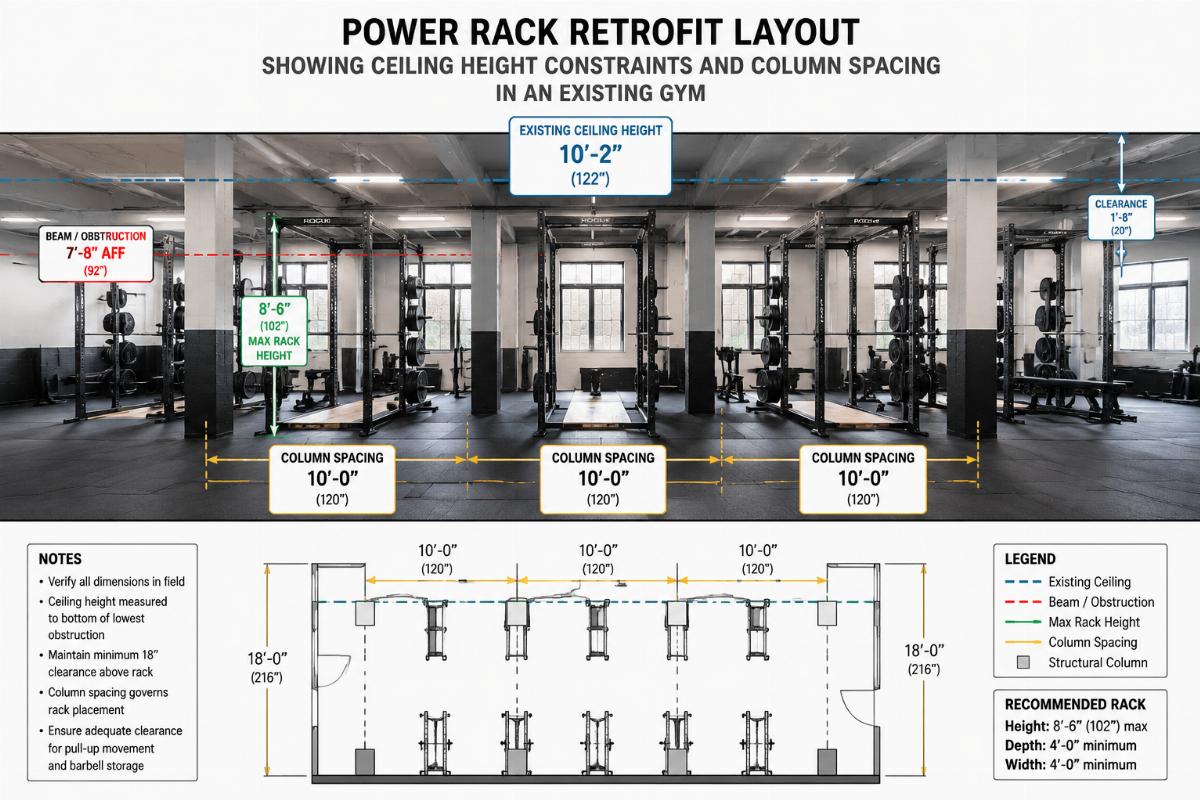
- Outer envelope. Overall length, width, and height of the existing machine, measured from the outermost points including handles, weight stack shrouds, and adjustment knobs.
- Anchor pattern. Center-to-center distances of every floor bolt, measured in both axes, plus the distance from each bolt to the nearest edge of the base plate. The thickness of the base plate itself matters too, because it determines whether existing bolts will reach or need replacement.
- Cable path. The direction the main cable exits the housing, the height of the primary pulley axis from the floor, and whether the cable runs underground, overhead, or along a wall.
- User interface geometry. Seat rail travel length, handle reach from the seated position, and the height range of the chest pad or seat adjustment.

A Latin American boutique chain learned this the expensive way. They ordered a full set of replacement low row units based on catalog photos and a rough floor sketch. When the containers arrived, the seat rail travel on the new machines was noticeably shorter than on the old ones. Their member base included a large number of taller users who relied on that extra travel to achieve full range of motion. The machines were technically functional, but members complained within the first week. The chain ended up paying for custom seat rail extensions on every unit, which cost several times what a proper pre-order measurement would have.
The rule I follow is simple: no three-view drawing, no quote. It slows the first week down, but it compresses the next three months. [NEED_CITE: pre-installation audit protocols for commercial fitness equipment replacement]
How to Match Weight Stack and Cable Travel to Existing Equipment Lines?
Stroke length and pulley ratio must align with both the local user demographic and the feel of the adjacent selectorized machines, or members will notice the difference immediately.
This is where many commercial chain gyms retrofit low row machine projects quietly go wrong. The assumption is that a heavier stack equals a better machine. In reality, what the user feels is the combination of stack weight, pulley ratio, and cable travel, not the stack alone.
A stack that is too heavy for the pulley ratio will feel harsh at the start of the stroke and bottom out abruptly. A stack that is too light with a high mechanical advantage will feel vague and fail to challenge stronger users. The goal is to match the resistance curve of the new low row to the rest of the selectorized line in the same zone, so a member moving from a lat pulldown to the low row feels a consistent progression.
Three parameters drive this match:
- Cable stroke length. This is the total distance the handle travels from fully retracted to fully extended. For a user base with a wide height range, the stroke needs to be long enough to accommodate both shorter and taller members without either group hitting the end of travel too early. [NEED_CITE: ergonomic stroke length requirements for selectorized strength equipment]
- Pulley ratio. This determines how much stack weight translates into handle resistance. A lower ratio gives a smoother, lighter feel; a higher ratio makes the stack feel heavier per kilogram.
- Stack increment per pin. The weight jump from one pin hole to the next should be fine enough that members can progress gradually, typically in small single-digit kilogram steps.
A Middle East chain retrofit nearly stalled on this point. The original low row units had a relatively light stack with a low pulley ratio, which suited their member profile. The replacement units they initially spec’d had a much heavier stack but the same pulley ratio, which made the starting resistance feel abrupt and uncomfortable for newer members. By adjusting the pulley configuration rather than changing the stack itself, the resistance curve was brought back in line with what the members expected.
The lesson is that the stack is only one variable. The commercial chain gyms retrofit low row machine spec must be tuned as a system, not as a single number. [NEED_CITE: selectorized equipment resistance curve matching in multi-station gym environments]

What Is a Realistic Retrofit Timeline from Measurement to Full Deployment?
A well-structured commercial chain gyms retrofit low row machine project typically runs through a verification stage, a sampling stage, and a batch production stage, with each gate requiring sign-off before the next begins.
Rushing this sequence is the single most common cause of costly rework. I have seen buyers try to compress the entire cycle into a few weeks, only to receive a full container of machines that do not fit, do not feel right, or do not match the adjacent line. The rework then takes far longer than the original timeline would have.
The sequence that works reliably breaks down as follows:
- Stage one, site audit and drawing confirmation. The buyer’s team collects the three-view drawings, anchor patterns, and cable routing data. The manufacturer reviews these against the proposed replacement spec and confirms the dimensional envelope. Any conflicts are flagged here, not at the loading dock.
- Stage two, prototype or sample unit. A single unit, or a small batch for multi-site chains, is produced and shipped for physical fit-check on the actual floor. This is not a cosmetic sample; it is a functional unit that gets bolted down, used by members, and inspected for cable alignment, seat travel, and stack feel.
- Stage three, batch production and container consolidation. Only after the sample is approved does full production begin. For multi-site rollouts, units for different locations are often consolidated into shared containers to reduce freight cost and simplify customs clearance. [NEED_CITE: container consolidation best practices for multi-site fitness equipment deployment]
A chain operator in the Gulf region followed this sequence across multiple locations. The first site’s sample revealed that the weight stack shroud width on the replacement unit was slightly wider than the old one, which would have blocked the adjacent dumbbell rack access. The shroud was redesigned before batch production started, and the final deployment across all sites went smoothly.
Skipping the sample stage to save a few weeks almost always costs more in the end. The commercial chain gyms retrofit low row machine timeline is not a race; it is a sequence of gates.

How to Avoid Costly Mistakes in Multi-Site Chain Renovations?
Standardize a site-audit checklist across all locations and require factory pre-shipment dry-fit documentation before any container is sealed.
Multi-site rollouts multiply every risk. A dimensional error that affects one machine becomes a problem repeated across dozens of locations. The only reliable defense is to treat every site as a unique constraint, even when the chain’s floor plan looks identical on paper.
The approach that has proven itself in the field rests on two pillars:
- A unified audit template. Every location uses the same measurement form, covering outer envelope, anchor pattern, cable path, and user interface geometry. This makes it possible to compare sites side by side and spot outliers before production begins.
- Factory dry-fit verification. Before the container is loaded, the manufacturer assembles a representative unit using the actual production tooling and photographs the anchor plate, cable exit, and stack alignment against the site drawing. This dry-fit record travels with the shipment, so the installation team on the other end can verify immediately that what arrived matches what was approved.
A distributor handling a chain rollout across several Latin American countries found that two of the sites had slab depths that differed noticeably from the others. Because the audit template captured this detail early, the anchor bolt specification was adjusted for those two sites before shipping, avoiding a现场 stoppage.
The commercial chain gyms retrofit low row machine process at scale is not fundamentally different from a single-site job. It is the same discipline, repeated consistently, with documentation that travels with every unit. [NEED_CITE: standardized audit protocols for multi-site commercial fitness equipment deployment]

Conclusion
A successful commercial chain gyms retrofit low row machine project is won or lost before the first unit is built, in the data collected from the existing floor and the discipline of the verification gates that follow. Dimensional compatibility, cable travel tuning, and weight stack matching are not optional extras; they are the structural foundation of the entire retrofit. Rush the audit, skip the sample, or ignore the anchor pattern, and the consequences follow the container all the way to the gym floor. Do it properly, and the new machines drop into the old holes, feel right to the members, and the chain moves on to the next location without looking back.