Hex Dumbbell Set Manufacturer for Commercial Gyms in Egypt
Most buyers think heavier dumbbells mean better value per container. The real bottleneck is not unit price—it is whether the container weight limit and the destination port’s unloading capacity can actually handle it.
Sourcing a hex dumbbell set for gyms in Egypt requires locking down three variables before production starts: rubber compound suited to high-heat climates, a container loading plan that respects axle-weight limits at Egyptian ports, and an HS code pre-classification confirmed with the local customs broker—not the factory’s default code. [NEED_CITE: Egyptian Customs tariff classification rules for fitness equipment vs rubber articles]
I still remember a shipment to a hotel project in Cairo. The rubber hex plates looked fine in the factory yard. At the port, the broker classified them under "rubber articles" instead of "fitness equipment." Duty jumped from the single-digit range to the mid-teens overnight. The client was furious. Since then, I treat every dumbbell export to Egypt like a customs filing exercise first and a manufacturing order second. Below is what I have learned from years of loading, shipping, and clearing these sets across North Africa and the Middle East.
Getting the specs, materials, and paperwork right is only half the job. The other half is making sure the product survives the climate, the container survives the voyage, and the paperwork survives Egyptian customs. Let me walk through each layer.
What Specs Do Egyptian Gyms Actually Need for a Hex Dumbbell Set?
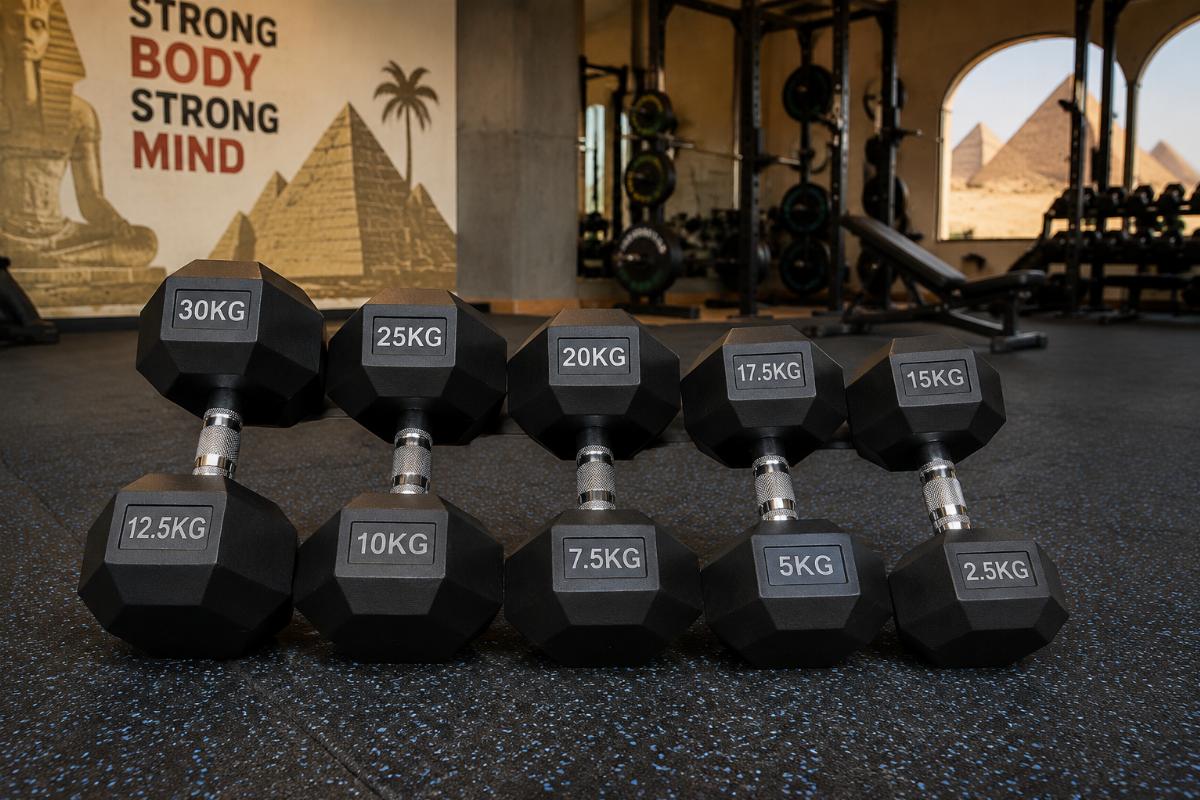
Commercial gyms in Egypt overwhelmingly rely on the 2.5 kg to 30 kg range, not the 50 kg monsters you see in American hardcore boxes. Hotel fitness centers and boutique studios lean even lighter, often stopping at 20 kg. The reason is simple: the average Egyptian gym member is not a competitive powerlifter, and floor-space economics favor more pairs in the mid-range than a single heavy rack.
A typical commercial gym package I helped configure for a chain in the Greater Cairo area ran something like this:
| Weight Tier | Pair Count | Primary User Profile |
|---|---|---|
| Light (2.5–10 kg) | High density | Group classes, beginners, hotel guests |
| Mid (12.5–20 kg) | Standard density | Regular members, functional training |
| Heavy (22.5–30 kg) | Limited pairs | Experienced lifters, strength zone |
| Ultra-heavy (35 kg+) | Optional, 1–2 pairs | Niche demand only |
The mistake I see most often is over-ordering the heavy end. A Middle East distributor once loaded a full container with 35–50 kg pairs because the per-kilo price looked attractive. Half the sets sat in the warehouse for months because local gyms had no demand for that weight. Meanwhile, the 10–15 kg range—the real workhorses—sold out in weeks.
For CrossFit-style boxes, the mix shifts slightly. They tend to want more pairs in the 15–25 kg range and prefer rubber hex dumbbells that can survive being dropped on rubber flooring repeatedly. [NEED_CITE: durability testing standards for dropped free weights per EN and ASTM guidelines] Hotel gyms, on the other hand, prioritize quiet operation and clean aesthetics—urethane finishes win there, even if the cost is higher.

The takeaway: do not let the supplier’s catalog dictate your mix. Tell them your member profile and floor plan, and build the hex dumbbell set around actual usage patterns.
Rubber vs Urethane: Which Material Survives Egypt’s Climate?
Egypt’s summer temperatures regularly push past 40°C in gym environments without industrial HVAC, and that heat exposes every shortcut in rubber compounding. The three material options you will encounter are cast iron cores with virgin rubber coating, recycled rubber coating, and polyurethane (urethane) coating. Each behaves very differently under sustained heat and heavy use.
Virgin rubber, when properly compounded, offers a good balance of odor control, abrasion resistance, and cost. It smells mildly when new but fades within weeks. Recycled rubber is cheaper upfront but releases a persistent chemical odor that becomes worse in high temperatures. In a Cairo hotel gym with limited ventilation, that odor becomes a member complaint within the first month. [NEED_CITE: volatile organic compound emission differences between virgin and recycled rubber in fitness equipment]
Urethane is the premium choice. It is virtually odorless, resists UV degradation better than rubber, and holds its color longer. The trade-off is cost—urethane-coated hex dumbbells can carry a meaningful price premium over rubber. For hotel and high-traffic commercial gyms in Egypt, that premium usually pays for itself within a couple of years through lower replacement rates.
| Material | Odor in Heat | Abrasion Resistance | Color Retention | Cost Level |
|---|---|---|---|---|
| Virgin Rubber | Mild, fades over time | Good | Moderate | Mid |
| Recycled Rubber | Persistent, worsens in heat | Fair | Poor | Low |
| Urethane | Negligible | Excellent | Excellent | High |
I once reviewed a batch of recycled-rubber dumbbells destined for a gym in Alexandria. The supplier had quoted an attractive price, but when I asked for the rubber compound data sheet, the answers were vague. We switched to virgin rubber from the same production facility—the price difference was modest, but the odor complaint risk disappeared entirely.
For any hex dumbbell set heading to Egypt, I now insist on seeing the compound specification before production. If the supplier cannot provide it, that is a red flag worth taking seriously.

How to Load a Full Container Without Triggering Overweight Penalties?
A 20-foot container can physically hold far more dumbbells than Egyptian road-weight limits will allow you to deliver from the port. This is the single most expensive miscalculation in free-weight exports to Egypt. Dumbbells are dense. A 20GP loaded entirely with iron and rubber products can easily exceed the maximum gross weight allowed on Egyptian highways, forcing the client to split the cargo at the port—adding cost, delay, and frustration.
The loading strategy I follow for a hex dumbbell set bound for Egypt typically looks like this:
- 20GP container: Target a gross weight that stays within the destination country’s road-transport limit, not the container’s structural maximum. Mix heavier dumbbells with lighter accessories—benches, resistance bands, gym flooring—to distribute weight and fill volume.
- 40HQ container: Offers more volume for the same weight ceiling. Ideal for mixed orders where dumbbells share space with cardio equipment or functional training gear. The extra cube lets you fill out the container without pushing weight limits.
- Weight distribution: Place the heaviest pairs at the bottom, centered over the axles. Secure with timber bracing and load straps. Shifting cargo during ocean transit can damage both the product and the container floor.
A distributor in North Africa once received a 20GP stuffed to the structural limit with 30 kg hex dumbbells. The container was fine. The truck from the port to the warehouse was not—the local transport authority flagged it at the first checkpoint, and the cargo had to be partially offloaded and re-dispatched. The cost of that reshuffle ate into the margin on the entire order.

The principle is straightforward: plan the loading around the destination’s road limits, not the origin’s container specs. A reliable hex dumbbell set supplier should be able to provide a loading plan with estimated weights before you confirm the order. If they cannot, find one who can.
What Import Documents and HS Codes Avoid Customs Traps in Egypt?
The HS code for dumbbells must be confirmed with the Egyptian customs broker before the goods leave the factory—not after they arrive at the port. Egyptian customs does not automatically accept the exporter’s classification. If the broker on the ground disagrees, reclassification can shift the duty rate substantially, and there is no quick appeals process once the cargo is sitting in the bonded zone.
The correct classification for fitness-oriented dumbbells generally falls under the fitness equipment heading, not under general rubber or iron articles. [NEED_CITE: Egyptian Customs HS code classification guidance for free-weight fitness equipment] The distinction matters because duty rates differ significantly between these categories.
The document package I prepare for every Egypt-bound shipment includes:
- Commercial Invoice and Packing List: Detailed with per-item weight, quantity, and unit value. Egyptian customs scrutinizes these closely for valuation consistency.
- Certificate of Origin (CO): Required for preferential treatment where applicable. Must match the invoice exactly.
- CE Certificate: Egypt increasingly references international conformity standards. Having CE documentation for the hex dumbbell set smooths the inspection process.
- Bill of Lading: Standard shipping document, but ensure the product description matches the invoice and packing list word-for-word.
- HS Code Pre-classification Confirmation: A written record from the Egyptian broker confirming the agreed code before shipment. This is the single most important piece of paper in the file.
I have seen shipments held at Sokhna port for weeks because the HS code on the bill of lading did not match what the broker expected. The cargo was not seized—it was simply stuck in bureaucratic limbo while the parties argued over classification. The storage fees alone were a painful lesson.

My rule is simple: no container leaves the loading bay until the Egyptian broker has confirmed the HS code in writing. It takes a few days of email coordination upfront and saves weeks of port delays downstream.
How to Choose a Reliable Hex Dumbbell Set Supplier from China?
The factory with the lowest quote is rarely the factory that delivers the best outcome for an Egypt-bound order. The real cost of a dumbbell shipment includes duty surprises, port delays, odor complaints, and premature coating failure. A slightly higher unit price from a supplier who handles classification, loading, and material specs properly will almost always deliver a better landed result.
When I evaluate a hex dumbbell set supplier for a Middle East or North Africa client, I look at five things:
- Material transparency: Can they provide rubber compound data sheets or urethane specification sheets? Vague answers here are a warning sign.
- CE certification: Not just a certificate hanging on the wall, but one that covers the specific product range being ordered.
- OEM and branding flexibility: Can they apply custom logos, color matching, and packaging without requiring an impractically large minimum order? For distributors building a local brand, this matters.
- Loading and consolidation capability: Can they mix dumbbells with other gym equipment in a single container and provide a weight-verified loading plan? A supplier who only ships single-product containers is less useful for a turnkey gym project.
- After-sales support: Do they stock spare parts—handle grips, end caps, coating touch-up kits—and can they ship them quickly when needed?
A gym chain operator in the MENA region once switched from a low-cost supplier to a Shandong-based manufacturer after the second batch arrived with coating peeling issues. The new supplier provided urethane options, handled the full container consolidation with other strength equipment, and coordinated the HS code with the Egyptian broker. The unit price was higher, but the total landed cost—including duty, transport, and replacement claims—dropped noticeably.

The manufacturers I have worked with most consistently in Shandong Province understand these export requirements because they have been shipping to Egypt and the broader African market for years. They know that a hex dumbbell set is not just a product—it is a logistics and compliance package. Choosing a supplier who thinks in those terms is the single best insurance policy for a smooth project delivery.
Conclusion
A successful hex dumbbell set import into Egypt depends on material selection, container weight planning, and HS code pre-confirmation—not just unit price negotiation. Get the rubber compound right for the climate, load the container within road-weight limits, and lock the customs classification before production starts. These three steps, done properly, prevent the vast majority of costly problems that free-weight importers encounter in this market.