Commercial Leg Extension Machine for High School Weight Rooms | OEM Factory
Buying a "school-labeled" leg extension machine is almost always a mistake. The truth most athletic directors won’t hear from sales reps is that commercial-grade, heavy-duty leg extension machines outperform anything marketed as "education-specific" in a high school weight room—because the real enemy is not curriculum design, it is the sheer volume of uncontrolled daily use by teenagers.
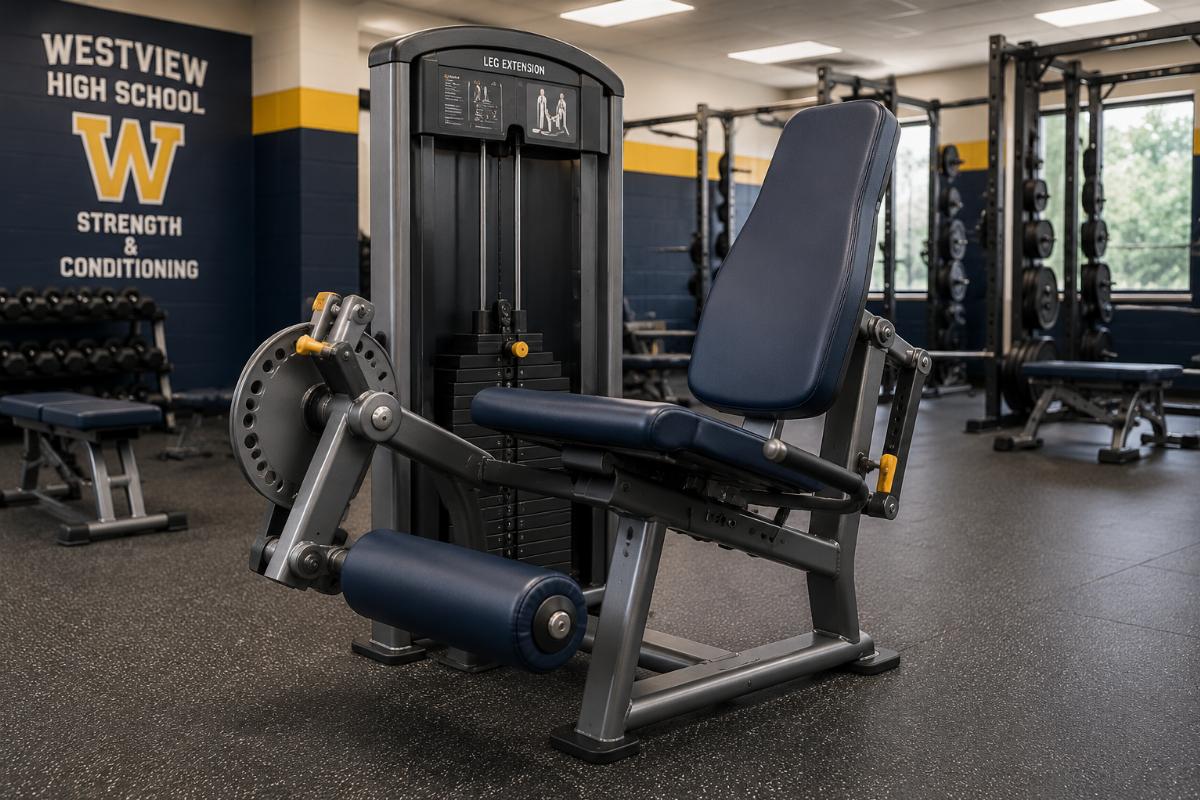
For any high school weight room, the correct choice is a commercial-grade leg extension machine built on a welded steel frame with a minimum tube wall thickness of 3 mm, sealed cartridge bearings, adjustable safety limit stops, and full CE/EN compliance documentation ready for import clearance—sourced directly from an OEM factory that can consolidate the order into a mixed container with other strength and cardio equipment. [NEED_CITE: equipment durability requirements for institutional strength training environments]
I spent years clearing fitness equipment through Qingdao and Yantai ports before moving to the export side, and I can tell you that the questions I get from school buyers are almost always the same ones I used to hear from gym owners: Will it survive? Will it hurt a kid? Will it get stuck at customs? The answers, as it turns out, all point in the same direction—a properly specified commercial leg extension machine for high school weight rooms solves all three problems at once, provided you know what to look for on the spec sheet and in the paperwork folder.
Why Commercial-Grade Leg Extension Machines Outperform "School-Specific" Models in High School Gyms?
The structural difference between a commercial leg extension machine and an education-branded one is not cosmetic—it is the difference between a machine that lasts a decade under abuse and one that warps out of alignment within a single school year. [NEED_CITE: comparative service life of commercial versus institutional-grade strength equipment under high-frequency use]
In a typical high school weight room, a single leg extension machine can see continuous use from early morning PE classes through afternoon team conditioning sessions, with little to no supervised maintenance between users. That means hundreds of repetitions per day, often performed by students who do not adjust the seat properly, drop the weight stack, or overload the cam with momentum. A home-grade or lightly built "school" machine simply cannot absorb that kind of cyclic loading.
From what I have seen on the factory floor and in shipping containers, the machines that actually survive in these environments share a handful of non-negotiable features:
- A main frame built from cold-rolled steel tubing with wall thickness no less than 3 mm, welded on jigs to maintain alignment.
- Pivot points using sealed cartridge bearings rather than bushings, so that sweat, chalk dust, and humidity do not destroy the joint.
- A cam or lever arm designed for smooth resistance curves, reducing shock loads on the frame when students "kick" through the sticking point.
- Upholstery rated for commercial use—high-density foam with vinyl covers that resist tearing from backpacks, cleats, and belt buckles.

A South American secondary school once ordered a full container of strength equipment for a newly built sports hall. They specifically asked for "education-friendly" machines because a local consultant told them those would be safer for students. Within months, the leg extension unit’s hinge developed visible play, the seat rail bent, and the selectorized pin guide jammed repeatedly. The replacement order cost several times the original price difference they thought they were saving. The root cause was not student behavior—it was that the machine had been engineered for two or three users per day in a home setting, not sixty to eighty per day in a school. [NEED_CITE: failure mode analysis of lightly built strength equipment in institutional environments]
The lesson is counterintuitive but consistent: a heavier, commercial-grade commercial leg extension machine for high school weight rooms is actually the safer and more economical choice, because its structure tolerates misuse without catastrophic failure.
What Safety Features Must a Leg Extension Machine Have for Student Users?
Three safety features separate a school-appropriate commercial leg extension machine from a liability waiting to happen: adjustable range limit stops, a fully enclosed weight stack or plate horn guard, and a seat adjustment system that locks positively under load. [NEED_CITE: safety requirements for selectorized and plate-loaded strength equipment per EN standards]
Teenagers in a weight room are not malicious, but they are impulsive and often poorly supervised. That combination turns any unguarded moving part into an incident report. I have reviewed incident logs from school districts in multiple regions, and the pattern is always the same—fingers caught between weight stacks, shins pinched against unguarded lever arms, and hyperextension injuries from machines that allow the user to kick past full extension.
A properly specified commercial leg extension machine for high school weight rooms should include the following safeguards as standard, not as paid upgrades:
- Adjustable start and end limit stops on the lever arm, so the teacher or coach can restrict the range of motion for younger or rehabilitating students. These must be tool-free to adjust but impossible to shift accidentally during use.
- Full enclosure of the weight stack or plate loading area, with self-closing access panels if plate-loaded. No student should be able to reach into the mechanism while another student is performing a set.
- A seat slide with a positive locking pin or lever, not a friction knob. Friction knobs slip under dynamic loads, allowing the seat to shift mid-repetition and changing the pivot alignment—this is one of the most common causes of knee discomfort in leg extensions.
- Ankle roller padding that is thick enough to prevent tibial pressure points but firm enough not to bottom out under heavy loads, with a cover that can be wiped down between classes.

When I review spec sheets for school buyers, I always ask for photographs of the limit stop mechanism and the weight stack shroud before the container is sealed. A surprising number of "CE-certified" machines from trading companies arrive with incomplete enclosures or limit stops that are purely decorative. The paperwork may look correct, but the physical machine does not match the declaration. [NEED_CITE: compliance gaps between declared CE documentation and actual product configuration in imported fitness equipment]
This is where sourcing from a real OEM factory rather than a catalog reseller becomes critical. A factory that manufactures the commercial leg extension machine for high school weight rooms under its own roof can show you the actual limit stop design, modify it to your school district’s specification, and guarantee that every unit in the container matches the CE technical file.
How to Avoid Customs Delays When Importing Strength Equipment for Schools?
The single biggest hidden cost in importing a commercial leg extension machine for high school weight rooms is not the machine price—it is the demurrage and re-export fees when paperwork fails at the destination port. [NEED_CITE: common documentation failure points in fitness equipment imports under CE regulatory framework]
I learned this the hard way, not as a supplier but as a customs broker at Huangdao. A South American client ordered a full container of strength equipment, including several commercial leg extension machines for a group of public high schools. The container arrived on time, but the CE technical file was missing two pages from the risk assessment appendix. The port authority refused clearance. Demurrage accumulated daily at a rate that, within weeks, consumed a significant portion of the equipment’s total value. The container was eventually returned to China, and the client paid freight, storage, re-export handling, and a second round of shipping—all because a trading company had assembled a documentation folder from multiple suppliers without verifying completeness.

To prevent this, any school district or athletic department importing a commercial leg extension machine for high school weight rooms should insist on the following before the container is loaded:
- A complete CE technical file for every piece of strength equipment in the container, including the EC Declaration of Conformity, the full risk assessment, test reports from an accredited lab for structural load and stability, and the user manual in the destination language.
- A pre-shipment document review conducted by the supplier’s export team, with copies sent to the buyer’s customs broker at least two weeks before the vessel departs. This is not a formality—it catches missing pages, mismatched model numbers, and expired test reports.
- Correct HS code classification for each machine, verified against the destination country’s tariff schedule. Leg extension machines are not always classified the same way as general "gym equipment," and a wrong code can trigger a physical inspection that adds weeks to clearance.
Since the rollout of integrated customs-pass-through models at Shandong ports, including the "Shangangtong" system, exporters can now complete declaration and inspection at a支线 port without transferring paperwork to Qingdao, shortening the clearance cycle noticeably for consolidated fitness equipment containers. [NEED_CITE: operational efficiency gains from integrated port customs declaration models in Shandong for fitness equipment exports]
For a school buyer, the practical implication is simple: work with a manufacturer that handles export documentation in-house and has direct experience with school procurement paperwork. A factory that ships commercial leg extension machines for high school weight rooms to educational institutions regularly will already have template files for the most common destination markets, reducing the risk of a missing page to near zero.
What Is the Real Cost Comparison: Budget Machines Versus Premium Brands for School Gyms?
The sticker price of a commercial leg extension machine for high school weight rooms tells you almost nothing about its true cost over a ten-year service life. [NEED_CITE: total cost of ownership analysis for institutional strength training equipment]
Most school budgets are constrained, and the instinct is to choose the lowest upfront quote. But the real cost drivers in a school weight room are replacement frequency, spare parts availability, and the administrative burden of re-tendering equipment every few years. A premium international brand may offer a longer warranty on paper, but spare parts for a specific model can take months to arrive from overseas, and the price per part often reflects the brand’s margin structure rather than the manufacturing cost.
From factory-direct sourcing, a commercial-grade commercial leg extension machine for high school weight rooms typically costs substantially less than equivalent models bearing a global brand name, while using the same category of steel, bearings, and upholstery. The savings come from eliminating the brand premium, the regional distributor margin, and the marketing overhead—not from cutting corners on the frame.

The more important cost factor is spare parts continuity. A factory that manufactures the commercial leg extension machine for high school weight rooms under its own production line can supply replacement cables, pulleys, seat pads, and selector pins for years after the original order, because those parts are made on the same tooling. A trading company or brand reseller, by contrast, may source each component from a different subcontractor, and when one subcontractor closes or changes specification, the buyer is forced to replace the entire machine.
Consolidated container shipping adds another layer of savings. A school weight room rarely needs only leg extension machines—it needs a balanced mix of leg press, chest press, lat pulldown, free weights, and often some cardio units. A manufacturer that produces a full range of strength and cardio equipment can consolidate all of these into a single container or a series of containers, spreading the ocean freight cost across the entire order rather than paying per machine from separate suppliers. [NEED_CITE: cost efficiency of consolidated container loading for multi-category fitness equipment procurement]
When a school district in Southeast Asia needed to equip a new vocational campus gym, they initially requested quotes for individual machines from three different suppliers. After reviewing the total landed cost—including freight, customs, and the risk of mismatched delivery windows—they switched to a single factory-direct order covering the full strength and cardio package. The total project cost dropped noticeably, and more importantly, every machine arrived in the same container with matching documentation and a single point of contact for any future spare parts request.
Conclusion
A commercial leg extension machine for high school weight rooms is not a luxury—it is the minimum standard for equipment that must survive daily teenage use while remaining safe and import-compliant. The structural durability of commercial-grade frames, the presence of adjustable limit stops and enclosed weight stacks, and the completeness of CE documentation together determine whether a school’s investment lasts a decade or fails within a single academic year. Sourcing directly from an OEM factory that manufactures the full range of strength and cardio equipment, handles export paperwork in-house, and can consolidate orders into mixed containers is the most reliable path to a weight room that serves students safely and stays within budget.