How Powerlifting Gyms Buyers Deploy Functional Rig for Sale
A functional rig that looks solid on the factory floor can still fail in deployment — not because the steel is weak, but because the buyer never calculated floor load capacity, modular packing efficiency, or customs classification before placing the order.
Deploying a functional rig for sale in a powerlifting gym is fundamentally a logistics-and-structural-engineering exercise, not a furniture-shopping exercise. The buyer must align column gauge selection with floor load limits, design the rig layout around lift-specific traffic flow, pre-classify HS codes for import clearance, and confirm modular compatibility with accessories — all before a single bolt is tightened.
I still remember a Southeast Asian studio chain that ordered a full functional rig set years ago. The supplier shipped the units fully assembled, wrapped in steel frames, straight into a 40-foot container. When the container reached the destination port, local customs flagged the entire shipment as oversized machinery with no decomposed packing list. The rig sat at the terminal for weeks, accumulating demurrage charges that eventually consumed a significant portion of the original invoice value. The buyer had to hire a third-party clearance agent to reclassify every component, pay penalty storage fees, and physically dismantle the rig on the dockside just to get it through the gate. None of that would have happened if the rig had been shipped in modular knock-down form with pre-assigned HS codes for each sub-assembly [NEED_CITE: customs classification methodology for modular fitness equipment under WCO Harmonized System guidelines]. That single mistake reshaped how I approach every functional rig deployment project to this day.
The lesson is simple but rarely taught: deployment success is decided long before the rig arrives at the gym door.
Why Functional Rig Deployment Is More Than Just Installation?
Most buyers treat functional rig deployment as a bolt-tightening job. In reality, it is a convergence of structural engineering, import logistics, and space-planning discipline.
When a commercial gym owner searches for a functional rig for sale, the instinct is to compare column thickness, pull-up bar width, and price per station. Those metrics matter — but they address only the product, not the deployment. Deployment asks entirely different questions: Can the floor handle the concentrated point load when a lifter drops a loaded barbell onto the rig’s base plate? Will the container loading plan maximize cubic utilization so that freight cost per station stays viable? Does the rig’s modular breakdown match the destination country’s import classification rules?
Industry data on fitness facility build-outs consistently shows that deployment-related cost overruns — including floor reinforcement, customs delays, and rework from poor layout planning — frequently exceed the equipment purchase price itself [NEED_CITE: cost distribution analysis in commercial gym fit-out projects per fitness facility industry reports]. A rig that costs a certain amount in factory-direct pricing can easily balloon into a much larger total deployment investment if the buyer skips pre-deployment planning.
Consider a Middle East hotel fitness center project I advised on. The building’s upper-floor gym was designed with a standard commercial slab — adequate for treadmills and cable machines, but not rated for the dynamic impact loads generated by heavy deadlifts and rack pulls on a functional rig. The buyer discovered this only after the rig was delivered. The solution required installing load-distribution steel plates beneath every upright base, adding rubber shock-absorption layers, and commissioning a structural engineer’s sign-off. The unplanned reinforcement work consumed a noticeable share of the total project budget and delayed the gym opening by weeks.
The core insight: functional rig deployment is not an installation phase — it is a design phase that must be completed before procurement begins.
How to Plan the Layout of a Powerlifting Functional Rig Zone?
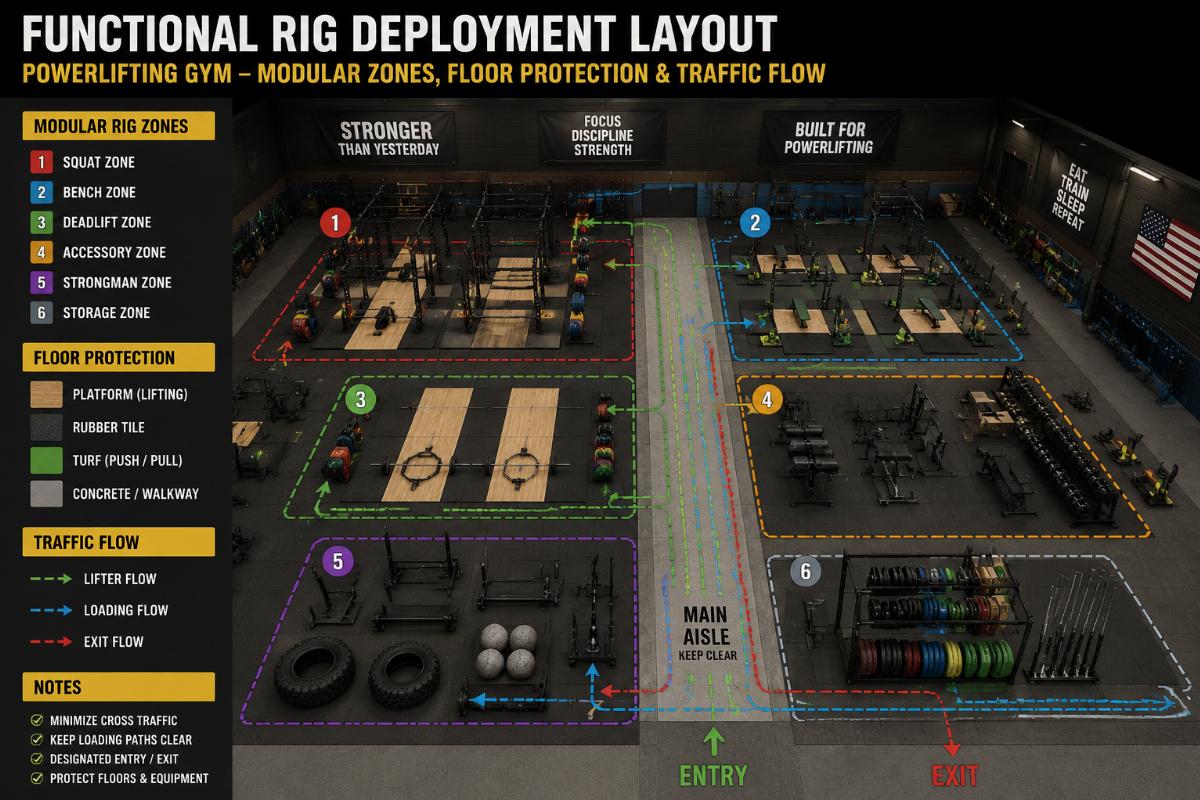
A powerlifting functional rig zone must be organized around three distinct movement domains — heavy compound lifts, accessory stations, and transitional circulation paths — with clear physical separation between each.
The layout of a functional rig for sale in a powerlifting-focused gym is not a matter of filling wall space with steel. It is a traffic-flow engineering problem. Powerlifting movements — squats, bench presses, deadlifts, overhead presses — generate high impact forces, require significant safety clearance, and create congestion during peak hours. If the rig layout does not account for these realities, the gym will suffer from bottlenecks, safety incidents, and member frustration.
The proven approach divides the rig zone into three functional areas:
Heavy lift zone: This is the core of the rig — the squat stations, bench press stations, and any monolift or J-cup positions. These stations need the widest upright spacing, the thickest column gauge, and the most robust floor protection. Lifters loading and unloading heavy barbells need elbow room on both sides. A minimum clearance of adequate lateral space per station is essential to prevent barbell collisions during simultaneous use [NEED_CITE: spatial clearance recommendations for powerlifting station layout per strength training facility design standards].
Accessory zone: Pull-up bars, dip stations, landmine posts, and gymnastic ring anchors belong here. These stations experience lower impact loads but higher repetition traffic. They can be positioned on lighter-gauge rig sections, which reduces material cost and floor load without compromising functionality.
Circulation path: The space between the rig and adjacent equipment — racks, plate trees, dumbbell racks — must allow a loaded barbell to be carried without obstruction. A common mistake is pushing the rig flush against a wall or too close to a plate storage rack, creating a chokepoint during busy sessions.
A gym operator in Southeast Asia once configured a functional rig for sale with all stations packed tightly along a single wall, maximizing station count but eliminating circulation space. Within weeks, members were complaining about near-collisions during heavy squat sessions, and the gym had to remove two stations to reopen the walkway. The lost stations cost more in member dissatisfaction than the original space savings were worth.

The principle is straightforward: design the layout for the worst-case traffic scenario, not the best-case space utilization.
What Specs Matter Most When Choosing a Functional Rig?
Column wall thickness, joint connection design, and modular compatibility with accessories determine rig performance far more than overall weight or cosmetic finish.
When evaluating a functional rig for sale, buyers often fixate on total unit weight as a proxy for stability. This is a persistent misconception. Rigidity is governed by the structural geometry of the uprights and the engineering of the connection nodes — not by raw mass. A rig built with thicker-walled steel tubing in a larger cross-section profile, joined by precision-machined connectors and reinforced gussets, will outperform a heavier rig with thin-walled tubing and bolt-only joints every time.
The critical specification parameters break down as follows:
Column gauge and profile: The two most common upright profiles are the smaller cross-section and the larger cross-section. The larger profile delivers substantially higher moment resistance and is the standard for commercial powerlifting rigs where heavy squats and rack pulls are routine. The smaller profile suffices for accessory-dominant functional training zones but is undersized for primary heavy-lift stations [NEED_CITE: structural load capacity comparison of steel tube profiles per fitness equipment engineering standards].
Joint design: The connection method between uprights, cross-members, and base plates defines the rig’s long-term rigidity. Welded joints offer maximum stiffness but limit reconfigurability. Bolted modular joints allow layout changes and simplify shipping but require precise machining to eliminate play. The best commercial rigs use a hybrid approach — welded critical nodes with bolted accessory attachment points.
Modular compatibility: A rig is only as useful as its accessory ecosystem. Before purchasing, confirm that the rig’s hole spacing, attachment interface dimensions, and load ratings match the accessories the gym actually needs — landmines, cable pulleys, storage pegs, band posts. A mismatch here means the buyer either pays for custom adapters or lives with incompatible attachments.
| Specification Factor | Heavy-Lift Commercial Rig | Accessory-Dominant Studio Rig |
|---|---|---|
| Column profile | Larger cross-section | Smaller cross-section |
| Joint type | Hybrid welded-bolted | Primarily bolted modular |
| Floor load demand | High concentrated point load | Moderate distributed load |
| Accessory compatibility | Full ecosystem required | Selective attachment support |
| Reconfigurability | Limited | High |
A buyer in Africa once procured a functional rig for sale based entirely on per-unit pricing, without verifying hole-spacing compatibility with the attachment set already in their warehouse. The rig arrived, the attachments did not fit, and the buyer faced a choice: manufacture custom adapters locally at significant cost, or reorder the entire rig with correct specifications. The delay and rework consumed months of operational time.

The takeaway: spec selection is a systems-engineering decision, not a catalog-shopping exercise.
How to Avoid Logistics and Customs Pitfalls When Importing Functional Rigs?
Pre-classifying HS codes for every modular sub-assembly, optimizing container loading through knock-down packing, and confirming port free-day allowances before shipment are the three non-negotiable steps for importing a functional rig for sale.
The functional rig is one of the most logistics-sensitive products in the commercial fitness equipment category. Its large physical dimensions, heavy steel construction, and multi-component nature make it vulnerable to customs scrutiny, container inefficiency, and port demurrage. Buyers who treat logistics as the supplier’s problem — rather than their own — routinely discover the cost of that assumption at the destination port.
The first critical step is HS code pre-classification. A functional rig is not a single product in the eyes of customs authorities — it is a collection of steel frames, attachment hardware, and potentially separate accessory components. Each sub-assembly may fall under a different tariff heading depending on the destination country’s interpretation. Shipping a fully assembled rig as a single unit often triggers oversized-machinery classification, which carries higher duty rates and more intensive inspection requirements. Breaking the rig into modular components — uprights, cross-members, base plates, attachment kits — and assigning a distinct HS code to each before shipment dramatically reduces clearance friction [NEED_CITE: Harmonized System classification approach for modular steel fitness structures per international trade compliance guidelines].
The second step is container loading optimization. A functional rig for sale shipped in assembled form wastes enormous cubic capacity inside the container — the uprights create void spaces that cannot be filled. Knock-down packing, where uprights are laid flat and cross-members are nested, can improve container utilization substantially, reducing the number of containers needed and cutting freight cost per station. This is especially critical for buyers in regions where ocean freight represents a major share of total landed cost.
The third step is confirming port free days. Different destination ports offer different grace periods before demurrage charges begin. If the buyer’s clearance process takes longer than the free-day allowance — which is common in markets with slow customs processing — every additional day generates penalty fees. Confirming free-day terms with the freight forwarder before the vessel departs prevents surprise invoices.
A distributor in Southeast Asia learned this the hard way. Their first functional rig for sale order was shipped fully assembled, with no pre-classified HS codes and no confirmed port free-day buffer. The container was held at port for an extended period, and the accumulated demurrage charges represented a substantial fraction of the original product value. On their second order, the same distributor switched to modular knock-down packing with pre-assigned codes and confirmed free days — and the clearance time dropped dramatically, with zero demurrage.

The pattern is consistent: logistics preparation before shipment is always cheaper than logistics correction after arrival.
How Does Flooring Affect Functional Rig Deployment?
Floor load capacity and shock-absorption performance must be verified and engineered before the functional rig is positioned — not after.
The floor beneath a functional rig for sale in a powerlifting gym is not a passive surface — it is a structural component of the entire system. Every heavy squat, every dropped barbell, every rack pull sends dynamic impact forces through the rig’s base plates into the floor. If the floor cannot absorb or distribute those forces, the consequences range from cosmetic damage to structural failure.
The first consideration is static load capacity. The rig’s own weight, plus the weight of barbells and plates loaded on the stations, creates a sustained point load at each base plate. Commercial concrete slabs designed for general gym use may not be rated for these concentrated loads, especially on upper floors or in buildings with post-tensioned construction. A structural load assessment before rig placement is essential [NEED_CITE: floor load rating requirements for strength training equipment per commercial building structural standards].
The second consideration is dynamic impact resistance. When a lifter drops a loaded barbell from rack height — a routine occurrence in powerlifting gyms — the impact force multiplies dramatically. Standard rubber gym flooring absorbs some energy, but heavy-duty powerlifting zones typically require specialized impact-absorption systems: thick rubber tiles, layered shock pads, or even dedicated platform constructions with plywood and rubber composites.
The third consideration is load distribution. If the floor’s load rating is marginal, steel distribution plates can be installed beneath the rig’s base plates to spread the point load over a wider area. This is a common solution in multi-story gym facilities where floor reinforcement is impractical. The distribution plates add cost and height to the rig installation, but they prevent floor cracking and structural complaints from building management.
A hotel fitness facility in the Middle East faced exactly this scenario. The gym was located on an upper floor with a standard commercial slab. The structural engineer’s assessment showed the floor could not support the dynamic impact loads from a functional rig for sale configured for heavy powerlifting use. The solution involved installing custom steel distribution plates under every upright, adding a multi-layer shock-absorption system, and restricting certain high-impact movements to ground-floor areas. The additional flooring work consumed a noticeable portion of the total deployment budget — a cost that could have been anticipated and planned for during the procurement phase.

The principle is non-negotiable: the floor is part of the rig system, and it must be engineered as such.
Conclusion
Deploying a functional rig for sale in a powerlifting gym is a multi-disciplinary project that demands pre-deployment planning across layout design, specification selection, import logistics, and floor engineering.
The buyers who succeed are those who treat deployment as a design challenge to be solved before the purchase order is placed — not an installation task to be managed after the container arrives. Layout traffic flow, verify column and joint specifications against actual lift demands, pre-classify HS codes and optimize container loading, and confirm floor load capacity with structural engineering input. The rig itself is only one variable in a system that includes the building, the port, and the customs office. Get the system right, and the rig performs exactly as intended.